
Take a throw pillow that sells for USD 35 on Society6. The artist earns USD 3.50 from that sale. Sell a similar product through your own store with a fulfilment partner, and you set the retail price and keep everything above production and shipping.
That gap is the real choice behind print on demand. Marketplaces find the buyer for you and pay a small fixed cut. Fulfilment services print and ship for your own shop, which means you keep more per sale but you have to bring the traffic yourself.
This guide ranks 10 options across both models, with the numbers, catches and best-fit use for each.
Quick Answer
Printful is the best print-on-demand platform for most independent artists in 2027. It prints in-house, connects to the stores artists already use, lets you set your own prices and offers branding that makes your shop look like your own.
If you’d rather not run a store, Threadless Artist Shops and Redbubble handle everything for you. If you sell fine art prints, Prodigi is worth a close look.
Quick Recommendations
- Printful: Best overall for artists building their own brand
- Gelato: Best for selling to buyers in many countries
- Prodigi: Best for gallery-grade art prints
- Threadless: Best hosted shop with no monthly fees
- Redbubble: Best marketplace for built-in shoppers
How We Compared These Platforms
We looked at what an independent artist actually takes home and how much control they keep. Each platform was judged on:
- Earnings model: Fixed royalty, set-your-own markup, or full retail control
- Costs: Subscription, platform fees and anything charged before a sale
- Print and product range: Techniques, product types and production locations
- Control: Pricing, branding and who owns the customer relationship
- Effort: How much of the selling, shipping and support you handle yourself
All figures come from each company’s own pricing pages and help documentation.
The Split That Decides Everything
Every platform on this list falls into one of two camps.
Marketplaces such as Redbubble, Society6, Zazzle and Displate list your work alongside thousands of other artists. They find the buyer, print the product and handle customer service, and you receive a royalty or markup on each sale.
Fulfilment services such as Printful, Gelato and Prodigi print and ship orders for a store you run on Shopify, Etsy or another platform. Your customer pays you, the fulfilment partner bills you for production, and the difference is yours.
A few, like Threadless Artist Shops, sit in between, with a hosted shop under your name and fulfilment handled for you.
1. Printful
Best for: Artists building their own brand who want full pricing control
Printful is a fulfilment service that prints in-house across its own facilities in the US, Canada, Mexico, Latvia, Spain and the UK, with partner facilities in Japan, Brazil and Australia. It offers more than 608 products and connects to Shopify, Etsy, Amazon, Wix, WooCommerce and more.
Key points:
- Print methods include DTG, DTFlex, embroidery, all-over printing and custom knitting
- Branding options include custom packaging, packing slips, pack-ins and inside labels
- Signing up is free, and you only pay when an order comes in
The real number: The Growth plan costs USD 24.99 a month, gives up to 33% off products and becomes free once you reach USD 12,000 in yearly sales.
The catch: Its production network is smaller than partner-based services, and support runs through live chat and the Help Center rather than phone.
Verdict: The strongest all-round choice for artists who want their work to look and feel like their own brand.
2. Gelato
Best for: Artists selling to customers in many countries
Gelato routes orders through a production network it describes as local production in 32 countries. It connects to Shopify, Etsy, Order Desk and its API, and the idea is to print closer to the customer for faster, cheaper delivery.
Key points:
- Local production network in 32 countries
- Free plan connects up to two ecommerce stores
- Sells through Shopify, Etsy, Order Desk and an API
The real number: The Free plan has no subscription and no product discount, while Gelato+ gives up to 33% off products.
The catch: Network coverage doesn’t guarantee local production for every product and destination, so check your bestsellers before relying on it.
Verdict: A strong pick when your audience is spread across continents.
3. Prodigi
Best for: Illustrators and painters selling gallery-grade art prints
Prodigi is a UK-based fulfilment partner with a fine art focus. It uses giclée printing, and as a Fine Art Trade Guild approved printer, its prints undergo annual testing by a UKAS approved laboratory.
Key points:
- Own production facilities in the UK, the Netherlands and the US
- Giclée fine art printing produced in-house
- Connects to your own store as a fulfilment partner
The real number: A free account is available, and Prodigi Pro costs GBP 40 a month billed monthly or GBP 35 a month billed annually.
The catch: Its strength is wall art, so artists who want a wide apparel range may need a second partner.
Verdict: The go-to fulfilment option when print quality on paper and canvas matters most.
4. Threadless
Best for: Artists who want a named shop without running fulfilment
Threadless Artist Shops give you a shop under your name, with printing, shipping and customer service handled for you. Artist Shops are free, and you never pay anything out of pocket.
Key points:
- You set your own retail prices in your Artist Shop
- Your designs can also appear in the Threadless Marketplace
- No upfront costs or monthly fees
The real number: In an Artist Shop, you earn the retail price minus the base cost, which covers the product plus a 5% processing fee. Threadless Marketplace sales pay a flat 10% of the purchase price.
The catch: You still need to bring visitors to your shop, and Marketplace sales pay far less than your own shop.
Verdict: A low-risk way to get a branded storefront without managing orders.
5. Redbubble
Best for: Artists who want built-in shoppers with zero setup
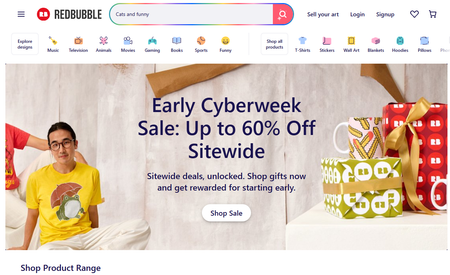
Redbubble is one of the best-known print-on-demand marketplaces. You upload your art, set a markup, and Redbubble handles printing, shipping and support.
Key points:
- Free to join, with a large global audience
- You control your markup on each product
- No inventory or fulfilment work
The real number: Account tiers decide your fees. Standard accounts pay a 50% platform fee on monthly earnings, Premium pays 20% and Pro pays none, with account fees capped at USD 150 per payment period.
The catch: An extra fee applies to markup above 20%, which limits how far higher prices help.
Verdict: Good for exposure, but the fees push serious sellers toward their own store.
6. Society6
Best for: Artists whose work suits home décor
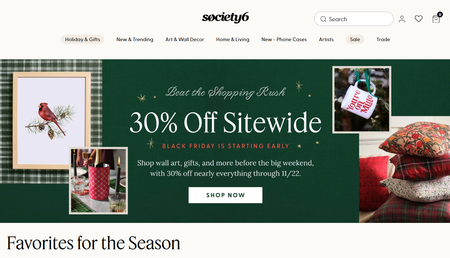
Society6 is a curated marketplace focused on art-led products such as wall art, pillows and tapestries. It sets retail prices and handles production, shipping and customer service.
Key points:
- Artists upload work and Society6 does the rest
- Strong fit for wall art and home décor
- No setup or monthly costs
The real number: Since March 18, 2025, Society6 sets prices and pays fixed earnings. Wall art, throw pillows and tapestries earn 10%, double the rate on other products.
The catch: You can no longer set your own markup on most products, so your earnings per sale are fixed.
Verdict: Simple and hands-off, but with a low ceiling on earnings.
7. Fine Art America
Best for: Photographers and painters selling framed and canvas prints
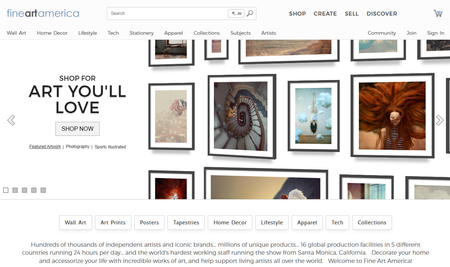
Fine Art America is an art marketplace and print service. It sets a base price for each product, and you add your own markup on top.
Key points:
- You keep the markup you set above the base price
- Wide range of wall art formats such as framed and canvas prints
- Printing, shipping and returns are handled for marketplace orders
The real number: A free account allows up to 25 image uploads, and Premium costs USD 30 a year.
The catch: It’s a crowded marketplace, so standing out takes consistent uploading and promotion.
Verdict: One of the most affordable ways to sell art prints with full markup control.
8. Displate
Best for: Artists whose work suits bold wall pieces
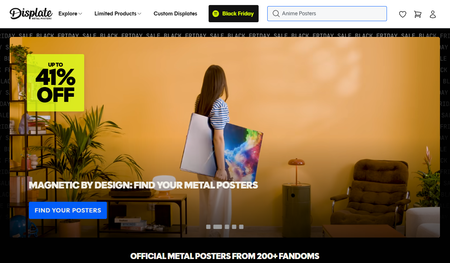
Displate specialises in metal posters printed on steel. Its glossy metal prints start at USD 39.48 and come in six sizes from 8″ x 10″ to 24″ x 36″.
Key points:
- Distinctive metal poster format
- Marketplace model, so Displate finds the buyer
- Strong fit for bold, graphic original art
The real number: Artists earn a fixed commission per sale rather than a markup they set.
The catch: You don’t control the retail price, and the single product format limits your range.
Verdict: Worth adding as a second channel if your style suits metal prints.
9. Zazzle
Best for: Designers who want to set their own royalty rate
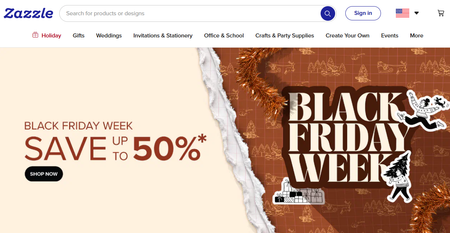
Zazzle is a marketplace with a huge product range, from stationery to gifts. Joining as a creator is free, and Zazzle handles manufacturing, shipping and customer service.
Key points:
- You set your royalty rate on each product
- Large catalogue for personalised and gift items
- No upfront costs
The real number: Creators can set a royalty from the 5% standard rate up to 50% on physical products. An excess royalty fee of 5% of your gross royalty applies above a 10% rate.
The catch: Higher royalty rates make your products pricier to buyers, and the excess royalty fee trims what you keep.
Verdict: More pricing control than most marketplaces, with more fees to track.
10. INPRNT
Best for: Illustrators who want a curated, gallery-style shop
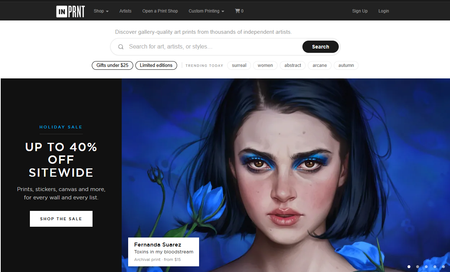
INPRNT is a curated art print marketplace. Every artist invited to open a shop is selected by its existing members through a community vote.
Key points:
- Community-curated collection of original work
- Focus on high-quality art prints
- Printing and shipping handled for you
The real number: Your earnings depend on the products and pricing set in your shop once you’re accepted.
The catch: Getting in isn’t guaranteed, since applications are voted on by the community.
Verdict: A prestigious home for illustration if you’re accepted.
What Actually Determines Whether POD Pays
The headline percentage matters less than what it applies to. A 10% royalty on a fixed base price, a markup you set, and a full retail price minus production costs are three very different amounts.
With your own store, a simple per-order check keeps you honest:
- Selling price
- minus production cost
- minus any shipping you cover
- minus storefront and payment fees
- minus a share of subscriptions, samples and marketing
- equals what you actually keep
Marketplaces skip most of these lines, but they pay you a much smaller slice in return.
Product, Paper and the Things That Get Returned
Most problems start with the file. Printful, for example, recommends at least 150 DPI for DTG products and 300 DPI for DTFlex, and it asks for the sRGB IEC61966-2.1 colour profile on uploads.
Placement matters as much as resolution. Keep type and fine details inside each template’s safe area, and think about borders and breathing room the way you would on any layout. The same principles of empty space that make a poster work also stop a print from looking crowded on a tote or mug.
Always order a physical sample before launch. A mockup shows placement, but only a sample shows colour, texture, print feel and how the item arrives.
Marketplace and Own Store, Side by Side
| Marketplace | Own store with fulfilment | |
| Who finds the buyer | The platform | You |
| Who sets the price | Usually the platform, or you within limits | You |
| Typical artist share | Fixed royalty or capped markup | Retail price minus production and fees |
| Upfront cost | Free | Free to start, plus store costs |
| Branding | Platform branding | Your own branding options |
| Customer relationship | Owned by the platform | Owned by you |
| Effort | Low | Higher |
| Best for | Testing designs and passive exposure | Building a brand and higher margins |
How to Choose a Print on Demand Platform
Start with your audience. If you already have followers, a newsletter or a portfolio site, a fulfilment partner like Printful lets you turn that traffic into higher-margin sales.
Match the product to the platform. Art prints point to Prodigi or Fine Art America, metal wall art to Displate, and apparel and merchandise ranges to Printful or Gelato.
Use marketplaces for reach. Redbubble, Society6 and Zazzle are useful for testing designs and picking up passive sales, even if you also run your own store.
Check rights before you sell. Make sure you hold commercial rights to every font, texture and asset in your design.
Frequently Asked Questions
What is the best print-on-demand site for artists?
For most independent artists, Printful is the strongest choice because it combines in-house printing, store integrations, branding options and full pricing control.
Do I need my own website to sell print on demand?
No. Marketplaces like Redbubble, Society6 and Zazzle give you a shop on their platform. A fulfilment service like Printful needs a store on Shopify, Etsy or a similar platform.
How much does Redbubble take from artists?
Standard accounts pay a 50% platform fee on monthly earnings, Premium accounts pay 20% and Pro accounts pay none, with fees capped at USD 150 per payment period.
How much do artists earn on Society6?
Society6 pays fixed earnings. Wall art, throw pillows and tapestries earn 10%, and other products earn half that rate.
Is print on demand worth it for artists?
It can be, because you don’t buy stock upfront. Earnings depend on whether you bring your own buyers or rely on a marketplace’s traffic and royalty rates.
Which platform is best for selling art prints?
Prodigi stands out for gallery-grade giclée printing, while Fine Art America lets you set your own markup on a wide range of print formats.
Can I sell on a marketplace and my own store at the same time?
Yes. Many artists use marketplaces for exposure and a fulfilment partner for their own branded store.
Does Printful have a monthly fee?
No. The free plan has no subscription. The optional Growth plan costs USD 24.99 a month and becomes free once you reach USD 12,000 in yearly sales.
Final Verdict
Print on demand rewards artists who choose the model before the platform. If you want to keep more of each sale and build a brand of your own, Printful is the best starting point, with Gelato and Prodigi as strong alternatives for global reach and fine art prints.
If you’d rather not run a store, Threadless and Redbubble get your work in front of buyers with almost no setup. Many artists end up using both: a marketplace for reach and their own store for profit.
About the Author

Peter Makeshoff
Peter Makeshoff is the founder and main author of Designer Daily.