
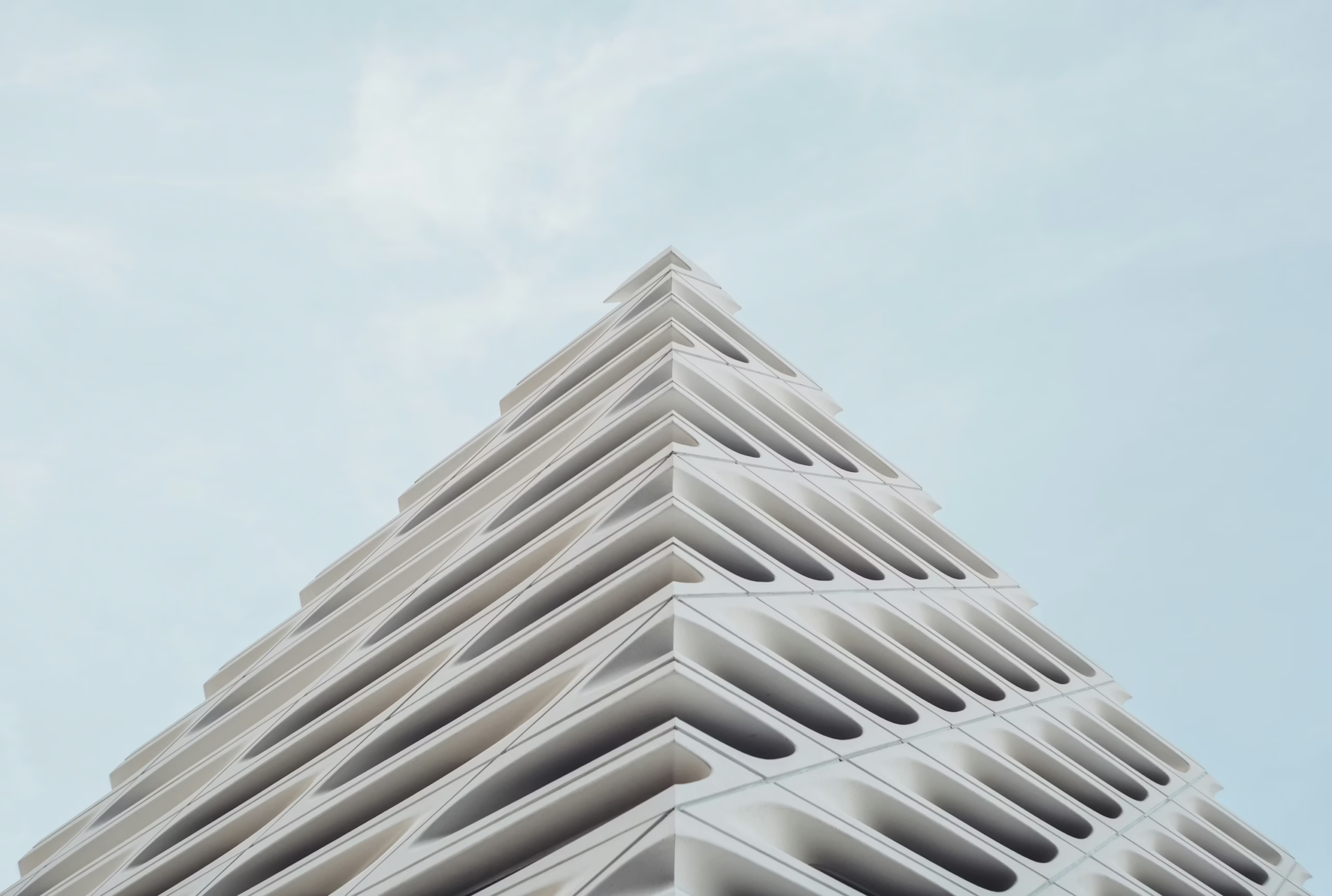
Walk into any major architectural shoot, and you’ll notice something surprising: the gear is almost invisible. Professional architectural photographers don’t show up with huge telephoto lenses or oversized rigs. They arrive with precision tools designed to solve one problem, capturing buildings exactly as they exist, without distortion, without compromise.
Here’s what’s actually in their bags in 2026.
The Camera: Resolution and Dynamic Range
Architecture demands detail. Lots of it. The current professional standard is the Sony Alpha 7R V, with its 61-megapixel sensor and 15-stop dynamic range. That dynamic range matters when you’re shooting a room with bright windows and dark corners, you need to see detail in both.
For those who want to step beyond full-frame, the Fujifilm GFX100S II offers a 102-megapixel medium format sensor and 16-bit RAW files. The color science and depth are exceptional, but the files are enormous and the system is heavier. It’s for dedicated architectural specialists, not generalists.
Canon shooters tend toward the EOS R5 (45 megapixels) or the newer EOS R5 II, while Nikon users favor the Z8 or Z7II. All are capable. The Sony ecosystem, however, has the widest selection of specialized wide and tilt-shift lenses, which is why many pros choose it.
The Lens: Where Architecture Lives or Dies
The lens makes or breaks architectural photography. You need three things: extreme wideness, zero distortion, and perspective control.
Tilt-Shift Lenses: The Non-Negotiable
If there’s one piece of gear that separates pros from amateurs, it’s a tilt-shift lens. It does two things no other lens can:
- Shift moves the lens parallel to the sensor, correcting converging vertical lines. Those famous shots where skyscrapers look perfectly straight, not like they’re falling backward? That’s shift.
- Tilt rotates the lens relative to the sensor, manipulating the plane of focus. It creates selective focus effects, making a real city look like a miniature model, or achieves infinite depth of field without stopping down to f/22.
The most anticipated lens of 2026 is the new Laowa 17mm f/4 Zero-D Tilt-Shift. At $1,249, it’s the first ultra-wide tilt-shift designed for mirrorless systems (Sony E, Canon RF, Nikon Z, L-Mount, Fuji GFX, Hasselblad XCD). It shifts ±12mm, tilts ±10 degrees, and features Laowa’s “Zero-D” design that virtually eliminates barrel distortion, a common plague of ultra-wide lenses.
For decades, Canon and Nikon made tilt-shift lenses for DSLRs but never fully adapted them to mirrorless. Laowa has filled that gap aggressively. If you shoot architecture professionally, this lens is worth the investment.
The Alternative: Ultra-Wide Zooms
If tilt-shift is out of budget, a high-quality ultra-wide zoom is the next best thing. The Sony 16-35mm f/2.8 GM II and Canon RF 15-35mm f/2.8L IS are the standards. At 16mm on full-frame, you can capture entire rooms and building facades in one frame.
The compromise? You’ll need to correct perspective in post-production (Lightroom or Photoshop), which crops your image and loses some resolution. For web and social media, this is fine. For large-format printing, it’s noticeable.
Tamron also offers strong options. Their 20mm f/2.8 is surprisingly sharp for the price, and the 18-300mm all-in-one zoom is useful for location scouting.
The Tripod: Stability Is Not Optional
You cannot shoot architecture handheld. Period. Exposures often run 1 to 30 seconds, especially at twilight or in dim interiors. Even a slight camera movement ruins the shot.
Professionals look for three things in a tripod:
- Stability. Carbon fiber is lighter and dampens vibration better than aluminum. The Leofoto series, with 20kg+ load capacity, is popular among working pros.
- Precision. Geared heads, like the Leofoto G20, allow micro-adjustments in ±15° increments across two axes. This is critical for leveling the camera perfectly, any tilt introduces perspective distortion.
- Panorama capability. A 360-degree rotating base with laser-engraved scales lets you shoot multi-image panoramas that stitch seamlessly.
For lighter travel, the Rollei C5i offers a 4-in-1 design that converts to a monopod, weighing just 1.6kg and supporting 8kg.
The Accessories: Small Things, Big Difference
- Polarizing filter. It cuts reflections on glass and water while deepening blue skies. Essential for modern glass facades. Make sure your lens has a standard filter thread, the new Laowa 17mm does, with an 86mm thread.
- Remote shutter release. Even pressing the shutter button introduces shake. Use a remote or your camera’s two-second self-timer.
- Geared tripod head. As mentioned above, this is the secret weapon for precision leveling.
What About Video?
Architectural videography is a growing field, driven by real estate marketing. The gear overlaps significantly with still photography, but with additions:
- A fluid-head tripod for smooth pans and tilts.
- A motorized gimbal (DJI RS series) for walk-through shots that feel like gliding through the space.
- Variable ND filters to maintain the 180-degree shutter rule in bright sunlight, essential in places like Dubai or Miami.
- A drone for aerial hero shots. The DJI Mini and Air series are popular entry points, though professionals often fly Inspire-class drones.
The Pro’s Full Kit (2026 Edition)
| Category | Item | Approx. Cost |
|---|---|---|
| Camera | Sony A7R V or Fuji GFX100S II | $3,900–$7,500 |
| Primary Lens | Laowa 17mm f/4 Tilt-Shift | $1,250 |
| Zoom Lens | Sony 16-35mm f/2.8 GM II | $2,300 |
| Tripod | Leofoto carbon fiber + geared head | $600–$900 |
| Filters | Polarizer + ND set (86mm) | $200–$400 |
| Accessories | Remote release, L-bracket, backpack | $200–$500 |
Total professional kit: Approximately $8,000–13,000
The Bottom Line
Architectural photography gear prioritizes control over speed, precision over versatility. The tilt-shift lens is the signature tool, nothing else can fix converging lines in-camera without losing resolution. A rock-solid tripod with a geared head is the second essential, enabling the micro-adjustments that make the difference between “almost level” and “perfect.”
Cameras matter less than you think. Any full-frame mirrorless with decent dynamic range will work. The Sony A7R V leads for its resolution and lens ecosystem, but a Canon R5 or Nikon Z8 will serve just as well.
Invest in the glass, the tripod, and the filters. The camera body is the cheapest part of the system.
About the Author

Peter Makeshoff
Peter Makeshoff is the founder and main author of Designer Daily.