
Most design resources focus on what looks good. This one focuses on what works. And why.
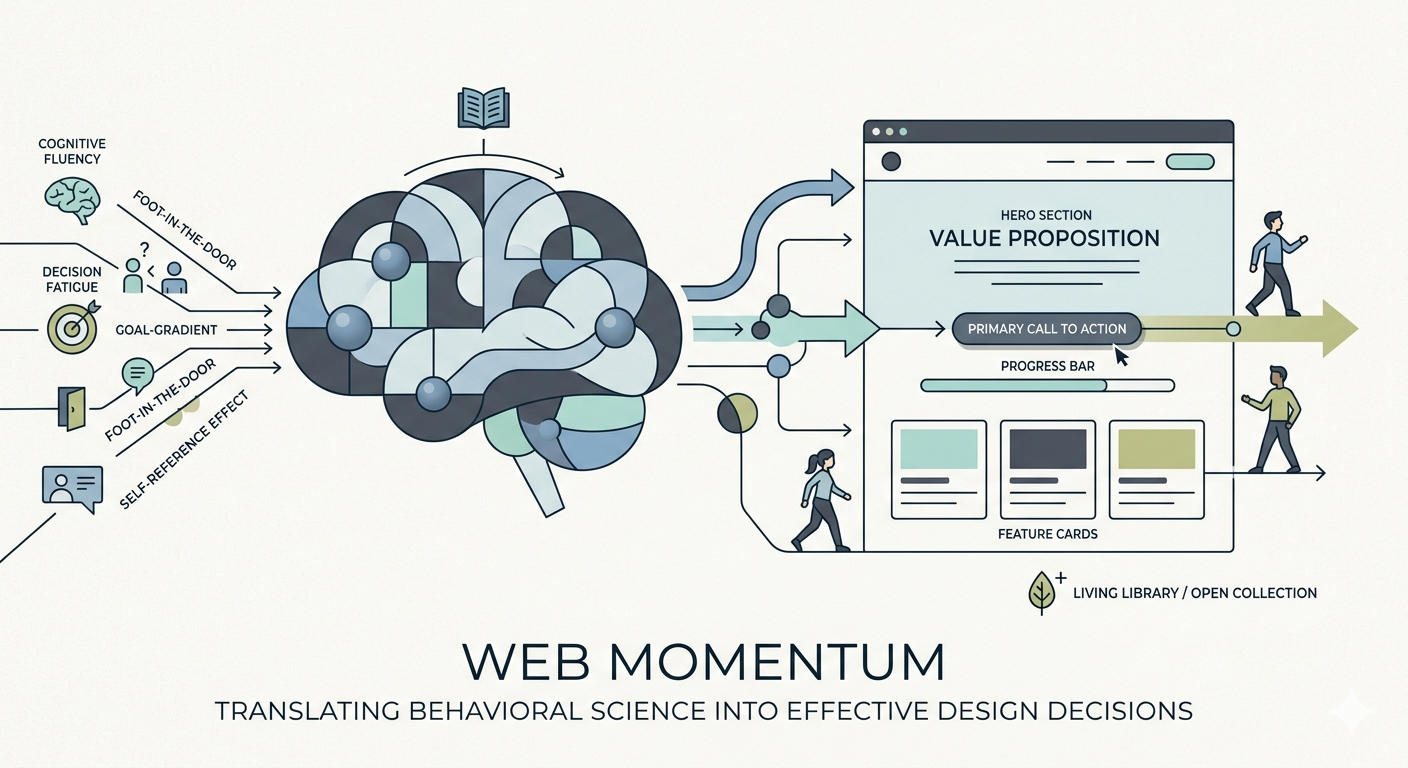
A new open collection is quietly taking shape, a curated library of behavioral science principles translated directly into web design decisions. Not academic theory for its own sake. Not marketing jargon dressed up as psychology. Just practical concepts that explain why some websites create momentum while others create hesitation.
The project is called Web Momentum. And it is built on a simple premise: high-performing websites are not built on trends. They are built on understanding how people think and decide.
Why Behavioral Science Belongs in Web Design
Every website is a decision environment. Visitors constantly evaluate: What is this? Is it for me? Do I trust it? What should I do next? These judgments happen in milliseconds, shaped by cognitive shortcuts, perceived effort, and emotional signals.
Design choices are never neutral. They influence interpretation, confidence, and action. When information is easy to process, perceived risk drops. When options are overwhelming, action slows down. When the next step is clear, motivation increases.
Understanding this psychological layer allows designers to build websites that support real goals, not just visual presence.
What the Collection Covers
The library includes principles such as cognitive fluency (the brain perceives ease of understanding as a safety signal), decision fatigue (too many choices reduce action), the goal-gradient hypothesis (motivation accelerates when progress is visible), the foot-in-the-door effect (small commitments lead to larger ones), and the self-reference effect (people remember what feels personal).
Each principle links established research to practical questions: How should a homepage be structured? How many calls to action are too many? Why does vague positioning reduce trust? How can progression be made visible?
The goal is always translation, from theory to implementation.
A Living Library
This is not a static resource. The collection is intentionally open and continuously expanding. New concepts will be added regularly, drawn from both classic psychological frameworks and newer research that proves relevant for digital strategy.
The aim is not completeness. The aim is usefulness.
For designers, this means having a growing reference that explains not just what to do, but why it works. For agencies, it means grounding recommendations in evidence rather than opinion. For anyone building websites, it means treating user psychology as a design material, not an afterthought.
Beyond Trends
Trends change. Tools evolve. Design styles shift. Human cognition changes far more slowly.
By grounding digital strategy in behavioral science, designers can create websites that are not only visually modern but structurally resilient, designed to support clarity, trust, and forward motion. That is what the Web Momentum collection aims to provide.
Explore the full collection and contribute your own insights at this link.
About the Author

Peter Makeshoff
Peter Makeshoff is the founder and main author of Designer Daily.