
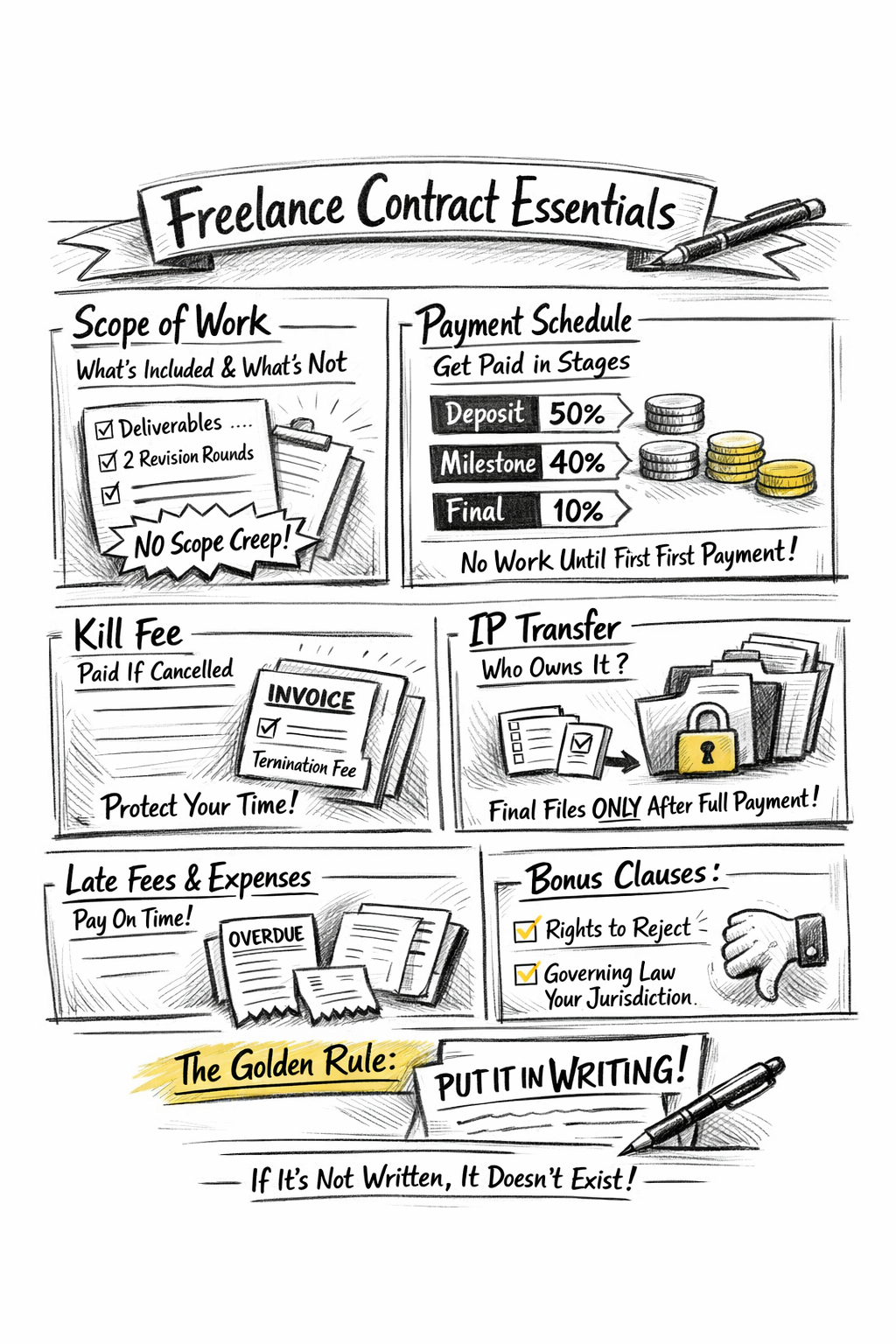
Navigating a freelance contract can feel like reading a foreign language designed to trap you. But a contract isn’t a weapon. It’s a shared blueprint for a successful project. These are the 5-7 clauses that form your non-negotiable foundation. Think of them as the essential tools in your legal toolkit.
1. Scope of Work: The “What” That Prevents the “What Else?”
This is the heart of the contract. A vague scope is an invitation for scope creep, the gradual piling on of extra tasks beyond what was agreed.
The Jargon: “Contractor shall provide design services as described in Exhibit A…”
Plain English Translation: “This is EXACTLY what I’m doing. Nothing more, nothing less.”
What it MUST Include:
- A detailed list of deliverables (e.g., “3 homepage mockups in Figma, 1 style guide PDF”).
- The number of revision rounds included (e.g., “2 rounds of revisions per deliverable”).
- What is not included (e.g., “Copywriting, illustration, or development not included”).
- Reference to a separate, detailed project brief or proposal.
Why it’s Non-Negotiable: This is your primary defense against endless requests. When a client asks for “one more tiny thing,” you can point back to the scope and say, “That’s a great idea. That would be outside our agreed scope, but I can provide a separate estimate.”
2. Payment Schedule: The “When” That Gets You Paid
Never let the entire project payment be due at the end. This clause ties payment to your work progress, not the client’s subjective satisfaction.
The Jargon: “Fees shall be paid as follows: 50% upon execution, 40% upon delivery of initial comps, and 10% upon final approval.”
Plain English Translation: “I get paid in chunks as we move forward. No work starts until the first payment clears.”
Standard Structure:
- Deposit (33-50%): Due upon signing, before any work begins. This secures your time and ensures client commitment.
- Milestone Payment (25-40%): Due upon delivery and approval of a key phase (e.g., wireframes, first mockups).
- Final Balance (10-25%): Due upon final delivery of all files, before final file transfer or publication.
Why it’s Non-Negotiable: It creates a partnership. They have skin in the game. You aren’t financing their project for months. It also provides natural off-ramps if the project goes off the rails.
3. Kill Fee: The “Break-Up” Clause
Sometimes projects die. The client’s budget evaporates, their strategy changes, or they go silent. A kill fee ensures you are paid for the work you’ve already done, not just the work you’ve delivered.
The Jargon: “In the event of termination by Client prior to completion, Client shall pay Contractor for all work completed to date, plus a termination fee of 25% of the remaining project fee.”
Plain English Translation: “If you cancel, you pay me for my time plus a penalty for the lost opportunity.”
How it Works: If a client cancels the project mid-way, you invoice for all hours/work completed (at your project rate), PLUS a percentage (often 25%) of the unfinished portion. This compensates you for the income you suddenly lost and can’t replace.
Why it’s Non-Negotiable: It protects you from catastrophic financial loss due to a client’s changing circumstances. It makes a client think twice before casually pulling the plug.
4. Intellectual Property (IP) Transfer: The “Who Owns This” Clause
This is the most critical clause. It dictates when and how the rights to your creative work transfer to the client. Never transfer full IP until you are paid in full.
The Jargon: “Upon final payment of all fees, Contractor hereby assigns all rights, title, and interest in the final delivered works to Client.”
Plain English Translation: “You own the final files only after I have all my money.”
Key Protections to Include:
- Your Tools (Retained Rights): You retain the right to the underlying process files (e.g., Figma files, sketches, source code). You’re selling the final product, not your working method.
- Portfolio Rights: You retain the right to display the work in your portfolio and marketing materials.
- Third-Party Elements: Clarify that you are not transferring rights to any licensed fonts, stock imagery, or code libraries you used.
Why it’s Non-Negotiable: Your final, unpaid invoice is your leverage. If you’ve already handed over full rights, you have zero power to collect. The work should be “in escrow” until the final check clears.
5. Late Fees & Expenses: The “Consequences” Clause
This clause isn’t about being punitive. It’s about incentivizing timely payment and covering your costs.
Late Fee Jargon: “Invoices not paid within 30 days shall accrue interest at 1.5% per month.”
Plain English: “Pay on time, or it will cost you extra.”
Expenses Jargon: “Client shall reimburse Contractor for all pre-approved expenses.”
Plain English: “If I have to buy a special font or stock photo for your project, you’re paying for it, but I’ll ask first.”
Why it’s Non-Negotiable: It professionalizes the relationship. Businesses pay other businesses on time. It also prevents you from subsidizing a client’s project with your own money for expenses.
Bonus Clauses for Extra Armor:
- “Rights to Reject”: You have the right to be disassociated from work that is modified after delivery without your approval. This protects your reputation.
- Governing Law & Venue: Disputes will be resolved in your city/state, not the client’s. This is a huge logistical advantage.
The Golden Rule: Put It In Writing
If it’s not in the signed contract, it doesn’t exist. A friendly email or a verbal promise holds no weight when money or deadlines are on the line.
Your contract isn’t a sign of mistrust. It’s a sign of professionalism. It shows you value your work, your time, and the clarity of the relationship. A good client will respect you for it. A difficult client will reveal themselves by fighting these basic protections, saving you from a nightmare project before it even begins.
About the Author

Peter Makeshoff
Peter Makeshoff is the founder and main author of Designer Daily.