
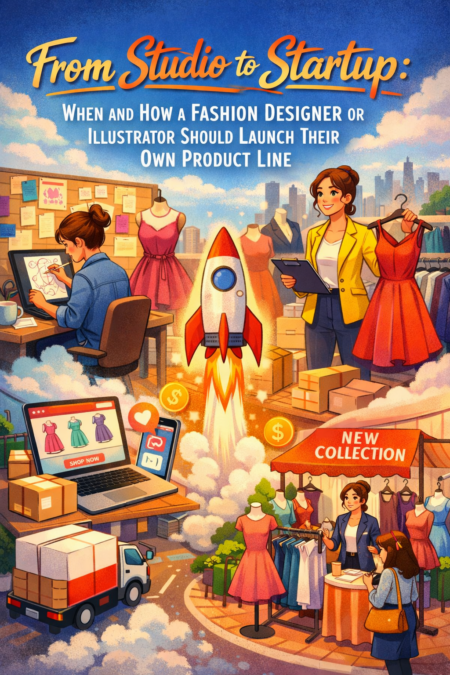
For years, you’ve built your creative career on client work, interpreting briefs, meeting deadlines, and amplifying other brands. The leap from this service-based model to creating your own product line is not just a business pivot; it’s a profound identity shift. It moves you from being a talented interpreter to a visionary author. This guide outlines the strategic path from studio to startup.
Part 1: The Mindset Shift – From Consultant to Creator
Before designing a single product, you must redesign your own role.
1. Define Your “Why” Beyond Aesthetics
Client Work: “I create beautiful things for others.”
Product Creator: “I solve a specific problem or fulfill a distinct emotional need for a specific person.” Your product must have a job to do. Is it to bring whimsy into a mundane routine? To provide sustainable luxury? To offer a tactile antidote to digital overload? Your “why” becomes your brand’s backbone.
2. Embrace the 80/20 Founder’s Mindset
As a service provider, 80% of your time is craft, 20% is administration. As a product creator, this flips. You will spend 20% of your time designing and 80% on operations: sourcing, production, inventory, marketing, customer service, and finance. Your primary skill becomes decision-making, not just drawing.
3. Separate Your Artistic Identity from Your Product’s Identity
Your personal style informs the product, but the product must serve its audience, not just your portfolio. You are now building a brand with its own consistent voice, which may be a specific, commercial slice of your broader artistic range.
Part 2: The Signal – Is It Time? Three Triggers to Launch
Don’t launch from a place of frustration. Launch from a place of validation.
Trigger 1: Consistent Audience Demand
When followers repeatedly ask, “Where can I buy that as a print?” or “Do you sell that pattern on a scarf?” you have a signal. Document these requests. What specific piece are they asking for? That’s your first MVP candidate.
Trigger 2: Recurring Thematic Work
Your personal projects or client work keeps circling a specific theme, character, or visual motif. You have a deep, unexploited IP library. A product line lets you mine that asset intentionally.
Trigger 3: The Financial Runway
You have saved enough capital (or maintained enough consistent client work) to cover 12-18 months of personal expenses plus a separate, dedicated product budget. This is non-negotiable. The product business will not profit for at least the first year.
Part 3: The Minimum Viable Product (MVP) – Test, Don’t Guess
Your first product is a hypothesis. Your goal is to test it with the smallest possible investment.
Step 1: Define the MVP Constraints
Choose ONE product in ONE colorway with ONE main motif.
- Illustrator MVP: Not 50 art prints. Choose your 3 most requested illustrations. Offer them as a set of three 8×10″ giclée prints in one edition.
- Fashion Designer MVP: Not a 12-piece collection. Choose the one accessory or garment that best embodies your design philosophy. A signature scarf. A signature oversized shirt. Produce it in one hero fabric/color.
Step 2: Validate with Pre-Orders (The Ultimate Test)
Before you produce anything at scale, sell it.
- Create a compelling sell sheet: Professional photos (can be mocked up), clear description, price, and estimated delivery date.
- Launch a pre-order campaign on a simple platform like Shopify, Lemon Squeezy, or even a dedicated Carrd page with PayPal.
- Set a clear, public goal: “We’ll produce this if we get 100 pre-orders in 30 days.” This validates demand and funds your initial production run without debt.
Step 3: Choose Your Production Path
- Print-on-Demand (POD): The fastest, lowest-risk start for illustrators (Society6, Printful). Use it for market testing, but accept lower margins and less quality control.
- Local/Small-Batch Production: Find a local screen printer, seamstress, or jewelry maker. You pay more per unit but gain control, quality, and a story. This is the ideal step after pre-order validation.
- Overseas Manufacturing: Only pursue this after you have proven demand and are ready to order hundreds of units. Requires significant capital, expertise in tech packs, and import logistics.
Part 4: The Logistics – Building the Machine
1. The Costing Model: Know Your Numbers
Your price is NOT: “What seems reasonable?”
Your price IS: (Cost of Goods + Labor + Packaging + Shipping) x 4
This “keystone markup” (retail price = 4x cost) accounts for your platform fees (15%), marketing costs (25%), and your profit. If a scarf costs you $15 all-in, it must retail for $60.
2. The Brand Ecosystem
Your product needs a cohesive home.
- Essential Assets: A simple, mobile-optimized website (Squarespace/Shopify), a consistent Instagram handle for the brand (not your personal studio account), and a professional email address.
- Storytelling: Every product page must answer: Why does this exist? What problem does it solve? Who made it and how? Your service career trained you for this.
Part 5: The Launch – Direct-to-Consumer Marketing Basics
Forget “build it and they will come.” Your existing audience is your launchpad.
Phase 1: The Soft Launch (Your Community)
Email your list and post to your social followers. “For years you’ve asked… I’ve listened. Meet [Product Name], the first piece from my new line.” Offer them an earliest-bird price for their loyalty. This initial surge builds social proof.
Phase 2: The Content Engine
You are no longer just posting finished art. You are documenting the product creation story.
- Content Pillars: The design inspiration (mood boards), the making (video of sampling), the MVP test (share the pre-order goal progress), the unpacking (first production samples), the customer love (reshare user-generated content).
- Goal: Build a narrative that makes people want to join the journey and own a piece of the story.
Phase 3: The Partnership Play
Trade product, not money. Identify 5-10 micro-influencers or complementary brands whose audience overlaps your dream customer. Send them a beautifully packaged product with a personal note. Authentic partnerships beat paid ads at this stage.
The Final Reality Check
Launching a product line will be the most challenging creative project of your life. It will expose every weakness in your business acumen. But it will also give you something client work never can: absolute creative ownership, a direct relationship with your audience, and an asset that can grow in value independently of your time.
Start small. Validate ruthlessly. Build the system. Your studio taught you how to create. Your startup will teach you how to build.
About the Author

Peter Makeshoff
Peter Makeshoff is the founder and main author of Designer Daily.