
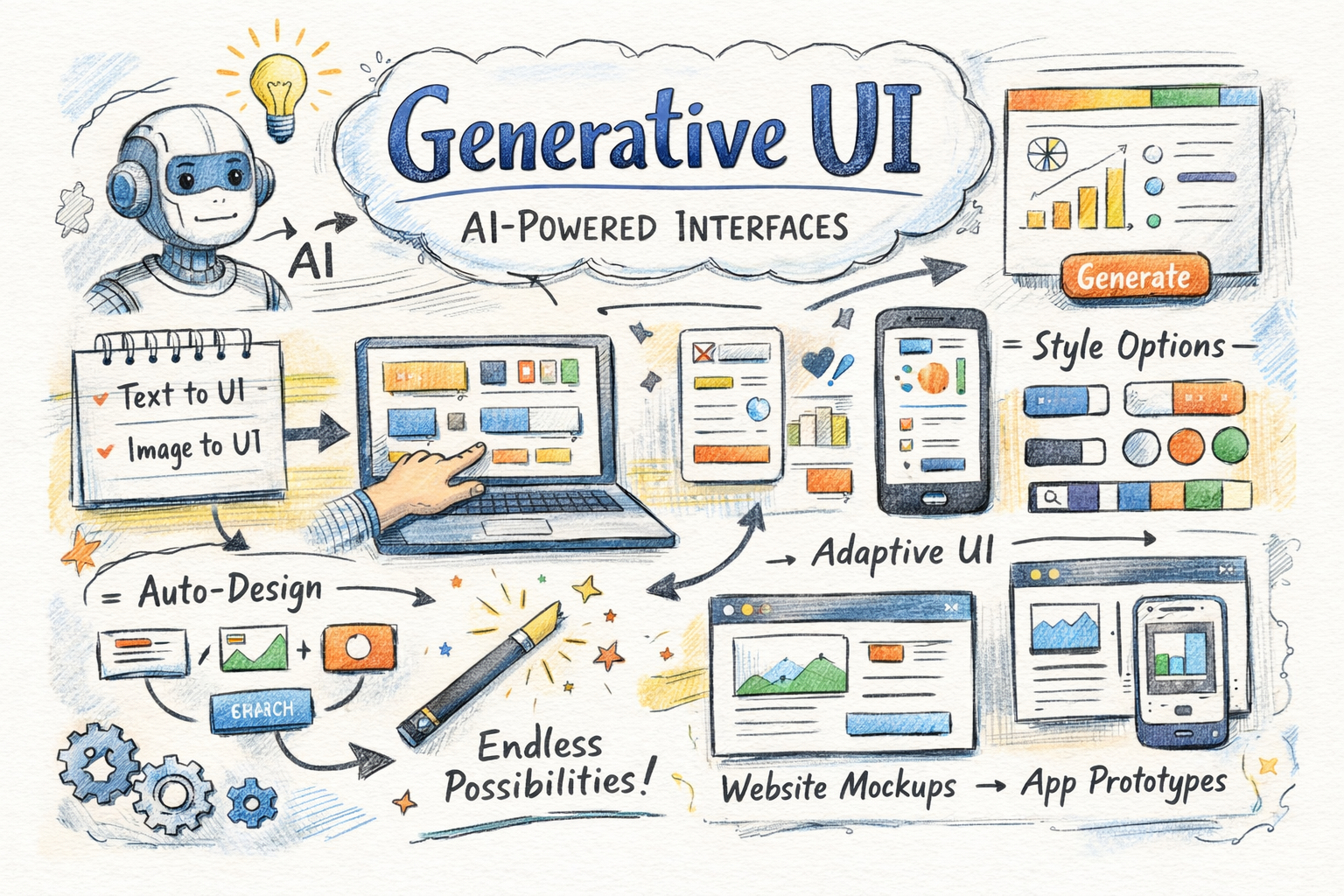
Imagine opening a food delivery app that has reorganized itself overnight. Your most-ordered cuisine is now at the top. The “reorder” button from last night’s Thai place is pulsating gently. A dietary tracker you glanced at last week has quietly embedded itself into the main navigation. The app feels uncannily personal, as if it has been custom-built for you alone. This is not just personalized content. This is Generative UI, an interface whose very structure, components, and workflow are uniquely assembled in real-time by artificial intelligence, tailored to the individual user’s context, behavior, and inferred intent.
We are moving beyond static templates and A/B tested layouts into a world where the interface itself becomes a dynamic conversation.
The Technical Foundation: How It Works
Generative UI sits at the convergence of three technologies:
- AI/ML Models: These analyze user data in real-time, past behavior, current session patterns, location, time of day, even biometric data from wearables, to predict intent and need.
- Component Systems & Design Tokens: The product is built from a robust library of atomic UI components (buttons, cards, inputs) and a dynamic set of design tokens (colors, spacing, type scales) that can be recombined infinitely.
- A Composition Engine: This is the “conductor.” It takes the AI’s intent prediction, selects appropriate components from the library, applies the relevant design tokens for context (e.g., a “focus mode” token set), and renders a unique UI instance on the fly.
The result is an interface that can change its layout, feature priority, visual tone, and interaction model from one session to the next, for each user.
New UX Paradigms: From Static Screens to Fluid Journeys
This shift breaks foundational design principles.
- The End of the “Happy Path”: There is no single user flow. Instead, the AI generates the most probable path for this user at this moment. A new user and a power user completing the same task may see entirely different sequences of screens.
- Progressive Disclosure Becomes Invisible: Features appear only when the system is confident you need them. A complex charting tool might materialize in a business app only after you’ve run three basic reports, signaling readiness.
- Morphing Affordances: A button’s label, color, and even its action could adapt. “Send” might become “Send to Marketing Team” if you always email that group at 3 PM on Tuesdays. The UI doesn’t just show data; it shows comprehension.
- Ambient & Anticipatory UI: The interface can recede, becoming a peripheral, ambient display until it detects need. A music app might collapse to a minimal waveform on your dashboard while you work, but expand full-screen controls the moment you reach for your headphones.
The Profound Design Challenges
Designing for generative UI is less about crafting pixels and more about crafting rules, probabilities, and boundaries.
- Designing the System, Not the Screen: The designer’s primary output becomes the foundational component library, the compositional logic, and the “meta-principles” that govern adaptation (e.g., “Never hide primary navigation for more than 3 steps”).
- Ensuring Coherence, Not Just Consistency: Rigid visual consistency is impossible. The new goal is coherent flexibility—the feeling that all permutations still belong to the same trustworthy system. This is achieved through shared design tokens, motion signatures, and a stable core interaction language.
- The Discoverability Paradox: If features appear only when needed, how does a user learn the full potential of the product? Design must incorporate subtle educational cues, like a “What can I do?” prompt or a timeline of newly unlocked capabilities.
- Testing an Infinite Surface: QA and user research become exponentially harder. You cannot test every permutation. Instead, you must test the AI’s decision logic and the integrity of the component combinations through simulation and stress-testing boundary cases.
The Ethical Imperative: The Dark Side of a Morphing Interface
The power to manipulate interface reality carries immense risk.
- Manipulation at Scale: An e-commerce AI could generate a UI that makes impulse buying frictionless for a user it identifies as susceptible, while showing a more conservative, price-comparison-heavy UI to a calculated buyer. This is dark patterns elevated to a systemic level.
- Loss of User Agency: When the UI changes constantly, users lose the sense of mastery and control. The feeling of “I know how to use this” is replaced with “What will it do for me today?” This can breed dependency and frustration.
- Algorithmic Bias, Built-In: If the generative AI is trained on biased data, it will generate interfaces that reinforce those biases. It might simplify interfaces for users from certain demographics, making harmful assumptions about their technical competence.
- The Opaque Black Box: A user cannot audit why their interface looks the way it does. “Why is this option so hard to find?” becomes an unanswerable question, eroding accountability. This demands a new right: the right to interface transparency—the ability to see “why this UI was generated for me” and to reset to a neutral baseline.
A Speculative Future: The Designer’s New Role
In this world, the designer transitions from author to gardener and curator. They plant the seeds (components and rules), tend the ecosystem (train and adjust AI models), and curate the outcomes (audit generated UIs for ethical and experiential quality). The core skills will be systems thinking, ethical reasoning, and an understanding of machine learning principles.
Generative UI promises interfaces of breathtaking relevance and efficiency. But it also demands a new design philosophy, one that prioritizes user sovereignty, transparent logic, and coherent identity over mere algorithmic optimization. The greatest design challenge of the next decade will not be how to make interfaces adapt, but how to ensure that in their adaptation, they remain fundamentally humane, understandable, and under the user’s ultimate control. The goal is not an interface that reads our minds, but one that respectfully, and transparently, responds to our needs.
About the Author

Peter Makeshoff
Peter Makeshoff is the founder and main author of Designer Daily.