
The global market for SEO services is on track to hit $146.96 billion by 2025, according to Grand View Research. That surge is great news for web designers and boutique marketers hungry for recurring revenue, yet it also means the field gets more crowded every day. Instead of hiring a full in-house search team, many agencies plug into white-label partners like AgencyPlatform’s SEO Reseller suite, reselling proven execution under their own brand. In this guide, you’ll walk through seven concrete steps—partner selection, service packaging, profitable pricing, branding, sales, onboarding, and scalable growth—so you can bolt a high-margin SEO arm onto your business with confidence.
Step 1 – Choose a white-label partner you’d trust with your own site
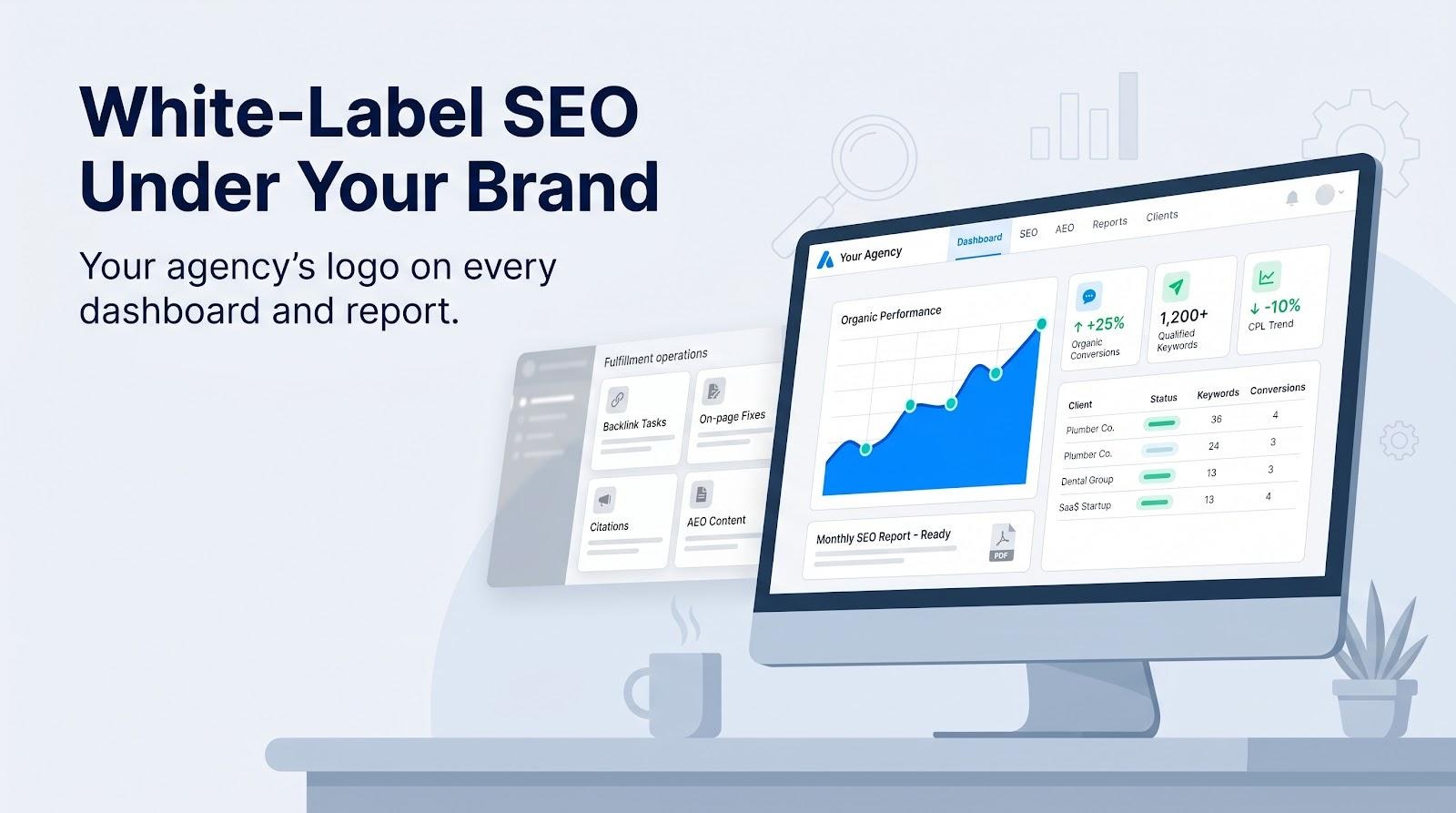
Your clients see the wins—or the mistakes—long before they learn who did the work. If the backend team cuts corners, those missteps land squarely on your agency, which is why partner selection is the foundation of the entire reseller model, not a quick vendor search.
Outsourcing is already mainstream: Conductor’s 2025 State of SEO found 54 percent of enterprise brands lean on external specialists to keep pace with algorithm shifts and AI-driven search. So prospects won’t flinch when you suggest it—but the market is crowded, and not every provider is stellar. Pick well and you inherit seasoned strategists, proven processes, and a branded dashboard that makes you look bigger than you are; pick poorly and you inherit thin content, spam links, and panicked emails from once-happy clients.
The five-part sniff test
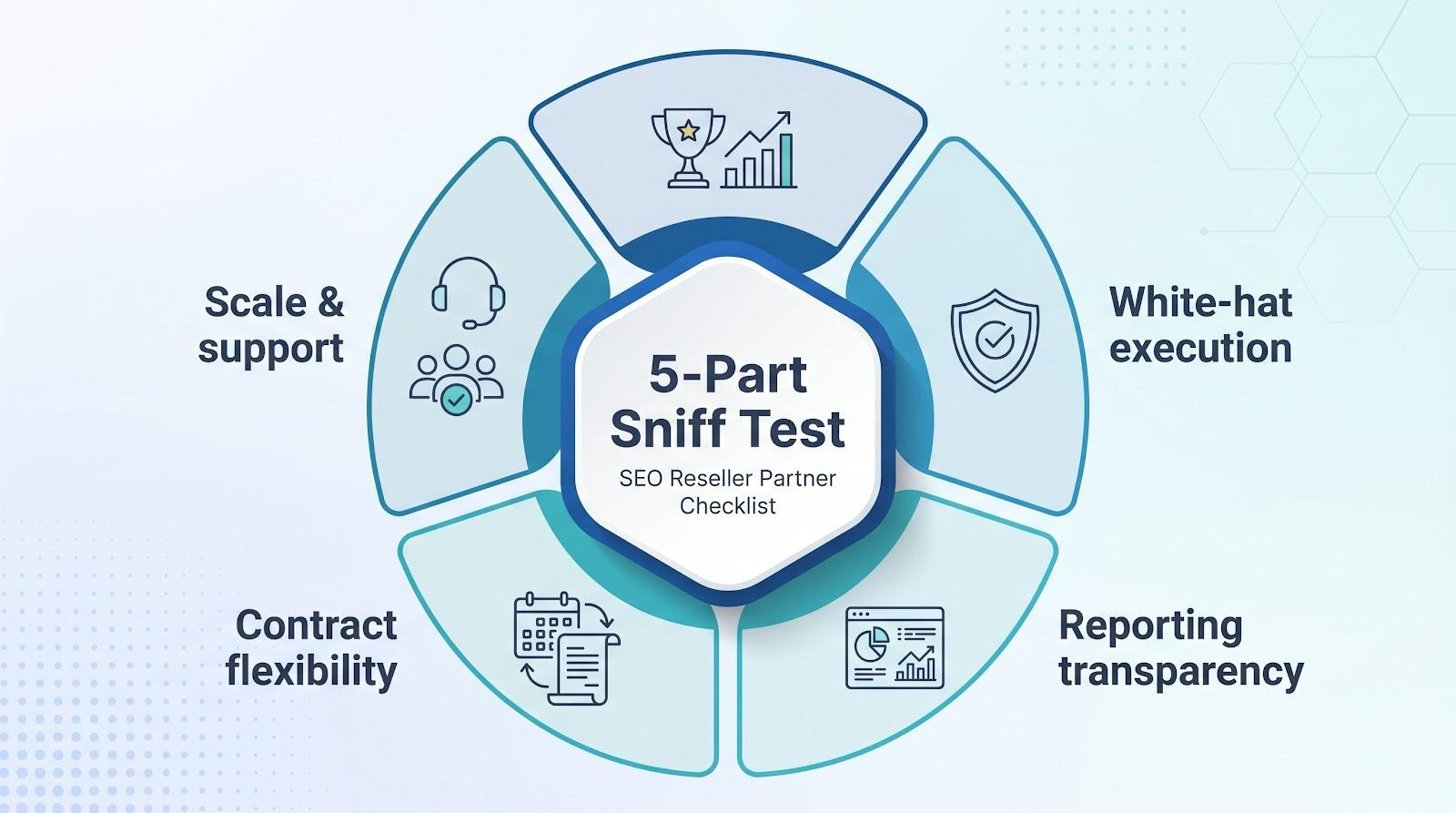
If we wouldn’t trust a provider with our own domain, we won’t trust them with a client’s. Run every candidate through this quick, five-point filter:
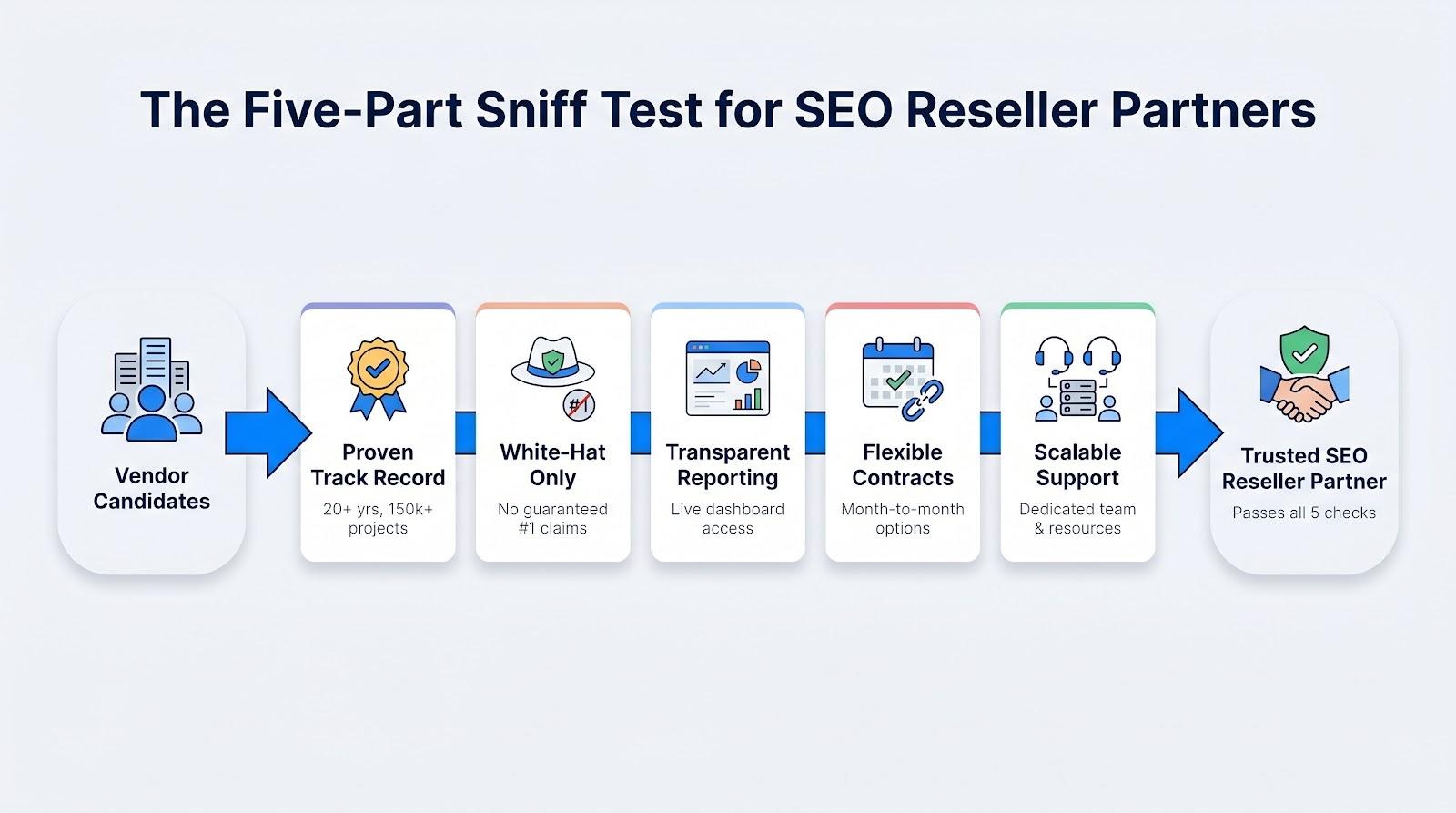
- Proven track record. AgencyPlatform has managed 150 000+ campaigns for 1 200 agencies over 20 years and topped GISuser’s 2026 white-label scorecard, thanks in part to its $178 wholesale local package and cancel-anytime terms.
- White-hat execution: zero “guaranteed #1” hype. DashClicks flags “guaranteed rankings” as the biggest red flag, linking that claim to penalties under Google’s Webspam Policy—spot it and move on.
- Radical reporting transparency. Look for live dashboards that refresh daily, editable comment threads, and branded PDF exports. Partners such as AgencyPlatform surface backlink lists in real time, so you can answer client questions without scrambling.
- Contract flexibility that matches your cash flow. Fifty-six percent of companies cite limited funds as their main outsourcing barrier (Wipfli Outsourcing Report 2025). Month-to-month terms remove that friction.
- Scalable capacity and support. Expect a 24-hour ticket response time and a 10-site onboarding window. Always request average turnaround times and SLA documentation before signing.
Filter vendors through these five gates and you’ll land partners who protect margins and uphold client trust. Next, we’ll compare the front-runners side by side so you can decide with data, not guesswork.
Step 2 – Carve out your niche and build three-tier packages
Generalist agencies get polite nods. Specialists win contracts. When you speak the language of dentists, SaaS founders, or multi-location retailers, buyers feel understood, so price resistance falls.
LinkGraph’s 2025 reseller guide is blunt: agencies that narrow their focus “attract ideal clients” and cut research hours because one competitor template scales across similar prospects. The payoff shows up in close rates, too. Referral leads convert 3 to 5 times better and close 69 percent faster than cold outreach (Influitive, Referral Marketing Statistics 2026). Referrals also flow most easily inside tight professional circles.
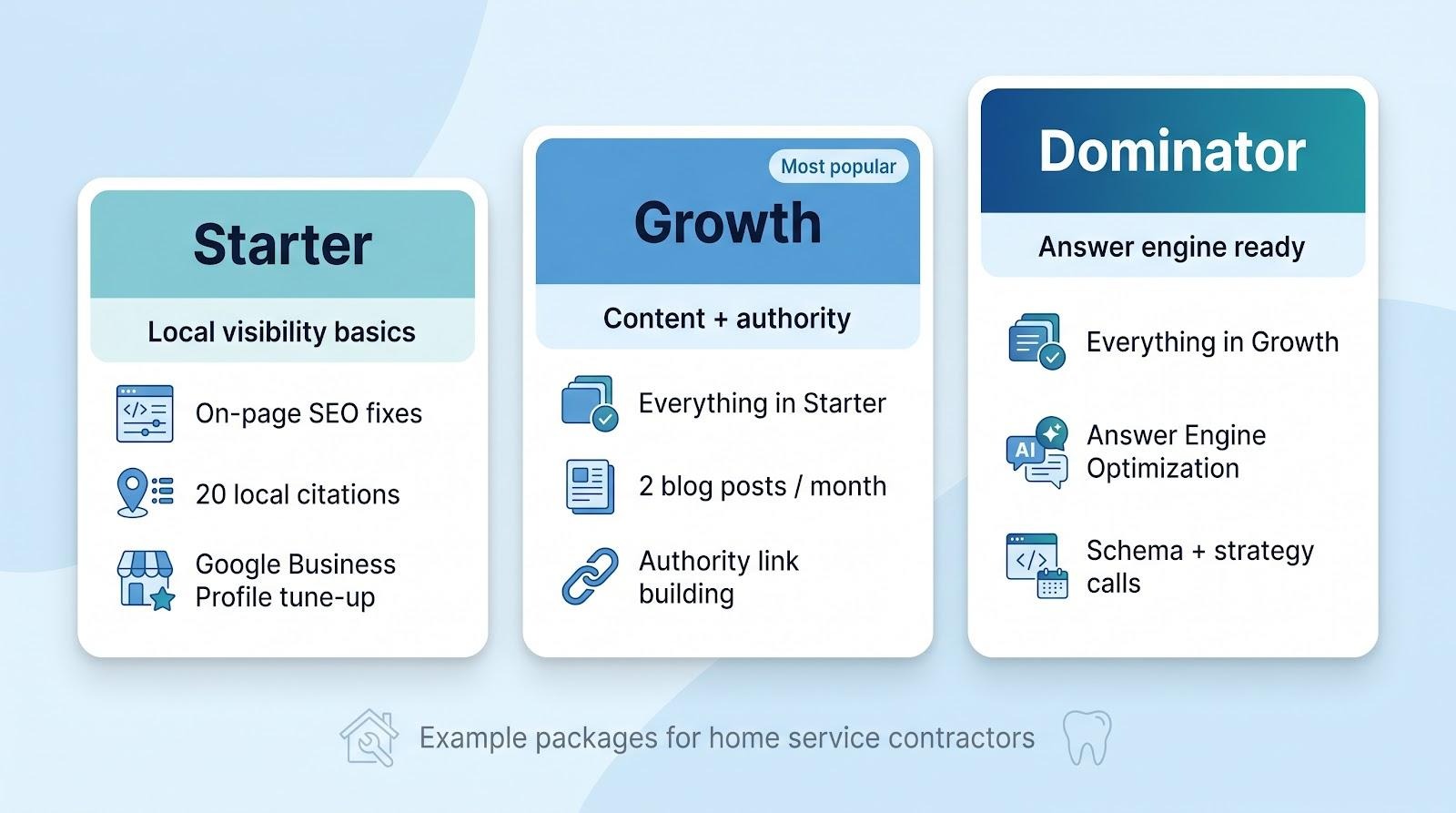
Start where trust already lives. If 70 percent of your web-design book is home-service contractors, double down. Build deliverables that solve the ranking gaps those contractors complain about, such as Google Business Profile tune-ups, service-area pages, and citation cleanup, then stack them into a simple three-tier ladder:
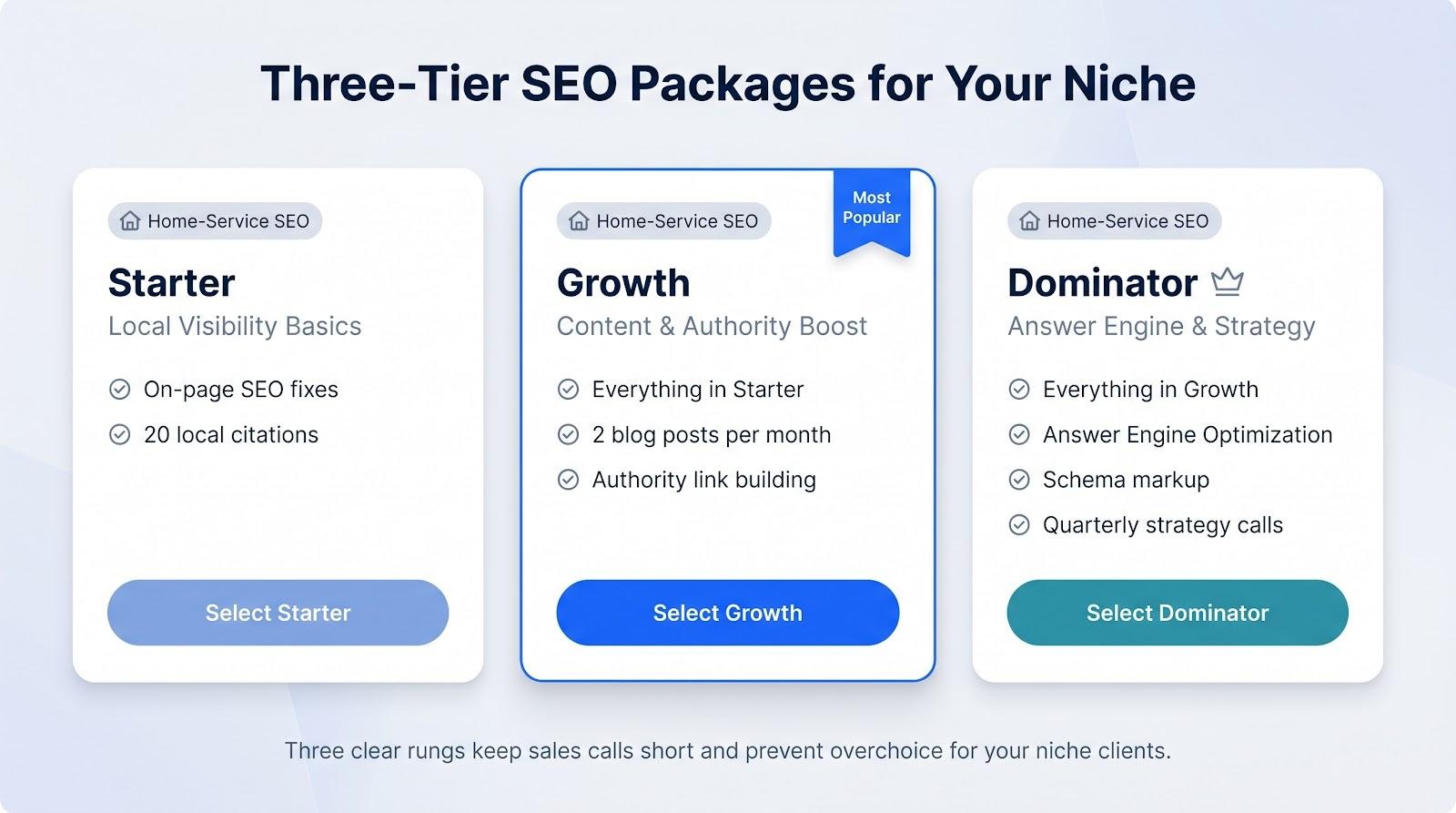
- Starter – on-page fixes plus 20 local citations
- Growth – everything in Starter, two blog posts each month, and authority links
- Dominator – everything in Growth, Answer Engine Optimization, schema, and quarterly strategy calls
Three clear rungs keep sales calls short. Cognitive-load research on “overchoice” shows that excess options slow decisions and slash conversions. Limit the menu to three, label each tier with a clear benefit (“Local Visibility Booster,” not “Silver Plan”), and map every tier to a precise wholesale cost so margins stay visible.
Finally, remember the compound upside of specialization: plumbers know plumbers. Deliver wins for a handful, and word spreads through their Slack channels faster than any cold campaign, fueling the referral engine that converts best.
Step 3 – Price for profit without sticker shock
Margin, not markup, keeps the lights on when a client vanishes or Google rolls out another update. Healthy agencies aim for gross margins of 50 percent or more on service delivery (Search Atlas, 2026 profitability analysis) so they can fund sales time, account management, and the occasional fire-drill rewrite.
Work backward from wholesale cost. Two reference points set the range:
- $294–$744 per month for U.S.-written SEO packages (Semify, 2026 pricing data)
- $499 per month starting price for flexible small-business SEO plans (Small Business SEO / Thryv, 2025 review)
Using the midpoint and the margin target:
| Line item | Wholesale cost | Resale price | Gross margin |
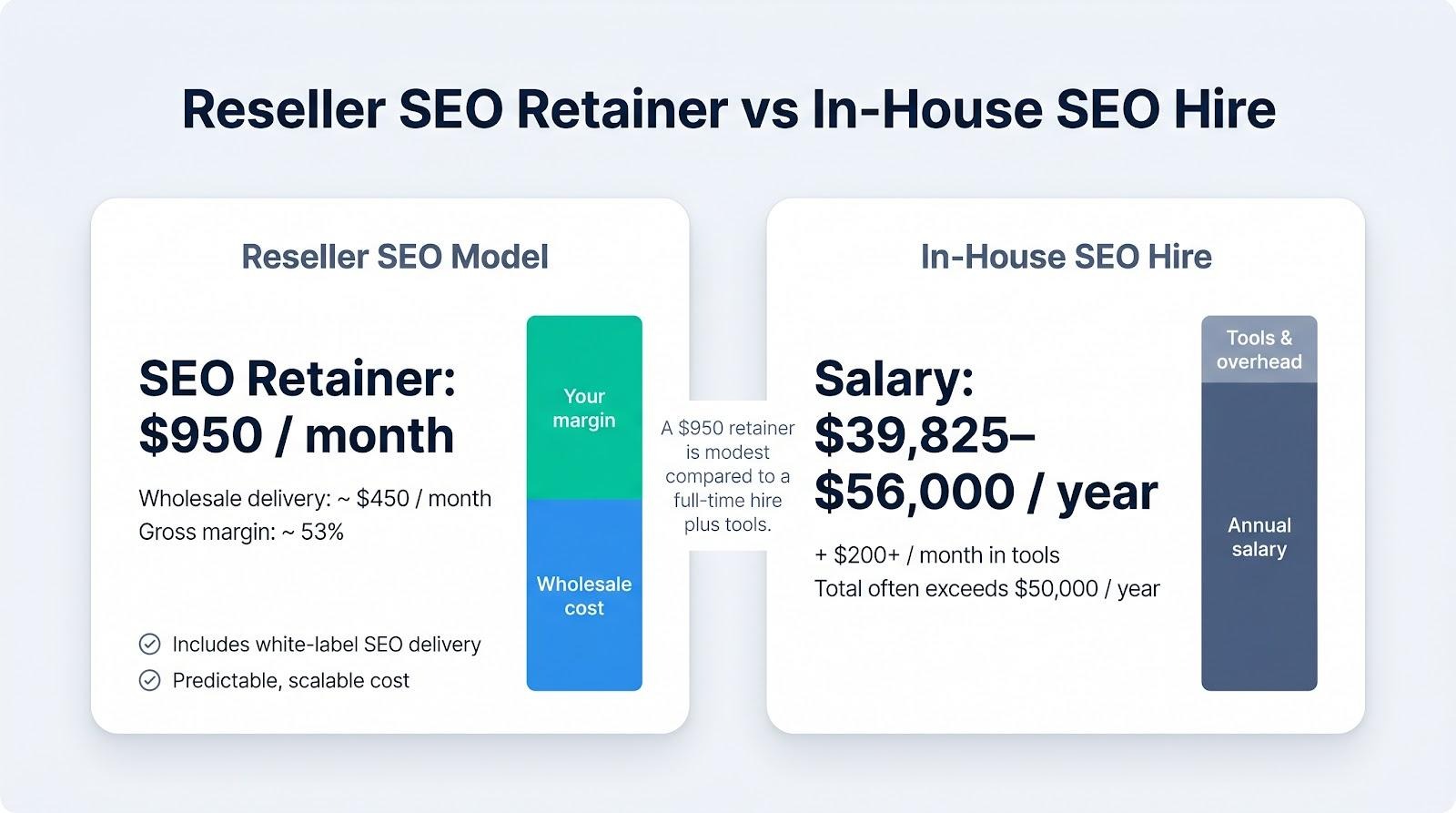
| SEO campaign (average) | $450 | $950 | 53 % |
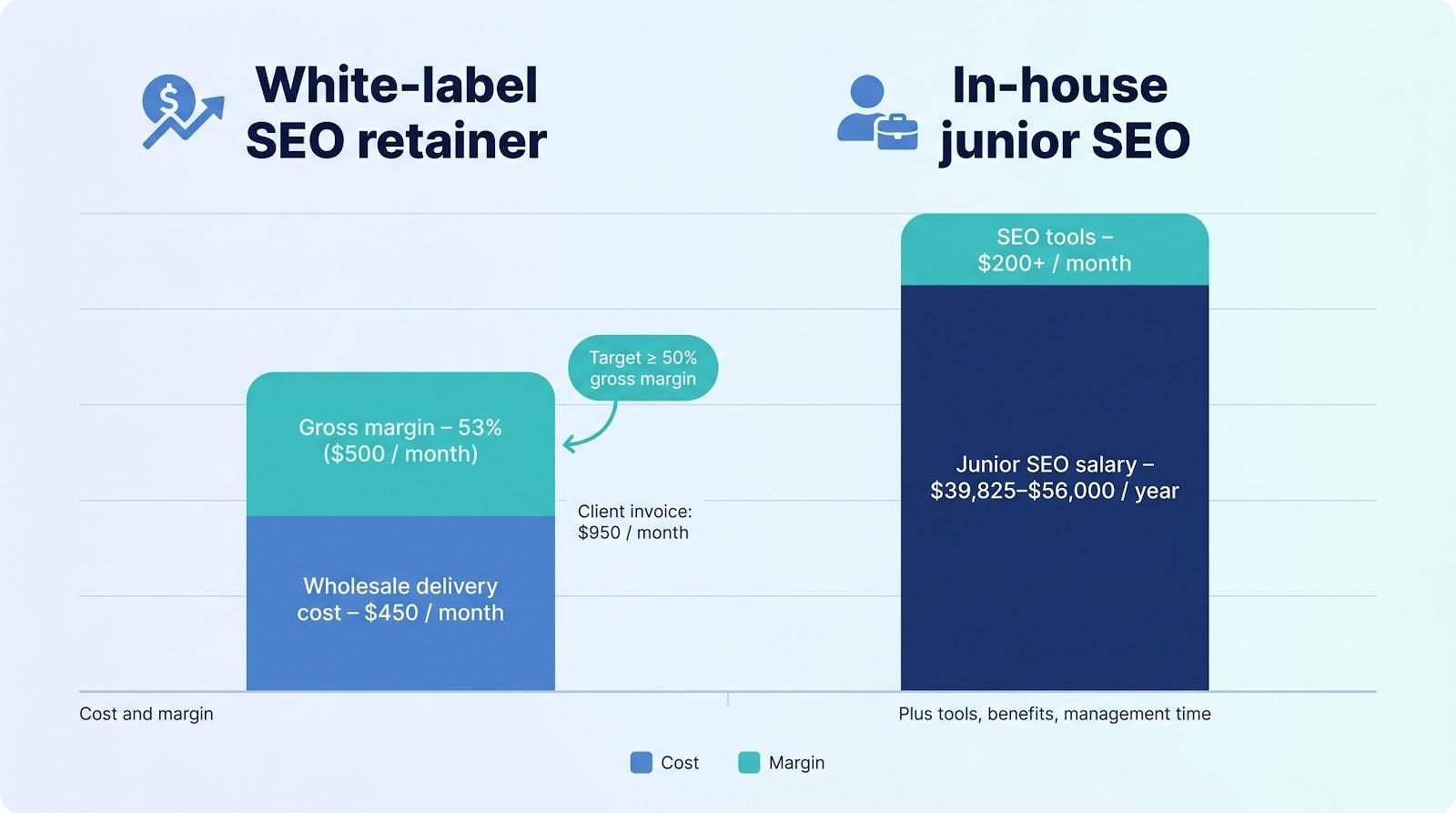
A $950 invoice can feel steep until you anchor it to the alternative. Hiring a junior SEO in the United States averages $39 825 to $56 000 in salary alone (Salary.com, May 2026). Add $200 or more per month in tools and that internal hire easily tops $50 000 a year.
Keep pricing tiered and predictable. Tie each jump to visible outcomes, such as extra content, richer links, and quarterly strategy calls, so clients perceive value rather than just a higher bill. Quote results (“20 percent traffic lift in six months”), not word counts. Outcomes justify premiums; task lists invite haggling.
Next, we will move from math to optics, showing you how to wrap these packages in a brand presence that makes your five-person shop look like a ten-person SEO department.
Step 4 – Wrap it all in your brand
Prospects judge what they can see. Consistent brand presentation across every touchpoint can lift revenue by twenty-three percent on average (Lucidpress / Marq, State of Brand Consistency 2024). Before you quote a single SEO price, show visual proof that you run a polished, full-stack marketing shop, not a freelance side hustle.
Start with your website. Add an “SEO services” page beside Design and PPC, mirror the same voice, and link to a password-protected sample report. Matching colours, typography, and tone tells visitors that SEO is woven into your core offer, not bolted on.
Next, lean on your partner’s white-label assets.
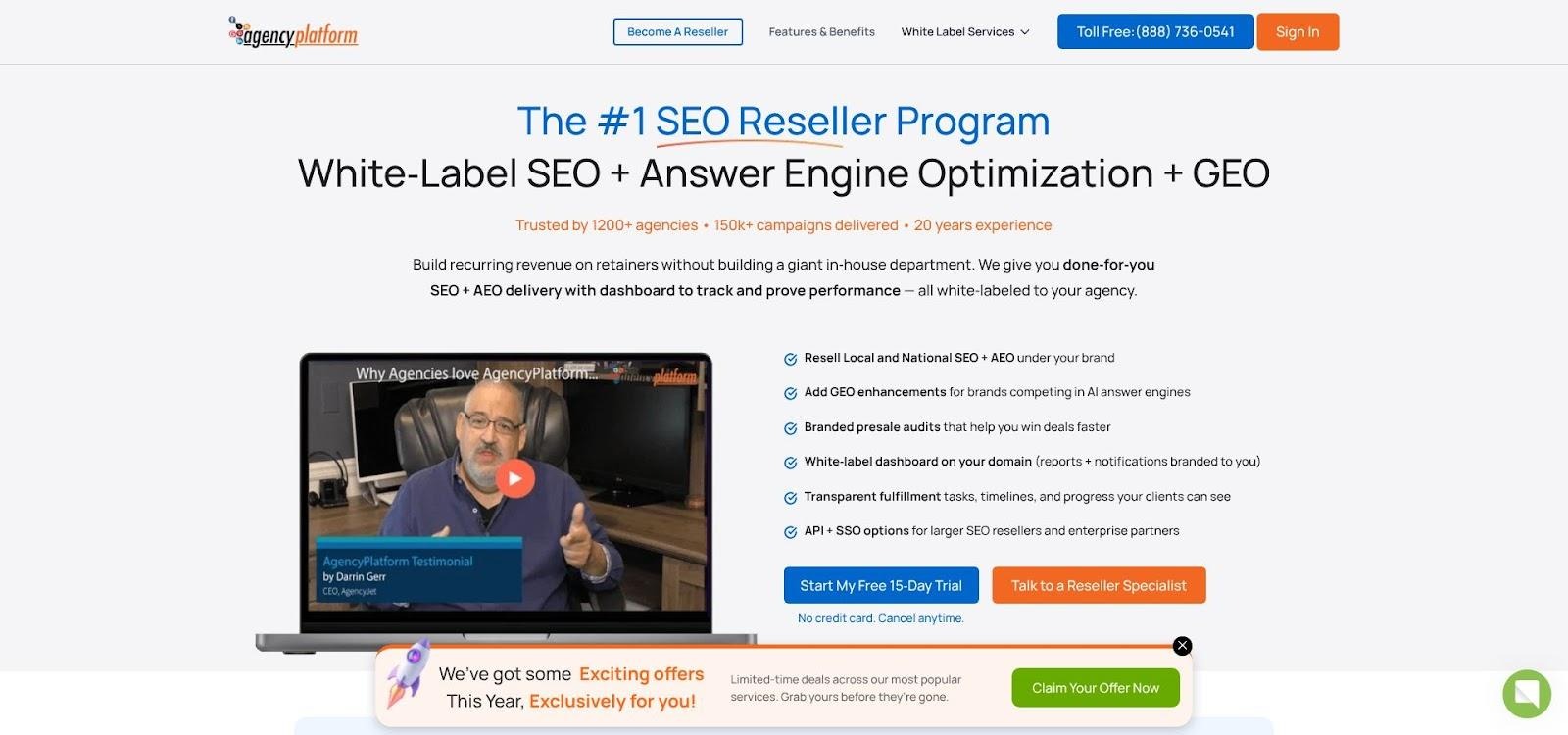
AgencyPlatform white-label SEO reseller program homepage screenshot
Agency Platform has delivered more than 150 000 campaigns for 1 200 agencies, evidence that an experienced SEO reseller can scale wins without sacrificing brand control.
Its portal refreshes keyword and traffic charts every six hours and stamps each PDF with your logo, so clients see progress without ever meeting the backend team.
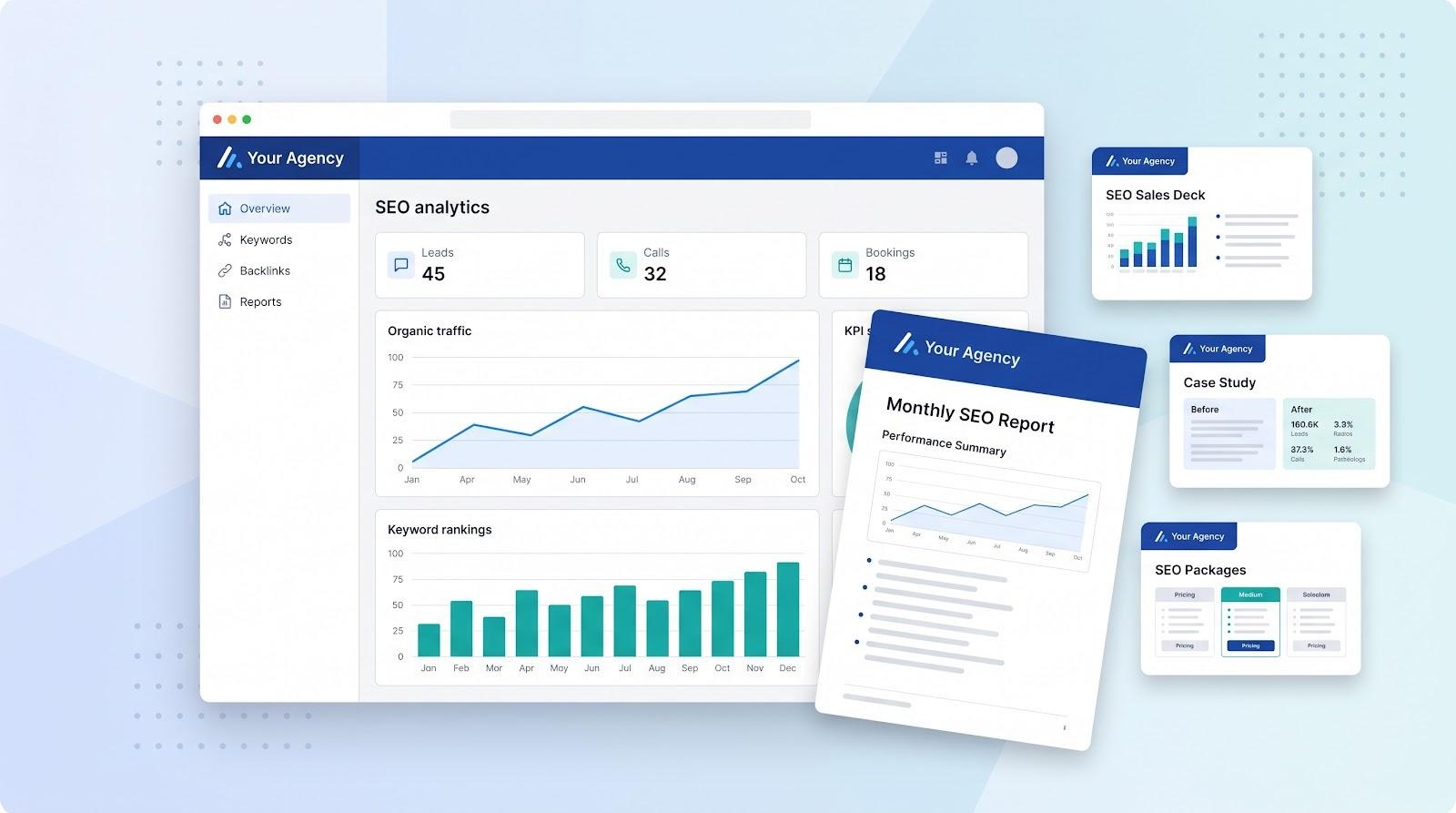
As WhiteLabel DM explains, “we work invisibly behind your brand — your clients never know we exist.” When a client logs in and sees rankings rising under your masthead, loyalty deepens.
Agency Platform’s white-label portal offers the same stealth advantage, refreshing keyword and traffic charts every six hours and stamping each PDF with your logo.
Download the sales decks, case-study templates, and pricing sheets your partner supplies. Swap screenshots, update headlines, and you have a pitch kit in an afternoon instead of a week.
Align every piece of collateral around outcomes. Replace “10 backlinks” with “stronger authority signals that push you onto page one.” Benefits stick; deliverable counts fade.
With brand and assets locked, you are ready to open the funnel. In the next step we will tap your warm network, because the easiest SEO sale is the client who already trusts you.
Step 5 – Turn your warm network into your first five SEO clients
Cold pitches drag. Referral or existing-client leads convert three to five times better and close sixty-nine percent faster than cold outreach because trust already exists. Mine the relationships you have before you load any mass-email tool.
- Scrub your roster. Who hired you for web design last year but never asked about rankings? Who buys PPC yet complains that “organic traffic is flat”? Those accounts already value your work and bypass gatekeepers.
- Send a two-minute Loom audit. Highlight one on-page flaw and one keyword gap, then close with:
“We fix issues like these every month for clients on our Growth plan—interested in details?”
Quick proof beats a slide deck. - Aim for five pilots in sixty days. Five early wins create case studies, testimonial quotes, and referral fuel, the compounding engine your pipeline needs.
Fulfilment can be commoditised; relationships cannot. Start inside your circle to skip the hardest part of the business—acquisition costs—and enter Step 6 with social proof in hand.
Step 6 – Onboard smoothly and keep work visible
A flawless kickoff sets the tone for the entire engagement. Companies with efficient onboarding processes have seen customer retention rise by up to fifty percent (Martal Group, 2025). Miss the hand-off, and the honeymoon ends before rankings move.
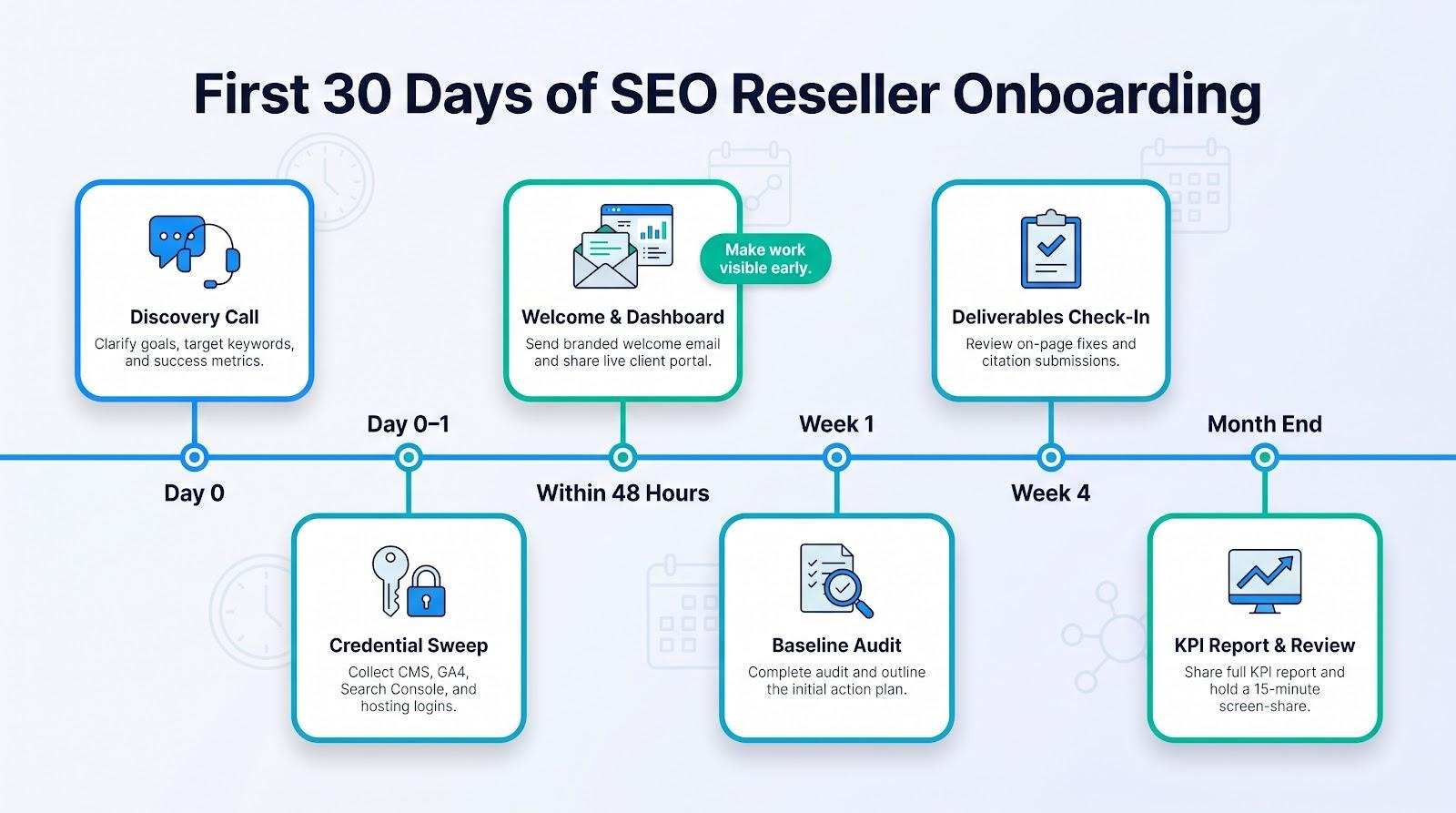
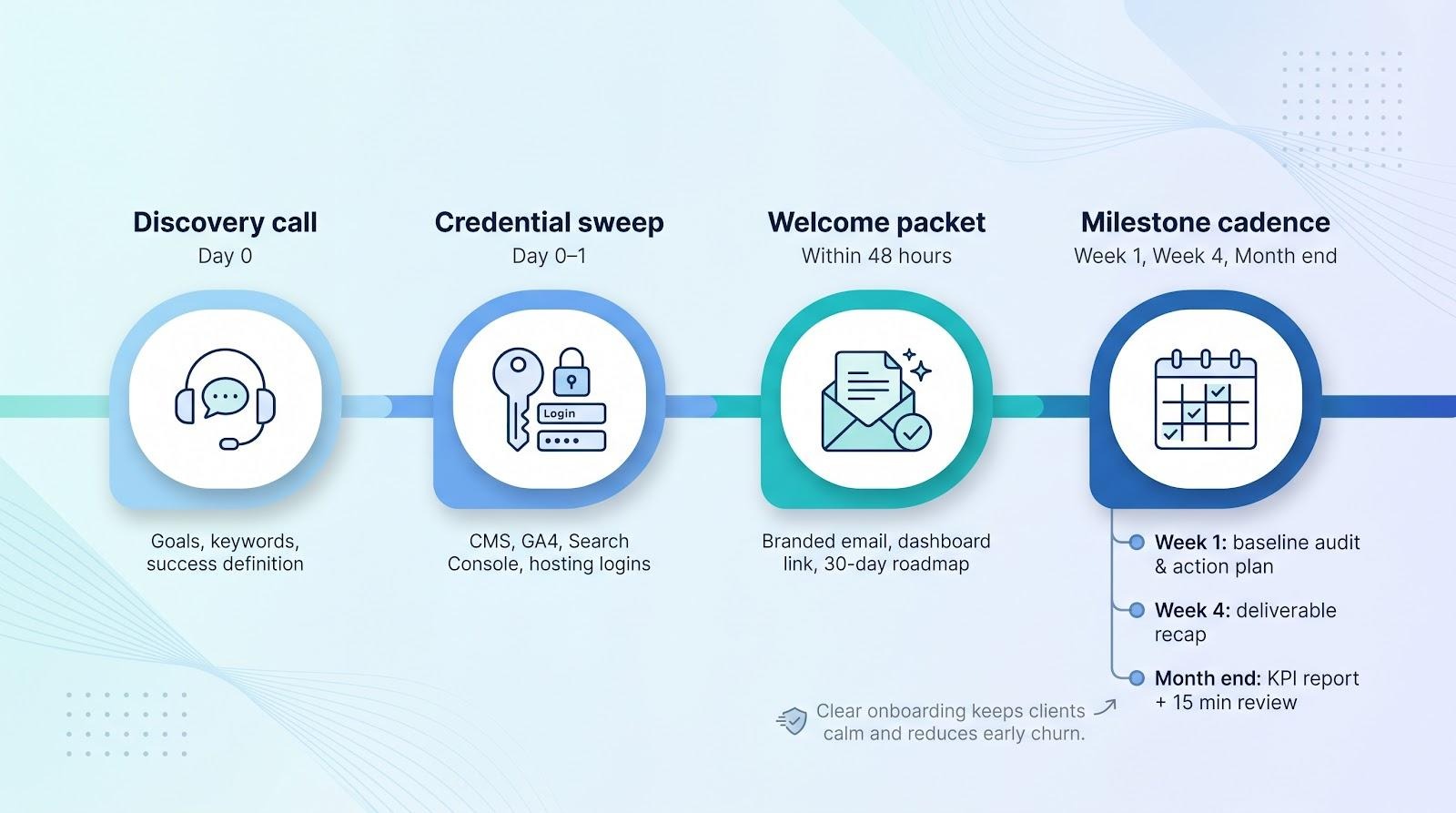
- Discovery call (Day 0). Confirm goals, target keywords, and define success in the client’s language: calls, demos, or bookings. Explain that meaningful traction appears in three to six months; anything faster is a red flag according to DashClicks.
- Credential sweep (Day 0 to Day 1). Collect CMS, GA4, Search Console, and hosting logins in one request, and store them in a secure vault.
- Welcome packet (within forty-eight hours). Send a branded email, share a password-protected dashboard (AgencyPlatform streams live rankings under your logo), and attach a thirty-day roadmap so clients feel progress before the first report.
- Milestone cadence.
- Week one: baseline audit and action plan
- Week four: deliverable recap, such as on-page fixes, and citation submissions
- Month end: full KPI report plus a fifteen-minute screen-share review
If something slips, own it, loop your provider in quietly, and give the client a new due date. A prompt recovery preserves trust: seventy-three percent of churn happens in the first ninety days (User Intuition, 2025).
Next, we will lock in a KPI scorecard that ties every task back to revenue, because rankings alone do not pay invoices.
Step 7 – Track what matters, tune the engine, and scale on your terms
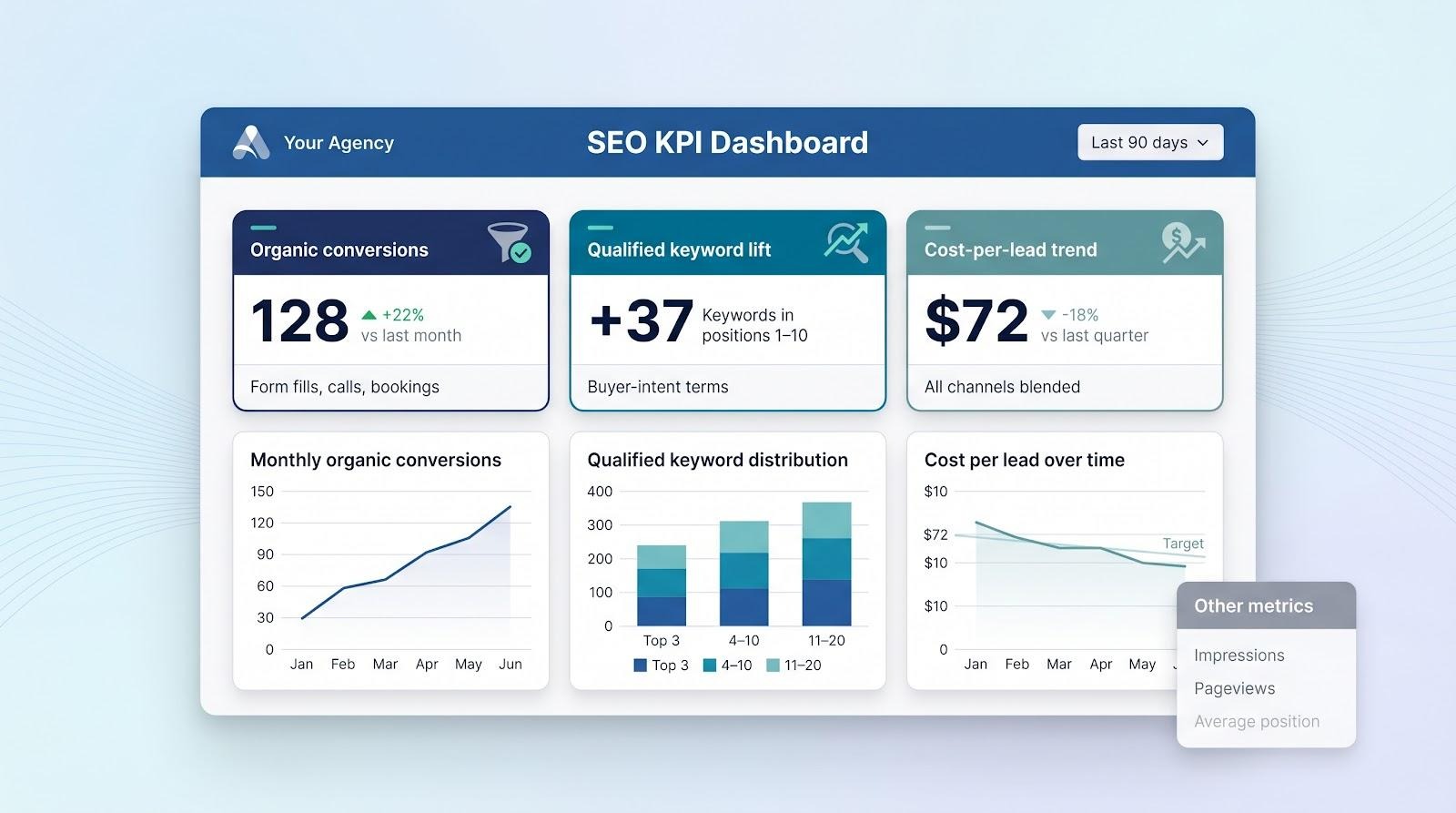
Rankings are vanity when they fail to translate into pipeline. Anchor every campaign to three business KPIs:
- Organic conversions (form fills, calls, or bookings)
- Qualified keyword lift (keywords ranking in positions one through ten that match buyer intent)
- Cost-per-lead trend
Dashboards that highlight these metrics and hide noise keep clients focused on return on investment. No surprise that eighty-nine percent of top marketers now align their KPIs with revenue, growth, and retention, abandoning vanity metrics (ReportDash, 2026).
Set review rhythms:
- Monthly report → progress snapshot
- Quarterly strategy call → decide whether to double down, pivot, or expand into Answer Engine Optimisation
DashClicks reminds agencies that meaningful SEO impact appears in “three to six months,” not thirty days, so calibrate expectations early.
When numbers stall, diagnose rather than guess. Check crawl errors, compare backlink velocity against the top three competitors, and revisit search intent. A quick pivot—such as rewriting thin evergreen pages or tightening internal links—often reignites growth without new spend.
Happy clients stay, and long lifespans unlock scale. Seventy-five percent of large enterprises now outsource SEO tasks (StudioHawk, 2024) and remain with partners who report clearly and iterate quickly. Capture each win in a single-slide mini case study and feed it back into your sales funnel; every success story lowers acquisition cost for the next prospect.
Scale in sprints: five new campaigns, conduct a process check, then five more. Negotiate a ten percent wholesale discount once volume rises; that single move can lift net margin by several points without raising client prices.
Measure, optimise, celebrate, repeat, and your reseller arm becomes a predictable, compounding revenue stream rather than a side project that steals weekends.
Conclusion
By following these seven steps—screening partners, packaging services, pricing for profit, wrapping offers in cohesive branding, leveraging warm relationships, perfecting onboarding, and tracking meaningful KPIs—you can bolt a profitable, white-label SEO division onto your agency without inflating overhead or burning weekends. Commit to process, stay transparent, and growth will compound.
About the Author

Peter Makeshoff
Peter Makeshoff is the founder and main author of Designer Daily.