
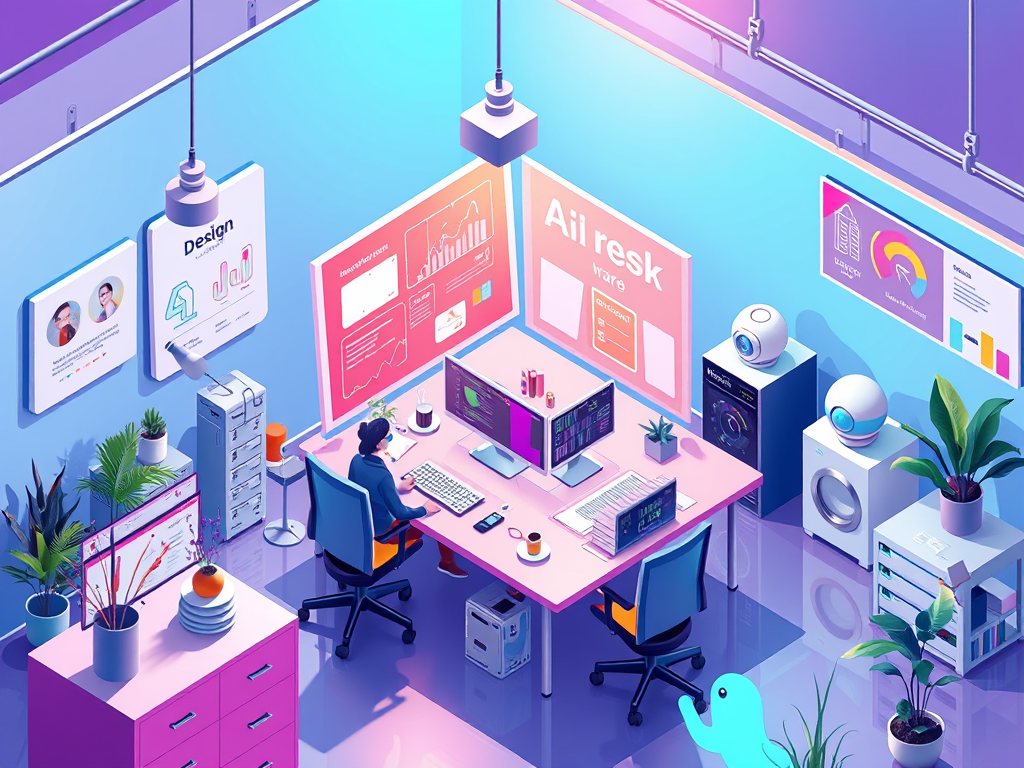
A blank canvas. A blinking cursor. For centuries, these have been the starting points of creation, symbols of both infinite possibility and paralyzing pressure. Today, they are increasingly joined by a new interface: a text prompt. With the rise of generative AI, a fundamental question is stirring the design community: are we welcoming a new creative partner, or merely mastering a more complex tool?
The answer isn’t simple, and the distinction is crucial. Calling AI a “tool” can feel reductive, while calling it a “partner” can feel alarmingly human. The truth lies in a nuanced understanding of both the technology and the irreplaceable core of our own creativity.
The Case for the “Fancy Tool”
Let’s be honest. In many workflows, AI functions as the most sophisticated tool we’ve ever had. It’s a chameleon, wearing many hats:
- The Supercharged Image Bank: It’s a mood board generator on steroids, conjuring visual concepts and styles in seconds, not hours.
- The Tireless Production Assistant: It automates the tedious: resizing banners, removing backgrounds, generating alt-text, and creating scalable vector patterns.
- The Instant Prototyper: It can spit out countless UI layouts, logo variations, or copy options, providing a broad, data-driven starting point.
In this role, AI is undeniably powerful. It excels at divergence: generating a wide field of possibilities based on a set of parameters. It’s a calculator for aesthetics, a speedboat for the ideation phase. But a tool, no matter how fancy, has no intent, no taste, and no understanding of the human context. It doesn’t know why a design needs to resonate with a specific audience feeling a specific emotion.
The Emergence of the “Creative Partner”
This is where the concept of a “partner” becomes compelling. A partner doesn’t just execute tasks; they challenge you, inspire you, and bring a different perspective to the table. AI can begin to occupy this role when we engage with it not as a command-line, but as a conversational collaborator.
Imagine this:
- The Brutal (and Unbiased) Editor: You can present AI with three design concepts and ask, “Which is the most accessible and why? Critique the hierarchy from a first-time user’s perspective.” It offers a perspective unclouded by your attachment to the hours you spent on a particular idea.
- The Cross-Disciplinary Muse: Stuck on a branding project for a coffee shop? Ask your AI partner to “explain the color theory of a 1970s Italian film poster and suggest a palette for a modern, cozy café.” It can make unexpected connections that break you out of your creative silo.
- The Iteration Engine: A partner helps you refine. You can take a generated image and say, “Make the character more weary, but with a glint of hope. Change the season to autumn and add a sense of quiet solitude.” This back-and-forth dialogue is where the magic happens.
In this model, the human is the curator, the visionary, and the empath. We provide the “why,” the strategic direction, and the emotional intelligence. The AI provides the “how,” the raw material, and the lightning-fast execution.
The Invisible Ingredient: The Human Touch
This is the non-negotiable element that separates compelling work from generic output. The “human touch” isn’t just a stylistic flair; it’s the sum of our lived experience. It is:
- Cultural and Emotional Context: AI can replicate a style, but it doesn’t understand the nostalgia of a faded polaroid, the rebellion of a punk zine, or the serenity of a Japanese wabi-sabi aesthetic. We imbue designs with this deeper meaning.
- Intentional Imperfection: The perfectly smooth vector graphic can feel cold. The human hand might add a subtle texture, a slightly uneven line, or a clever, hidden detail that creates a moment of delight and connection.
- Strategic Empathy: A design must solve a real human problem. We conduct user research, observe body language, and understand unspoken needs. We design not just for the eye, but for the heart and mind of another person.
How to Integrate AI Without Losing Your Soul
So, how do we harness this power without becoming passive passengers in our own creative process?
- Lead with Your Humanity. Always start with your own intent, your strategy, and your raw, un-aided sketches. Use AI in the middle of your process, not at the beginning.
- Master the Art of the Prompt. Treat prompting not as a command, but as a creative skill. The more descriptive and nuanced your prompt, the more partner-like the response. Learn its language.
- Curate, Don’t Just Accept. Reject the first 10, 20, or 100 outputs. Your taste is your greatest asset. Use AI to generate options, and use your expertise to select and refine the ones with potential.
- Always Add Your Layer. Take the AI output and make it yours. Redraw it, tweak the colors, combine it with other elements, and inject the imperfection and soul that makes it unique.
The Verdict
Is AI a partner or a tool? It’s a tool aspiring to be a partner, but it will only ever be as good as the human guiding it.
The future of design isn’t about humans being replaced by AI. It’s about designers who use AI replacing those who don’t. The most powerful creative team in the world is the combination of a human heart, a critical mind, and a machine’s boundless capacity for production. Embrace AI not as a threat, but as the most fascinating and challenging collaborator you’ve ever had. Your canvas just got a whole lot bigger.
About the Author
Peter Makeshoff
Peter Makeshoff is the founder and main author of Designer Daily.