
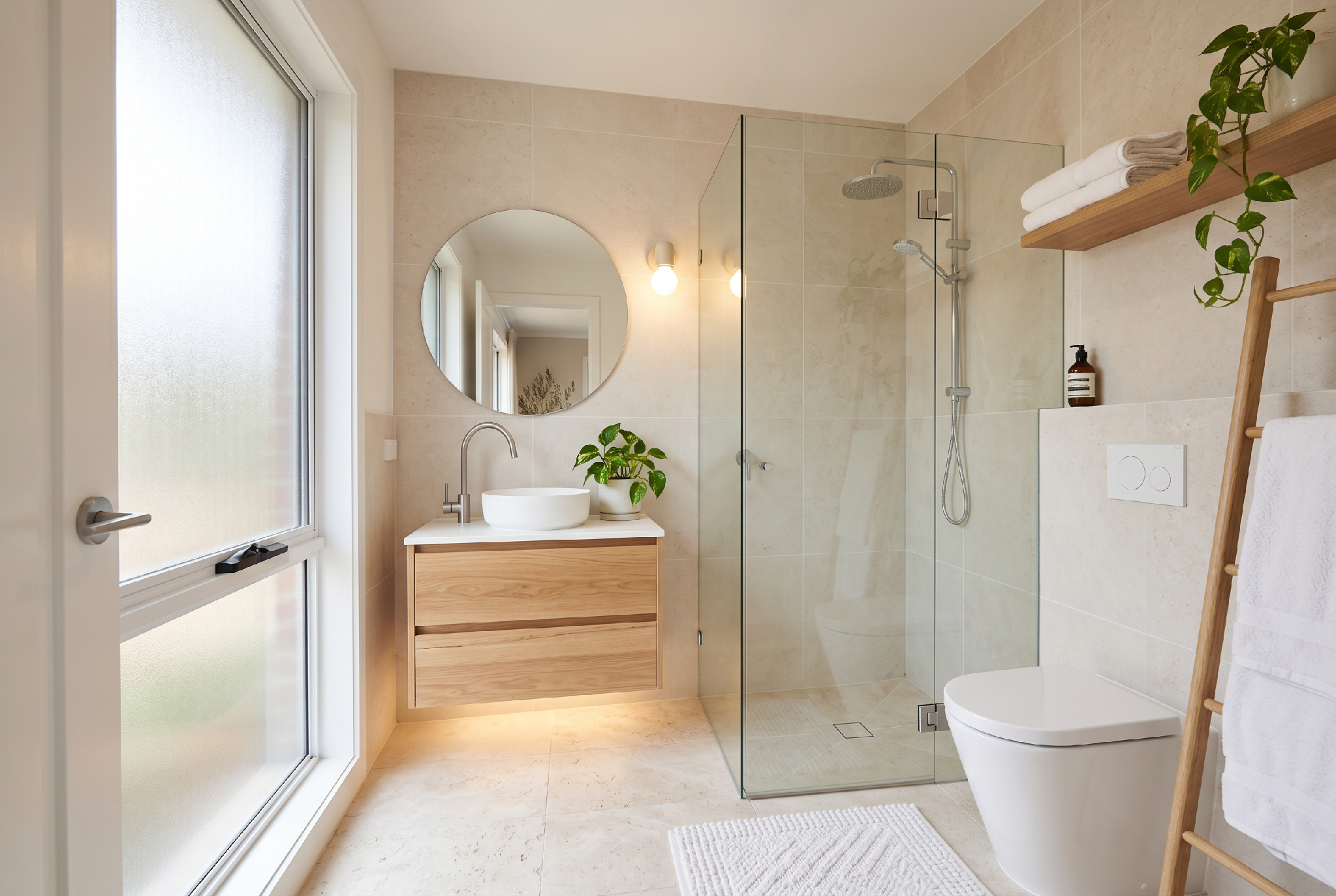
Why Small Bathrooms Require a Spatial Approach
Small bathrooms — they are also often poorly designed. The biggest problem with smaller bathrooms is that we treat them like bigger ones but just smaller.
A large vanity that blocks the door swing, shower screens that take up the walking path, and a vanity on legs that takes up valuable floor space all result in a cramped bathroom. Working with a 1.5 m × 2.4 m (3.6 m²) floor plan for your new space means that you’ve only got a really small footprint to work with and every bit of clear space counts. The door can take up 0.6 m² of space on the floor.
Think of a spatial approach as making the rules before you fill the room. Set out the clearances, work out the plumbing before selecting plumbing products, and then select products to fit.
Layout Principles That Maximise Every Square Metre
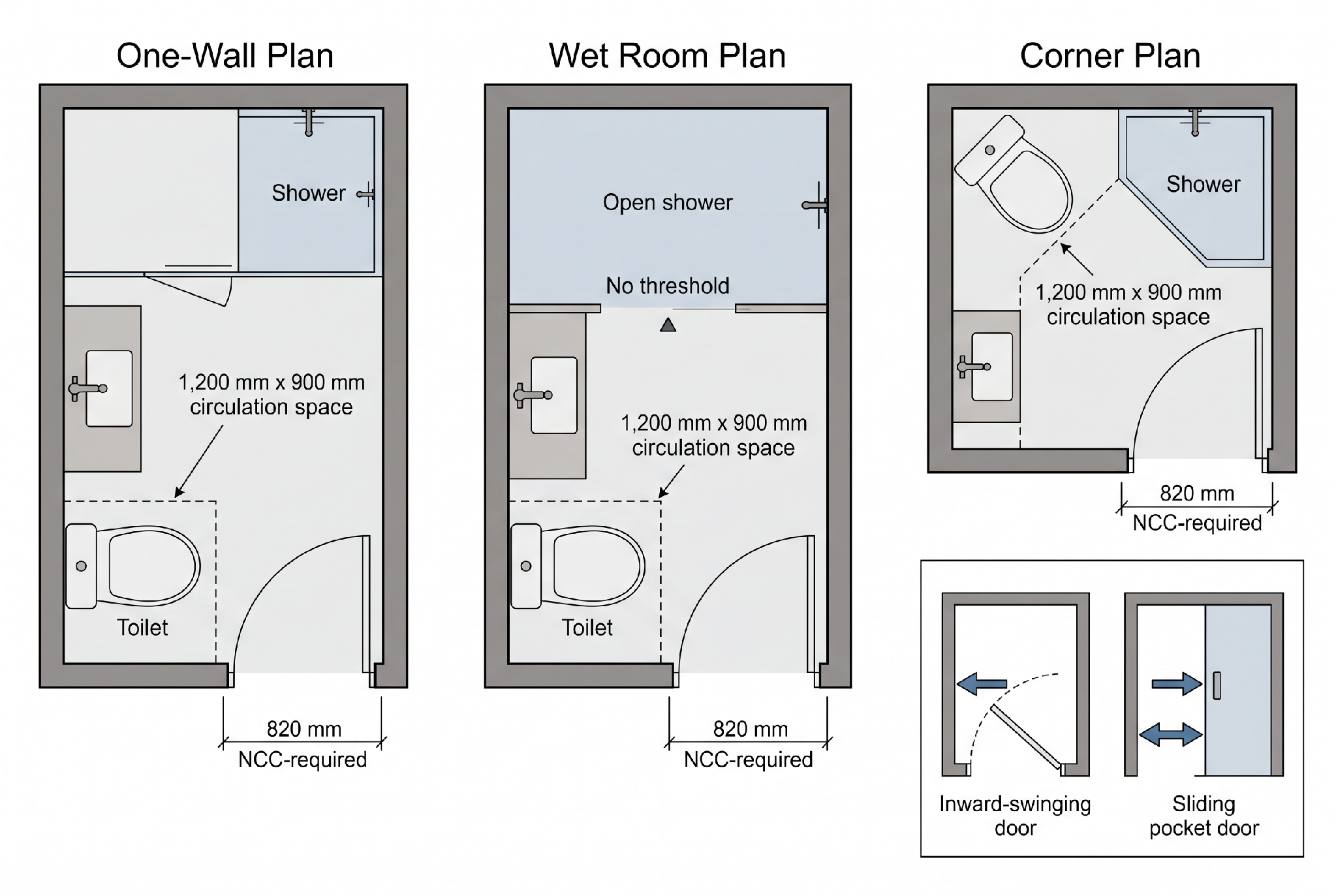
As a consequence, the layout is the most critical element of the design. There are a few types of floor plan that are particularly suitable for small spaces, including the one-wall plan, the wet room and the corner plan.
What kind of door you choose is crucial. An inward-opening door that swings in can take up much of the most available open space. Sliding and pocket doors are better because they take up less space and require much less floor space. You don’t even need to sacrifice floor space with a pocket door — it sits in a cavity in the wall and doesn’t take up floor space in the bathroom floor plan.
The Livable Housing Design Standard requires a minimum clear opening width of 820 mm for doorways leading to a sanitary compartment, and a minimum circulation space of 1,200 mm × 900 mm from the front edge of the toilet pan. In a separate sanitary compartment, you need to allow for a minimum clear width of 900 mm between the finished wall surfaces either side of the toilet. These are not suggestions — they are the baseline.
Once the layout determines where all the fixtures are, the next challenge is finding enough storage without eating into those clearance zones.
Storage Solutions That Keep Clutter Off the Floor
Floor-level storage is a small bathroom’s greatest nemesis. When you put a freestanding unit or a storage basket on the floor, you can see the room becoming smaller. You can make the room feel much larger if you keep the floor clear of everything, and it also makes it easier to clean.
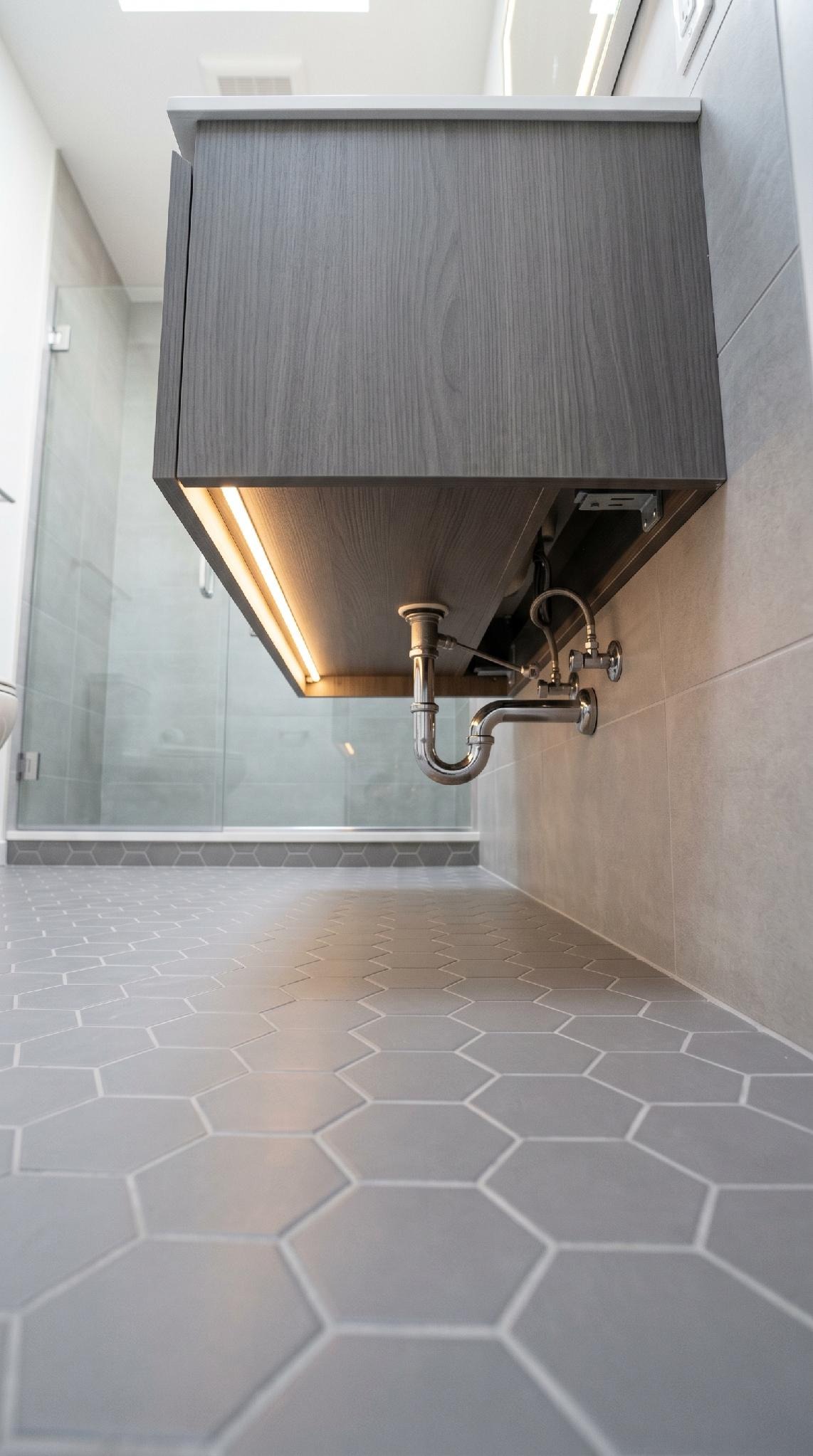
Consider a wall-hung vanity to begin. Recessed niches are installed between bathroom wall studs and waterproofed, so shampoo and body products can be kept within arm’s reach and do not protrude even 1 mm into the bathroom. A slim shelving unit installed above the toilet — roughly 200 mm deep — uses vertical space that would otherwise go entirely to waste.
A mirrored shaving cabinet is another option to consider. Good-quality LED shaving cabinets provide a mirror, some storage, and task lighting all in one wall-hung product — three problems solved in one. The electrical work will need to be carried out by a licensed electrician.
Fixtures and Fittings Sized for Compact Spaces
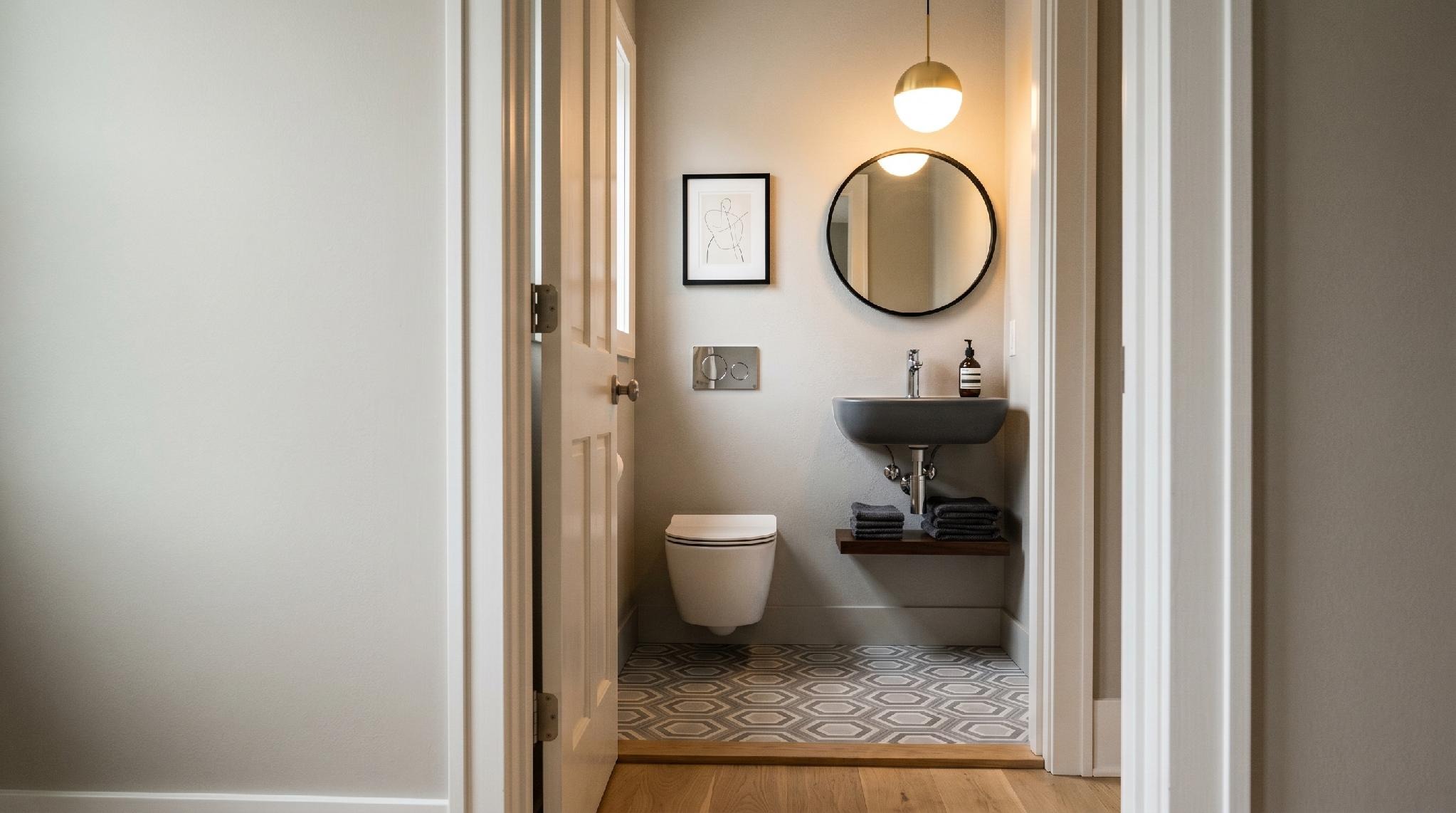
A small bathroom can be made much more usable by choosing fixtures and fittings that suit its dimensions. A small bath vanity around 450 mm to 600 mm wide is ideal in a tight bathroom; you retain clearances and still have space for a basin and a drawer or two. PVC is waterproof and a sound choice for wet areas, whereas MDF is not.
A corner bathtub can work well. A corner bathtub takes up a roughly 1,200 mm × 1,200 mm floor area, so it doesn’t consume the whole room. Acrylic bathtubs are lighter and warmer to the touch than stone resin options, which are heavier but better at retaining heat.
For showering, a frameless walk-in screen can enclose the shower area without a swing door, so there are no additional clearance requirements, and the sightline through the glass keeps the room feeling open. Ventilation is also a code requirement.
Getting ventilation right from the start means no retrofitting later — a ceiling-mounted exhaust fan positioned over the shower zone is usually the most practical solution in a small bathroom.
Tiles, Colour, and Lighting Tricks That Open Up a Room
Large-format tiles make a small bathroom appear larger. A 600 × 600 mm or 600 × 1,200 mm tile has significantly fewer grout lines than a 200 × 200 mm tile, which reduces visual distraction across floors and walls. Lighter-coloured grout, close to the tile colour, helps further. Factor in an extra 10 to 15 percent for cuts and waste, and confirm the subfloor is level to within 3 mm over 3 m before laying any tile format over 600 mm.
Slip resistance matters too. Residential bathroom and shower floors require a minimum P3 slip rating.
Colour is a further consideration. Warm neutral tones — white, light stone, or a warm grey — reflect more light and make a room feel larger. Keeping wall and floor tones similar, perhaps with one textured feature wall, maintains visual continuity and avoids colour-blocking clutter.
Lighting deserves careful thought. A single ceiling downlight casts shadows around the vanity and leaves corners dim. Supplement general lighting with task lighting at vanity level — an LED backlit mirror or LED shaving cabinet eliminates shadows where you need clarity most.
A small bathroom can be genuinely practical and inviting. Plan the layout first, resolve storage second, choose your fixtures third, then select the finishes — and the result can feel considered, comfortable, and surprisingly generous.
About the Author

Peter Makeshoff
Peter Makeshoff is the founder and main author of Designer Daily.