
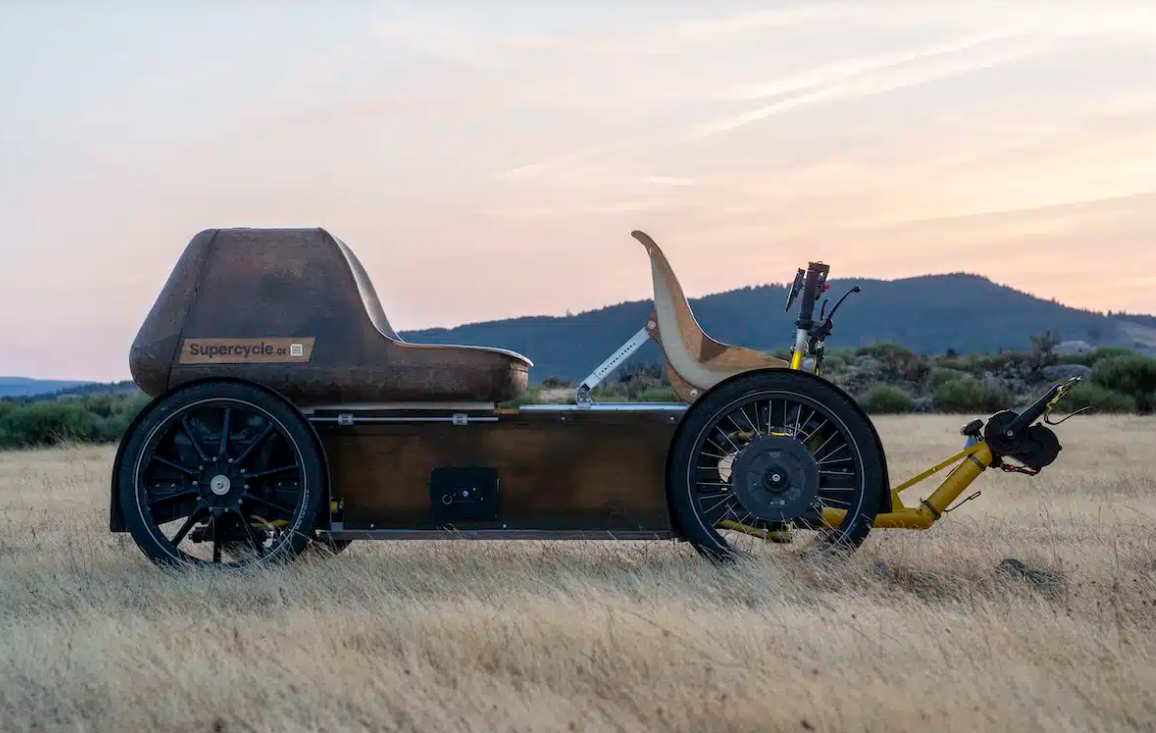
Light electric mobility continues to evolve with approaches that question our relationship to the manufacturing, maintenance, and use of urban vehicles. The Supercycle project, developed by a young couple of designers, offers an alternative vision: that of a small, self-built, human-assisted electric quadricycle designed for durability and energy autonomy.
An Intermediate Vehicle Born from European Collaboration
The Supercycle vehicle explores the realm of light intermediate vehicles—those “véligos” positioned between cargo bikes and micro-cars. Unlike commercial projects such as Karbikes, which blend bicycle and automobile elements, Supercycle focuses on self-building and open-source principles, echoing the spirit of the Vélo-Pélican, a universal grafting system developed by students at ENSCI.
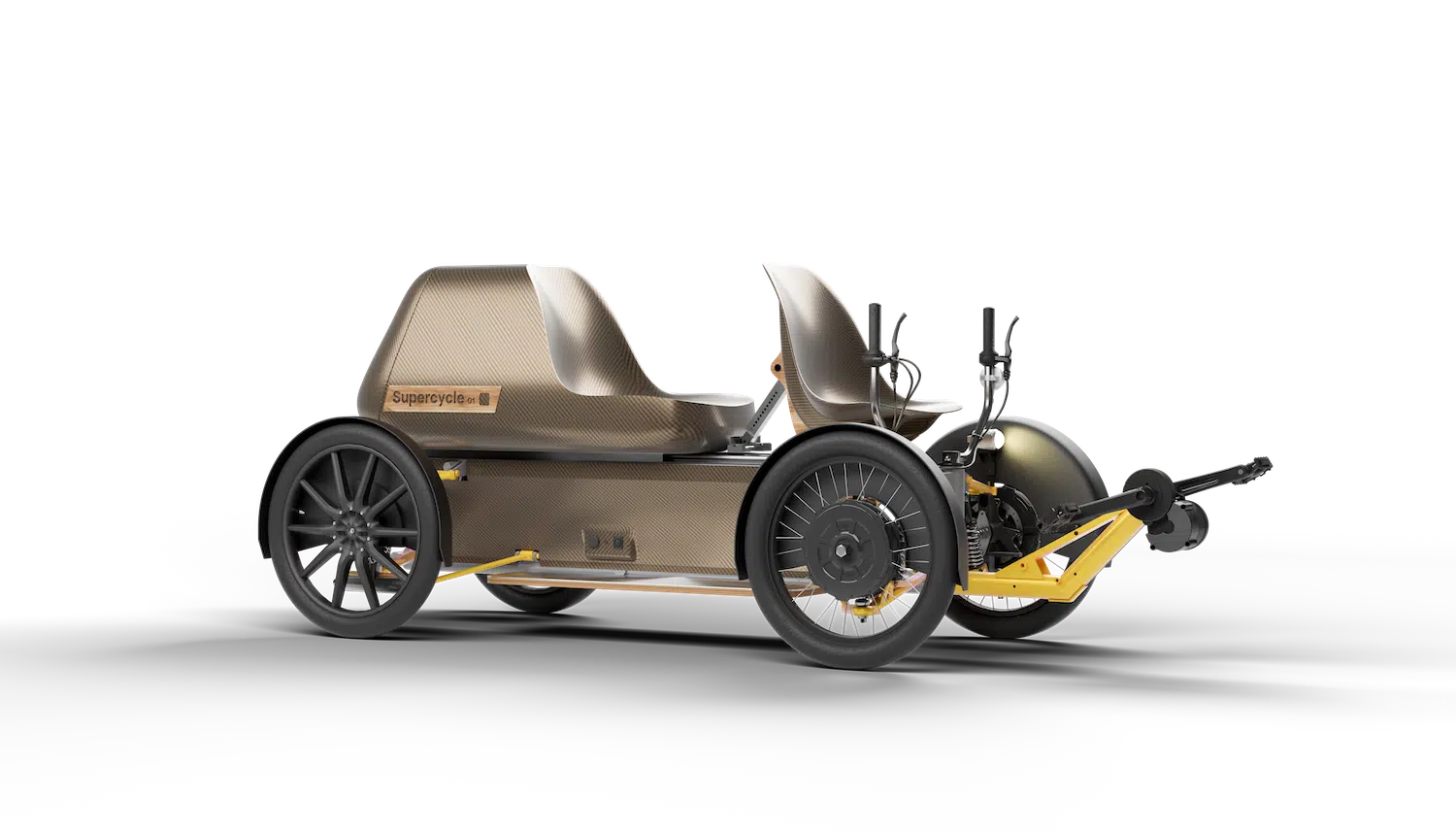
The vehicle’s frame comes from the Dutch company Flevobike, originally developed for the Swedish cyclologistics firm Velove. The designers chose to remove the original mechanical transmission, motor, and various accessories to make way for an open-source generator and two Grin motors. This lighter, modular approach allows for simplified maintenance and increased durability, making the vehicle virtually indestructible except for the tires. No more chain, cassette, chainring, brake pad, or brake disc changes. No more grease.
Plant-Based Composite and Reconditioned Batteries: A Circular Approach
The material aspect of the project deserves particular attention. Two new seats and a trunk were custom-made from flax fiber and epoxy composite. This material choice echoes research into plant-based composites, such as the Katra 2.0 chair, which also uses flax fiber for its mechanical properties comparable to, or even better than, fiberglass. The use of flax fiber, for which France is the world’s leading producer, strengthens the project’s local roots. As the ULTRA LIN program highlighted, this textile material with unsuspected properties offers interesting prospects for industrial design.
The four suspensions give the vehicle remarkable riding comfort. The battery in the first two prototypes consists of an assembly of four reconditioned batteries supplied by Bib-Batteries, retaining 95% of their theoretical capacity when new. This reuse approach fits into a circular economy logic, similar to the upcycling initiatives developed by Maximum to transform industrial waste into furniture.
Technical Specifications: Performance and Simplicity
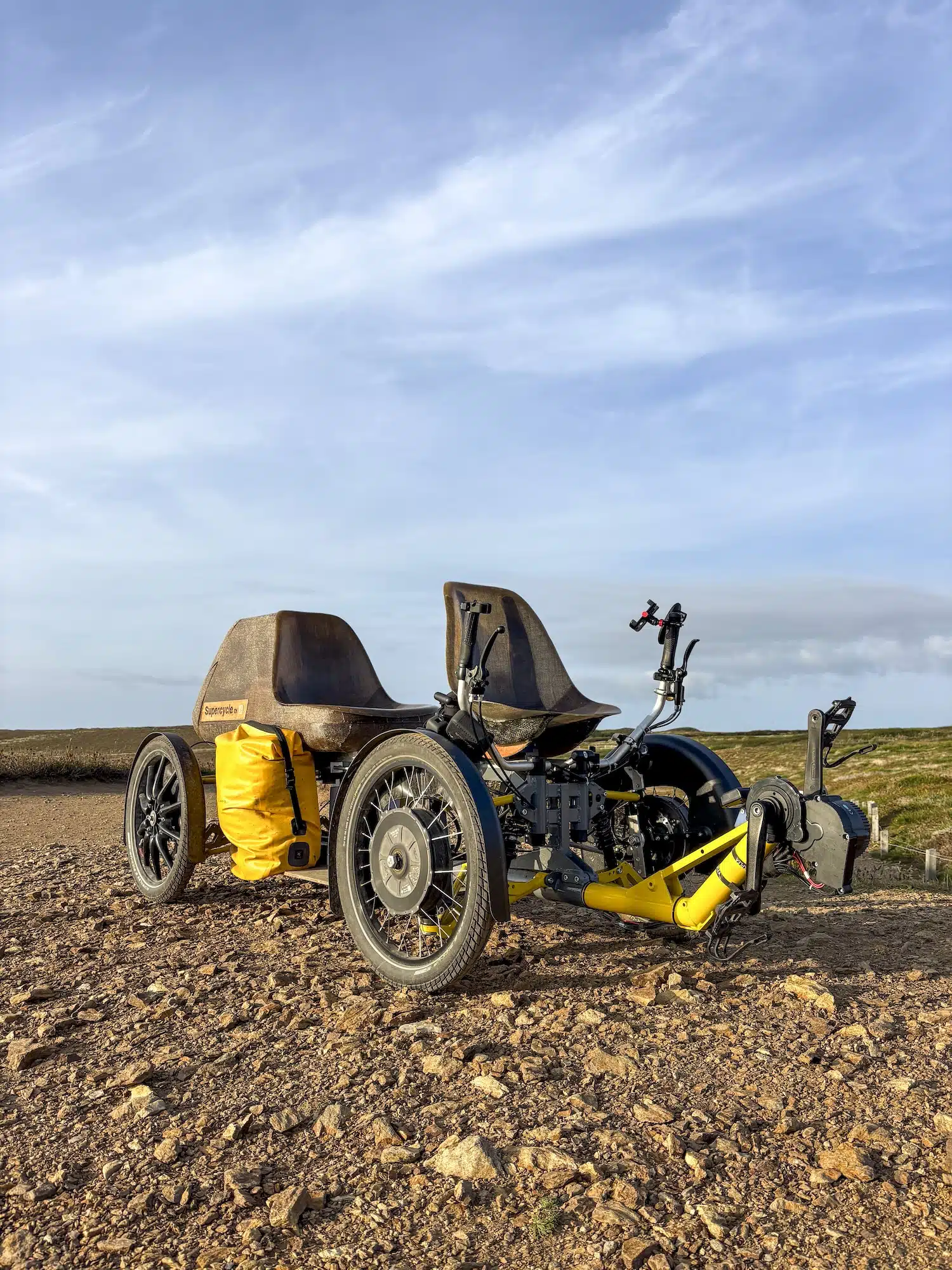
With a curb weight of 70 kg and a maximum payload of 250 kg, the Supercycle can accommodate two adults and a 70-liter trunk. The propulsion relies on non-geared Grin All Axle V3 hub motors, controlled by a Grin Baserunner controller. The vehicle reaches a top speed of 43 km/h, with a maximum torque of 130 Nm and a peak power of 4 kW.
The fully electric pedal drive system eliminates traditional mechanical constraints. The braking system combines three technologies: regenerative braking via the motors, hydraulic brakes at the front, and mechanical brakes at the rear. This energy recovery during braking, coupled with a consumption of 23 Wh/km at 25 km/h and 26 Wh/km at 35 km/h, allows for a maximum range of 150 km with a 3 kWh (48V) battery. The full charge time is 8 hours.
With compact dimensions—250 cm in length and 90 cm in width—the vehicle easily navigates urban and suburban environments. Two prototypes have already covered over 5000 km each, demonstrating the concept’s reliability. Two new prototypes are currently being produced for the Cité Culturelle in Étampes.
About the Author

Peter Makeshoff
Peter Makeshoff is the founder and main author of Designer Daily.