
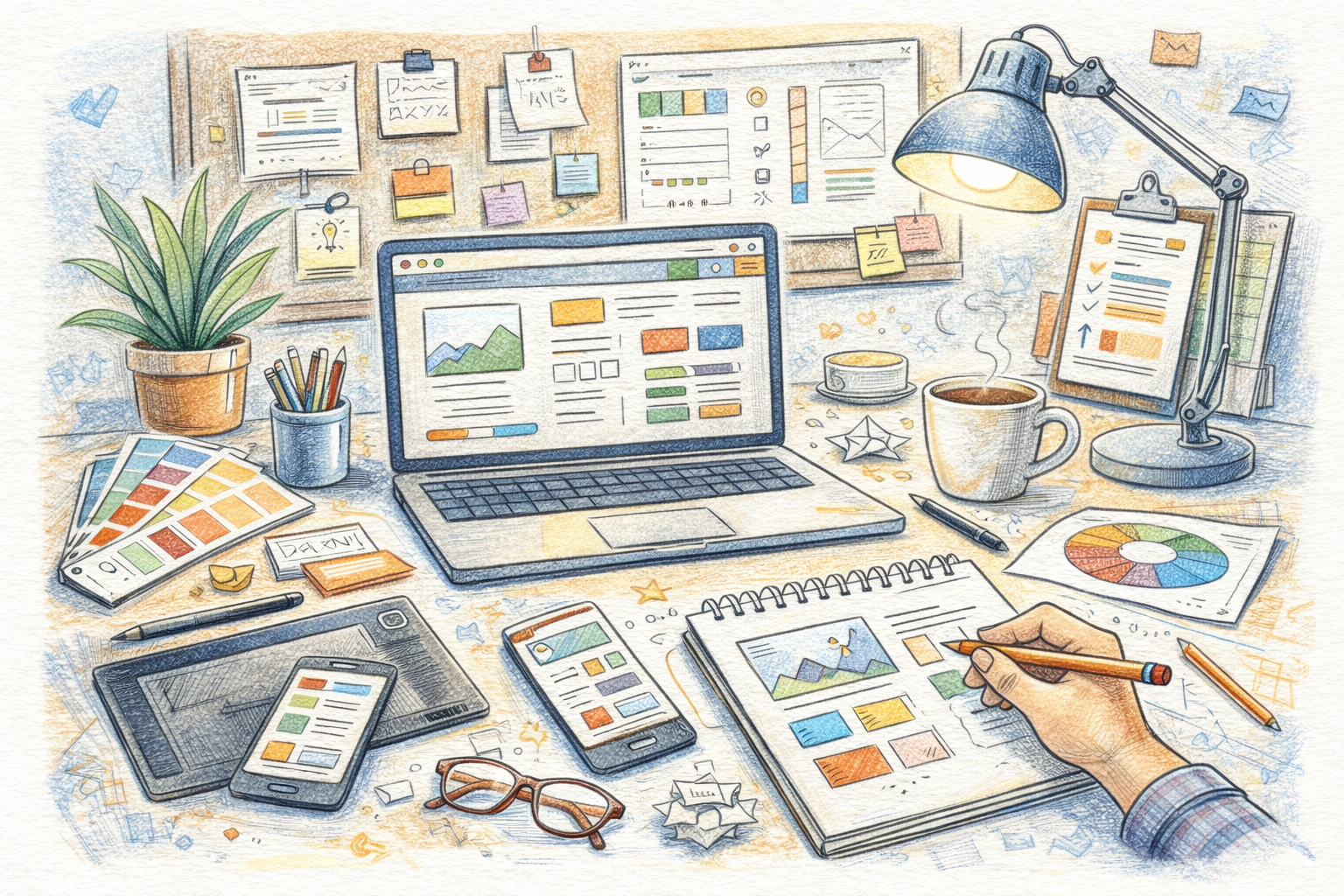
Creativity is often imagined as a lightning strike from the mind, but in practice, it is more like a carefully cultivated garden. The soil, the tools, and the daily tending determine what grows. For designers, this garden is the physical and digital environment in which we work. The monitor setup, the choice of a note taking app, the ritualistic play of a specific soundtrack, these are not mere preferences. They are the active architecture of thought, enabling or constraining the creative process in profound, often unseen ways.
The Physical Stage: The Desk and the Screen
The desk is the primary cockpit of creative work, and its configuration is a direct expression of cognitive priorities.
The Monitor Array as a Mental Model
A single laptop screen promotes deep, linear focus. It is the writer’s setup, forcing a serial procession of tasks. The dual monitor setup, however, creates a spatial distinction between making and referencing. The primary screen hosts the active canvas (Figma, code editor), while the secondary holds the brief, the inspiration, the reference website, or the communication hub (Slack, email). This externalizes working memory, freeing mental RAM for synthesis rather than retention.
The ultimate expression is the three monitor rig: one for the tool, one for the references, and a third often dedicated to the output itself (a live browser preview, a prototype mirror). This setup treats the creative process as a distributed system, with each screen representing a node in a real time feedback loop. The constraint is not mental juggling, but the physical turn of the head.
The Analog Anchor
Amidst the glow of screens, the persistence of physical tools, a notebook and a pen, is telling. The notebook is not merely for notes. It is for the thoughts that are too tentative, too messy, or too diagrammatic for a blinking cursor. The act of drawing a quick flow or circling a word on paper engages a different, more associative part of the brain. It is a pressure release valve for the structured logic of digital tools. The Moleskine or the dot grid notebook is not nostalgia. It is a cognitive tool for pre digital thinking.
The Digital Habitat: Tools as Thought Partners
Our software choices are subscriptions to particular philosophies of work.
The Note Taking App as a Second Brain
The choice between a linear list (Apple Notes) and a networked graph (Obsidian, Roam) is a choice about how you believe ideas connect. The linear list supports execution and capture. The networked graph supports discovery and serendipity, treating each note as a potential neuron that can form unexpected links with others. This tool doesn’t just store ideas. It actively suggests relationships the designer may not have seen, shaping the creative process towards connection.
The Browser Tab Graveyard
The chaotic sprawl of 47 browser tabs is not mere disorganization. It is a tangible map of a research thread in progress. Each tab represents a found reference, a competing product, a color palette, or a code snippet. This chaos is a form of external, visual brainstorming. The ritual of finally bookmarking or saving key tabs to a mood board (in Pinterest, Are.na, or a dedicated Figma file) is the act of distilling inspiration from noise, of moving from open exploration to defined direction.
The Configurable Interface: From Defaults to Dogma
The designer who customizes every keyboard shortcut in Figma, who scripts repetitive tasks in Illustrator, who chooses a stark, minimal code editor theme (like Solarized Dark or One Dark), is doing more than optimizing. They are removing friction at the point of execution to preserve mental energy for the point of conception. A misconfigured tool that requires hunting for a menu is a tiny cognitive tax levied a hundred times a day. The well configured tool disappears, creating the illusion of direct mind to output translation.
The Rituals: The Psychology of Preparation
Creative work requires a transition from the mundane world into a state of flow. Rituals are the on ramp.
The Sonic Cocoon
The specific playlist, the album on repeat, or the ambient soundscape (rain, coffee shop murmur) is a powerful psychological trigger. It serves a dual purpose: it masks distracting external noise, and it cues the brain that it is now in “work mode.” The music often shares a key characteristic: it is familiar and rhythmically consistent without being lyrically demanding. It provides a predictable auditory environment in which unpredictable creative work can happen.
The Ordered Prelude
The ritualistic clearing of the physical desk, the opening and arranging of specific apps in a preset order, the pouring of coffee into a particular mug, these are not superstitions. They are sequenced actions that gradually lower the activation energy required to begin. They automate the preliminary, so willpower can be reserved for the primary creative task. It is a gentle booting up of the creative operating system.
The Forced Interruption: The Walk
Paradoxically, one of the most crucial environmental factors is the deliberate removal from it. The scheduled walk, the aimless pacing, the trip to the coffee shop, these are not breaks from work. They are a change of sensory input that allows the subconscious to process. The solution to a layout problem often appears not while staring at the grid, but while looking at the pattern of trees on the street. The environment, in its absence, continues to work.
The Constraint of Comfort
There is a danger here: that the environment becomes so personalized, so optimized for a specific type of thinking, that it becomes a creative silo. The impeccably minimal desk and the perfectly curated digital workflow can filter out the valuable chaos of random inspiration. The ritual can become a rut.
The most fertile creative environment may therefore be one that balances enabling constraints (a clean workspace, efficient tools, focus rituals) with intentional disruptions (changing the physical location, trying a new piece of software in a limited way, breaking the playlist routine). It is a system designed not for maximum comfort, but for optimal creative friction, the kind that generates heat and light.
In the end, we do not just shape our environments. Our environments, in a continuous feedback loop, shape us and the work we produce. To design is to engage in a constant dialogue with the desk, the tools, and the ritual. The output on the screen is not created in a vacuum. It is the final artifact of a deeply personal, carefully constructed world.
About the Author
Peter Makeshoff
Peter Makeshoff is the founder and main author of Designer Daily.