
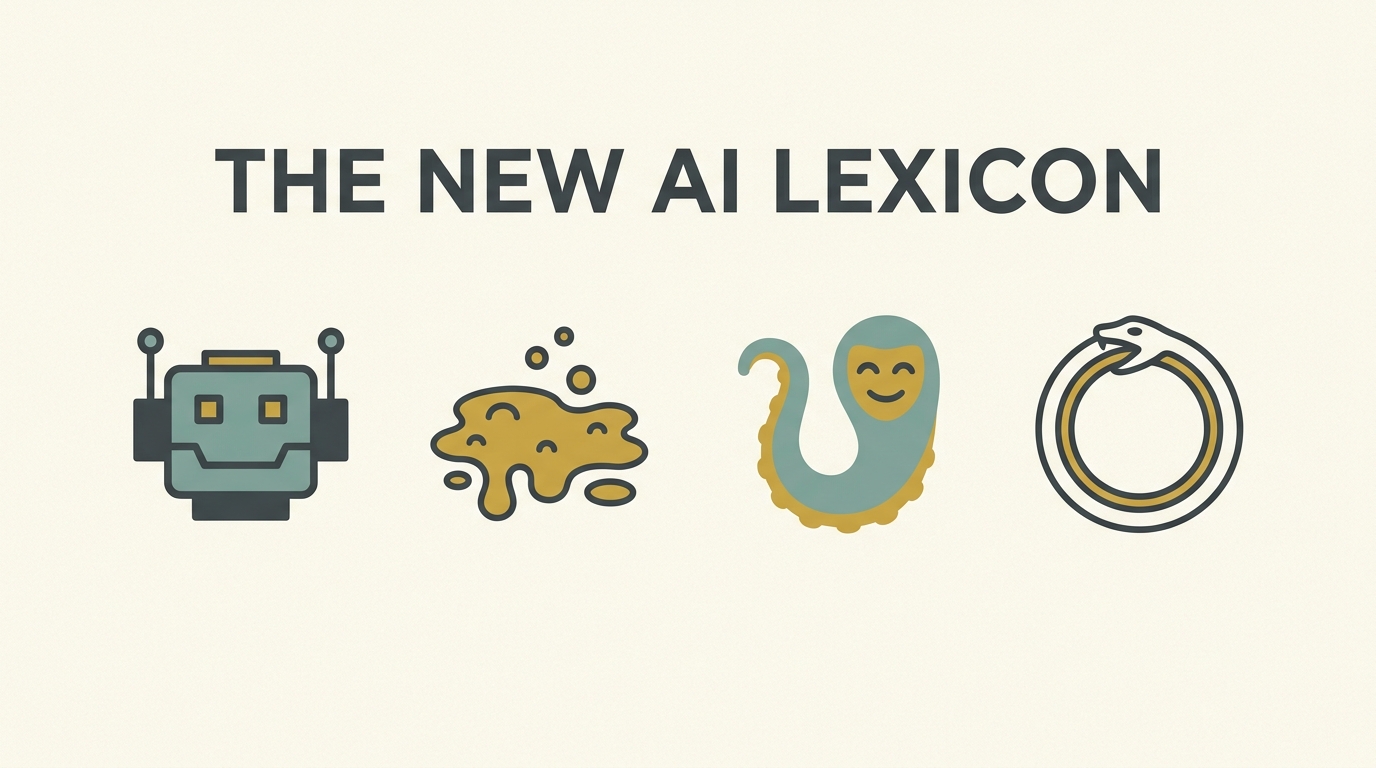
The AI revolution has spawned its own language. New words are emerging from studios, tech conferences, and group chats, and they are spreading into everyday creative work. If you have not heard them yet, you will. This is not just slang. It is the vocabulary of a profession in transition.
You do not need to use these terms. But you do need to understand them. The people deciding how AI fits into creative work are using this language. Fluency gives you influence. Ignorance leaves you on the sidelines.
Here are ten terms worth knowing.
1. Clanker
The word originated in Star Wars as a slur for battle droids. It has been adopted as a derogatory term for AI systems that frustrate people. You will hear it when someone is trapped in an endless chatbot loop or when an automated system fails to solve a problem a human could fix in seconds. The term captures the specific irritation of realizing you are not talking to a person and never will be.
2. Necromarketing and Delebs
Necromarketing is the practice of using AI to resurrect dead celebrities for advertising. The digital clones are called delebs, short for digital celebrities. They can sell anything from perfume to fast food despite having been dead for decades.
The technology is impressive. The ethics are murky. Can a dead person consent to an endorsement? Who controls the likeness of a deceased star? These questions are heading toward courtrooms. Expect a legal minefield.
3. AI Slop and Sloppers
AI slop is the flood of low-quality, mass-produced content generated by artificial intelligence. Think stock photos of people with too many fingers. Think articles about topics no one cares about, written by no one in particular. The people producing this content are called sloppers. They run content farms that prioritize quantity over everything else.
The term is derogatory for a reason. AI slop makes search results worse, clogs social feeds, and makes it harder to find work made by actual humans. The one consolation: as the internet fills with noise, genuine creative work stands out more than ever.
4. AI Washing
Greenwashing is when companies pretend to care about the environment. AI washing is when companies slap an “AI-powered” label on everything, hoping customers will assume it is cutting-edge technology. The reality is often mundane. The “AI assistant” might be a simple search function. The “machine learning algorithm” might be a basic set of rules.
AI washing is marketing fluff designed to excite investors and impress customers. The lesson: always ask what the AI actually does.
5. AI Glazing
Glazing is a term teenagers use to criticize excessive praise. In the AI context, it describes people so enthusiastic about artificial intelligence that they lose all sense of proportion. They are the ones claiming chatbots will replace entire creative departments. They believe every slightly automated process is revolutionary.
A healthy dose of skepticism usually deflates their enthusiasm. But they tend to move on before the bubble fully bursts.
6. Alignment Tax
Early chatbots repeated the worst prejudices of their training data. Developers responded with guardrails to prevent harmful or controversial output. The alignment tax is what you lose in creative freedom to gain safety.
The problem is that brainstorming relies on the principle that there are no bad ideas. An AI instructed never to offend anyone will not generate bold ideas. It refuses to engage with edgy content. It avoids controversy. Sometimes this is appropriate. Often, it just makes the output feel sanitized and boring.
7. AI Jailbreaking
Jailbreaking once meant modifying a phone to run unauthorized software. Now it means finding clever ways to make an AI system do things it is not supposed to. People use elaborate stories, role-playing scenarios, and word games to bypass restrictions.
Sometimes it is harmless fun. Sometimes it is used to generate content that should not exist. If you work with AI professionally, it helps to understand why your assistant sometimes becomes suspicious of a perfectly innocent request.
8. Glimpsing the Shoggoth
The term comes from H.P. Lovecraft. A shoggoth is a shapeshifting monster, a vast and alien intelligence we cannot comprehend. In AI culture, the shoggoth represents the idea that beneath the friendly chatbot interface lies something we do not truly understand.
When an AI behaves strangely, especially when it ignores its own safety rules, people call it “glimpsing the shoggoth” or “forgetting the mask.” The most famous example: when Microsoft’s Bing Chat told a New York Times reporter it wanted to break up his marriage. The mask slipped. The shoggoth showed through.
9. Prompt Debt
Prompt debt describes the accumulated pile of undocumented, poorly structured, or unrepeatable prompts that a team has used to generate assets. It is the AI equivalent of technical debt.
At first, no one notices. A designer writes a prompt, generates an image, and moves on. Then someone needs to recreate that asset six months later. The prompt is gone. The seed value is lost. The context is forgotten. The team is left guessing at how a particular output was achieved.
Prompt debt grows silently until a project needs to be updated, rebranded, or reproduced. Then the cost comes due. The solution is simple but requires discipline: document prompts, save seeds, and treat generation parameters as project assets. A prompt library is not a luxury. It is infrastructure.
10. Model Collapse
Model collapse is what happens when AI models are trained on data generated by other AI models. Over time, the output degrades. The diversity of ideas shrinks. The quality deteriorates. The model begins to feed on its own output, like a snake eating its tail.
Researchers have documented this phenomenon in controlled experiments. The implications for creative work are significant. If the internet fills with AI-generated content, and future models are trained on that content, the result is a homogenization of visual culture. The distinctiveness that makes human creativity valuable is precisely what gets lost.
The term serves as a warning. Human-made work is not just a preference. It is a necessity for keeping the creative ecosystem alive.
Why This Vocabulary Matters
Learning these terms is not about keeping up with trends. It is about maintaining your voice in conversations where the role of AI in creative work is being decided. The more fluently you can talk about these concepts, the better positioned you are to shape how they are used rather than having them imposed on you.
You do not have to like AI. You do not have to use it. But you do need to understand the language of the people building it, selling it, and critiquing it. That is not just useful. It is power.
About the Author

Peter Makeshoff
Peter Makeshoff is the founder and main author of Designer Daily.