
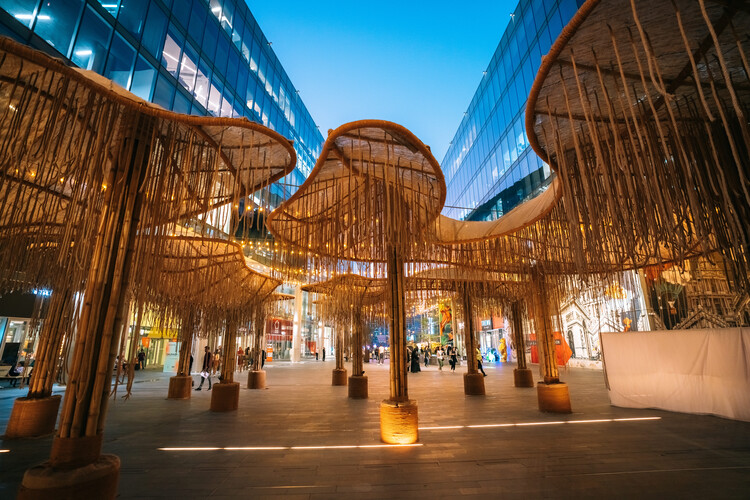
For decades, the design world revolved around London, New York, and Milan. That map is being redrawn. The Arabian Peninsula has emerged as something unprecedented: a region where design isn’t just consumed, it’s being commissioned at a scale and speed that has no parallel.
If you’re a designer considering international expansion, here’s what you need to know about Dubai, Riyadh, and Doha.
The Numbers That Matter
This isn’t cultural tourism, it’s a market shift backed by serious capital:
| Market | Design Agencies Market Size (2024) | Forecast (2033) |
|---|---|---|
| UAE | $12.02 billion | $18.09 billion |
| Saudi Arabia | $8.79 billion | $13.55 billion |
CAGR of 4.6–4.9% through 2033
These figures reflect national visions, Saudi Vision 2030, UAE Centennial, that are actively diversifying economies through culture, tourism, and design.
Dubai: The Experience Laboratory
Dubai has moved beyond spectacle. With 88.5% of its population expatriate, the city is a global test kitchen where design must speak to everyone while feeling like it belongs to no single culture.
What’s driving demand:
- Branded residences and lifestyle districts integrating wellness, coworking, and leisure
- Tourism contributed AED 267.5 billion to GDP in 2025
- Digital nomad influx: UAE ranked second globally for remote workers
The Gensler 2026 forecast notes that workplace supply still lags demand, creative campuses and adaptive reuse projects are where the action is. Resident satisfaction sits at 89%, but cost-of-living pressures (50% satisfaction) point to opportunities in smart density and diverse housing models.
Designer’s edge: Dubai clients understand global trends intimately. They’re looking for fresh perspectives, not translations of Western work.
Riyadh: The Transformation Powerhouse
If Dubai refines, Riyadh transforms. The Kingdom is in the midst of societal re-engineering, with design as its primary tool.
The infrastructure timeline:
- EXPO 2030 (Riyadh)
- FIFA World Cup 2034
- Ongoing giga-project rollouts (Diriyah, Qiddiya, NEOM)
These aren’t future hypotheticals, they’re driving current investment.
Downtown Design Riyadh returned in 2026, its growth “mirroring the rapid expansion of Saudi Arabia’s design market, driven by demand for high-end interiors and bespoke solutions emerging from luxury real estate and landmark developments.”
Global agencies are already in: Imagination established a permanent Riyadh headquarters in 2025, following major projects for Diriyah, Qiddiya, and PIF DevCo. They also launched the Imagination Academy for local talent development.
Designer’s edge: Scale here is unlike anywhere else. The question isn’t “can we afford this?” but “can you deliver at this pace?”
Doha: The Cultural Curator
Qatar plays a different game: slower, intentional, institutionally anchored.
February 2026 marked a turning point:
- Doha Design District hosted “Between the Majlis and the Gallery” at SANAD
- Art Basel Qatar launched its first Middle East edition with 87 galleries from 31 countries
Dana Kazic, director of Doha Design District, puts it simply: “Our ambition is clear: to elevate Doha as a key destination shaping the future of design.”
Designer’s edge: Qatar values depth over speed. If your work carries research, material inquiry, and cultural sensitivity, you’ll find serious institutional support.
Cultural Intelligence: What Works
The region isn’t a monolith. But certain principles hold:
Relationships first. Deals close over coffee, not email threads. Invest time in connection before presenting work.
Context matters. Islamic geometry, calligraphic traditions, and the majlis culture of gathering aren’t decorative tropes, they’re living design languages. Reference them with rigor, not tourism.
Scale is real. Projects that would be decade-long master plans elsewhere are five-year rollouts here. Be prepared for velocity.
Local talent is rising. Agencies like Imagination are investing in Saudi designers through dedicated academies. The goal isn’t parachuting in, it’s building with.
The Bottom Line
Dubai, Riyadh, and Doha aren’t emerging markets for design. They’re the markets, places where cultural capital is being actively built, not just acquired.
For designers willing to do the work, to understand the context, build genuine relationships, and show up with something that speaks to this specific moment, the opportunity isn’t just commercial. It’s the chance to help shape what global design means for the next generation.
The center has shifted. The question is whether you’re paying attention.
About the Author

Peter Makeshoff
Peter Makeshoff is the founder and main author of Designer Daily.