
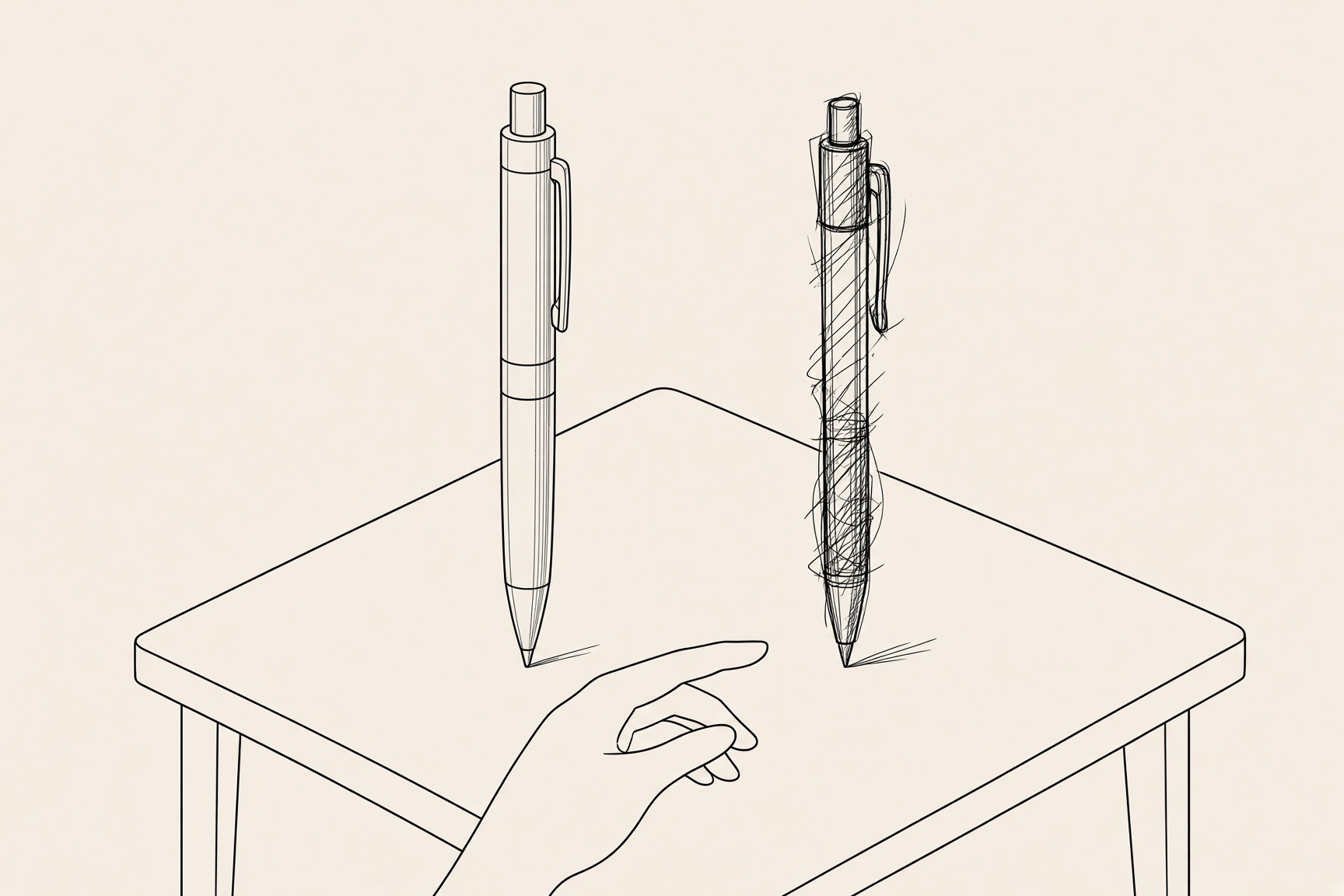
Two objects sit on a table. They serve the same function. They cost roughly the same to manufacture. But one feels expensive. The other feels cheap. The difference is not the price tag. It is the accumulated effect of dozens of small decisions that the user perceives but cannot articulate.
This is the territory of perceived quality. It is the gap between what an object is and what an object feels like. And it is one of the most important concepts in design.
The Weight of Quality
The first thing the hand notices is weight. An object that feels heavier than expected reads as substantial. An object that feels lighter than expected reads as flimsy. This is why manufacturers add hidden weights to products. A gaming mouse with internal weights feels more precise than the same mouse without them. A smartphone with a metal chassis feels more premium than the same phone with plastic.
But weight alone is not enough. The weight must be distributed correctly. A well-balanced object feels anchored in the hand. A poorly balanced object feels awkward and unpredictable. The center of gravity should align with the point of grip. When it does, the object feels like an extension of the body. When it does not, the object feels like a burden.
The Surface
The second thing the hand notices is texture. A smooth, cold surface reads as precise and modern. A warm, textured surface reads as natural and approachable. The choice of material is a statement about the object’s identity.
But the surface is not just about material. It is about finish. A high-gloss finish reads as luxurious but shows every fingerprint. A matte finish reads as understated and hides wear. A brushed finish reads as industrial and feels satisfying to touch. The finish is a promise about how the object will age.
The Resistance
The third thing the hand notices is resistance. A button that clicks with a crisp, definitive action feels precise. A button that mushes through its travel feels cheap. A drawer that slides with a smooth, weighted motion feels well-made. A drawer that rattles and sticks feels poorly made.
Resistance is the conversation between the user and the object. The object tells the user how it works through the way it feels. A well-designed object communicates through touch. It does not need a label to say “press here.” The resistance says it.
The Detail
The fourth thing the user notices is detail. The seam where two parts meet. The alignment of a logo. The tolerance of a fit. These details are often invisible at first glance. But they are felt. A perfectly aligned seam reads as care. A misaligned seam reads as carelessness.
The most expensive-feeling objects are the ones where every detail has been considered. The gap between the button and the case. The sound the lid makes when it closes. The way the packaging opens. These details are not functional. They are signals. They tell the user that someone cared.
The Experience
The fifth thing the user notices is the experience. The object’s behavior over time. Does it wear gracefully? Does it develop a patina? Does it still work after years of use? The object that feels expensive is the object that feels like it will last. The object that feels cheap is the object that feels like it will fail.
The perception of quality is not about the price. It is about the accumulation of signals. The weight, the surface, the resistance, the detail, the experience. Each signal is small. Together, they create a feeling.
The Bottom Line
The object that feels expensive is not the object that costs the most. It is the object that was designed with the most care. The object that feels cheap is not the object that costs the least. It is the object that was designed with the least care.
The designer who understands this can create objects that feel expensive at any price point. They can create objects that feel cheap at any price point. The choice is theirs. The signals are the tools. The perception is the goal.
The next time you pick up an object, notice how it feels. Notice the weight. Notice the surface. Notice the resistance. Notice the detail. Notice the experience. The object is communicating with you. The question is whether the designer was listening.
About the Author

Peter Makeshoff
Peter Makeshoff is the founder and main author of Designer Daily.