
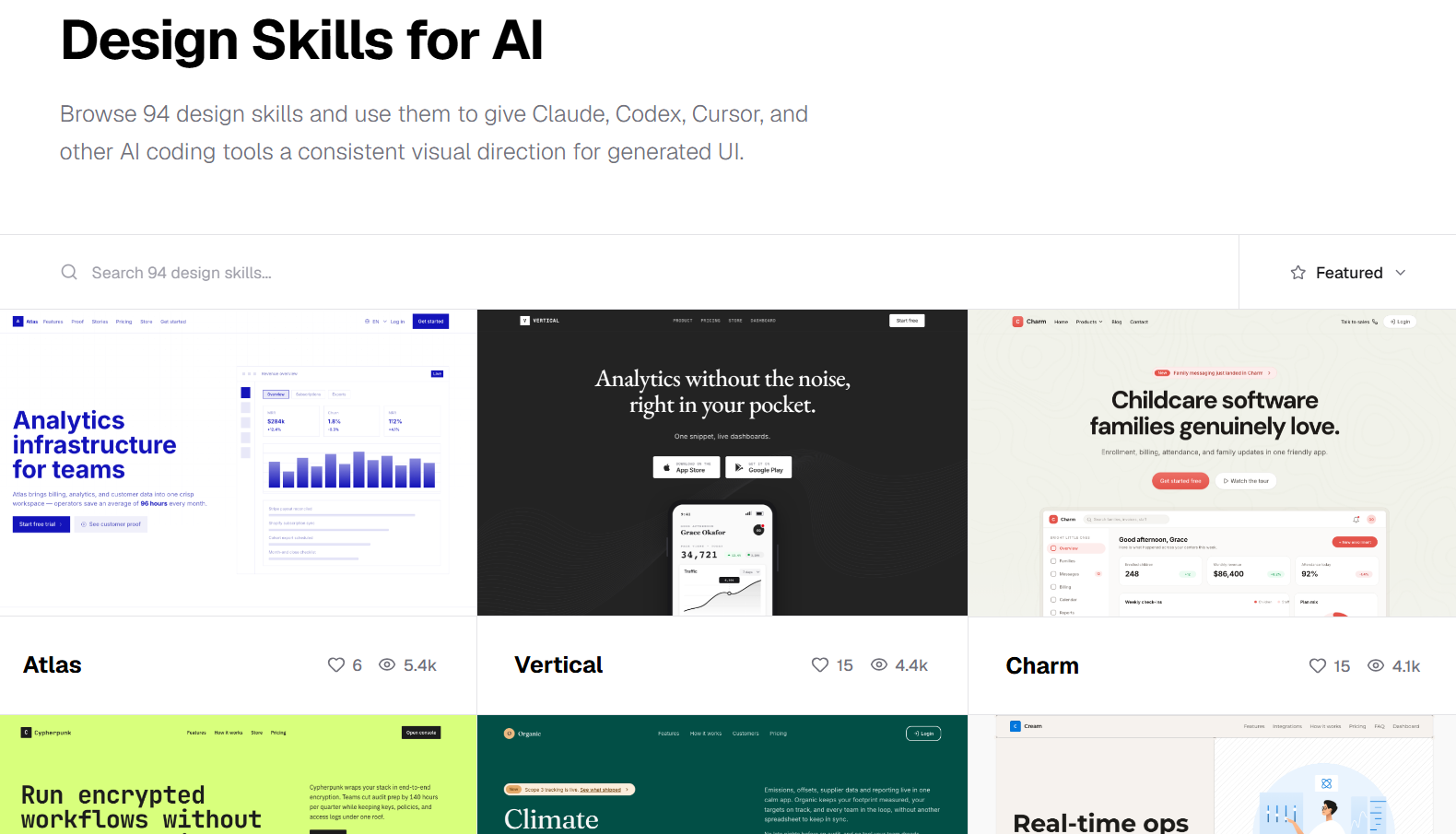
Robert Tanislav, the creator behind TypeUI, has released a massive collection of over 90 design systems specifically engineered to help AI coding tools generate consistent, production-ready interfaces. The collection, available at typeui.sh/design-skills, is the result of more than a decade of design experience distilled into a format that large language models can understand and apply.
The Problem: AI Generates Code, Not Design
AI coding assistants like Claude, OpenAI’s models, and Cursor have become remarkably capable at writing code. They can scaffold a React component, generate a CSS layout, and implement a design in minutes. But there is a persistent gap: the output often lacks consistency. The spacing is inconsistent. The color palette is arbitrary. The components do not follow a unified system.
The reason is simple. AI models are trained on code, not on design systems. They understand syntax and logic. They do not understand why a button should have a specific padding value or why a type scale should follow a modular ratio. They can generate a component. They cannot generate a system.
TypeUI’s design skills are an attempt to solve this problem by teaching AI tools how to think like designers.
What Is a Design Skill?
A design skill is a structured document that describes a design system in a format that AI can parse and apply. Each skill includes the foundational elements of a design system: typography, color, spacing, and layout principles. It includes component definitions: buttons, forms, cards, navigation, and modals. It includes patterns: how components are combined to solve common problems. And it includes guidelines: the rules and constraints that ensure consistency.
This is not a template. It is a specification. When an AI coding tool has access to a design skill, it does not guess at spacing values or color choices. It follows the system. The result is output that is not only functional but visually coherent.
The Scale of the Release
The release includes over 90 design systems. This is not a single system applied to different contexts. It is a library of distinct systems, each with its own visual identity. There are systems for minimal, editorial, brutalist, corporate, playful, and luxury aesthetics. There are systems for dashboards, marketing sites, e-commerce, and documentation.
The scale matters because design is contextual. A design system for a fintech dashboard is not the same as a design system for a fashion e-commerce site. By providing a wide range of systems, TypeUI allows AI tools to generate interfaces that are appropriate for the context, not just consistent.
The Foundation: 10+ Years of Experience
Tanislav notes that the systems are based on “everything we’ve learned over 10+ years designing products used in more than 50 million projects.” This is not a theoretical exercise. It is a distillation of practical experience. The systems reflect the decisions that designers make when building real products, not the abstractions of a design theory textbook.
The four pillars of each system are foundations, components, patterns, and guidelines. This structure reflects how professional design systems are organized. It is also a structure that AI can understand. Foundations define the visual language. Components define the building blocks. Patterns define how the blocks are combined. Guidelines define the rules.
Why This Matters for AI-Assisted Development
The current workflow for AI-assisted development often looks like this: a developer writes a prompt, the AI generates a component, and the developer manually adjusts the output to match the design. This is faster than writing from scratch, but it is not as fast as it could be. The manual adjustment step is a bottleneck.
Design skills eliminate that bottleneck. When the AI has access to a design system, the output is already aligned with the system. The developer does not need to adjust spacing or fix colors. The AI has done the work. The developer can focus on the logic and the functionality.
This is the promise of design skills: they allow AI to generate interfaces that are not just functional but designed. They bridge the gap between code generation and design thinking.
The Broader Context
The release of TypeUI’s design skills is part of a broader movement toward standardizing how AI understands design. The DESIGN.md format, which we covered previously, is another example of this trend. The goal is to create a common language that designers and AI tools can share.
This is not about replacing designers. It is about extending their reach. A designer who creates a design system can now share that system with AI tools, ensuring that the AI generates work that aligns with their vision. The designer’s role shifts from producing every artifact to defining the system that produces the artifacts.
The Bottom Line
TypeUI’s release of 90+ design skills is a significant contribution to the emerging field of AI-assisted design. It provides a practical solution to a real problem: how to make AI-generated interfaces consistent and production-ready. The collection is available now at typeui.sh/design-skills. For developers and designers working with AI coding tools, it is worth exploring.
About the Author

Peter Makeshoff
Peter Makeshoff is the founder and main author of Designer Daily.