
Right-handed people are the default. They are the majority, roughly ninety percent of the population. Their needs are assumed. Their comfort is the baseline. Their perspective is the standard. And because they are the majority, they rarely notice when a design excludes everyone else.
The left-handed, the ambidextrous, and the millions of people with temporary or permanent limitations to their right hand live in a world that was not designed for them. They notice. They notice every single day.
The Scissors Problem
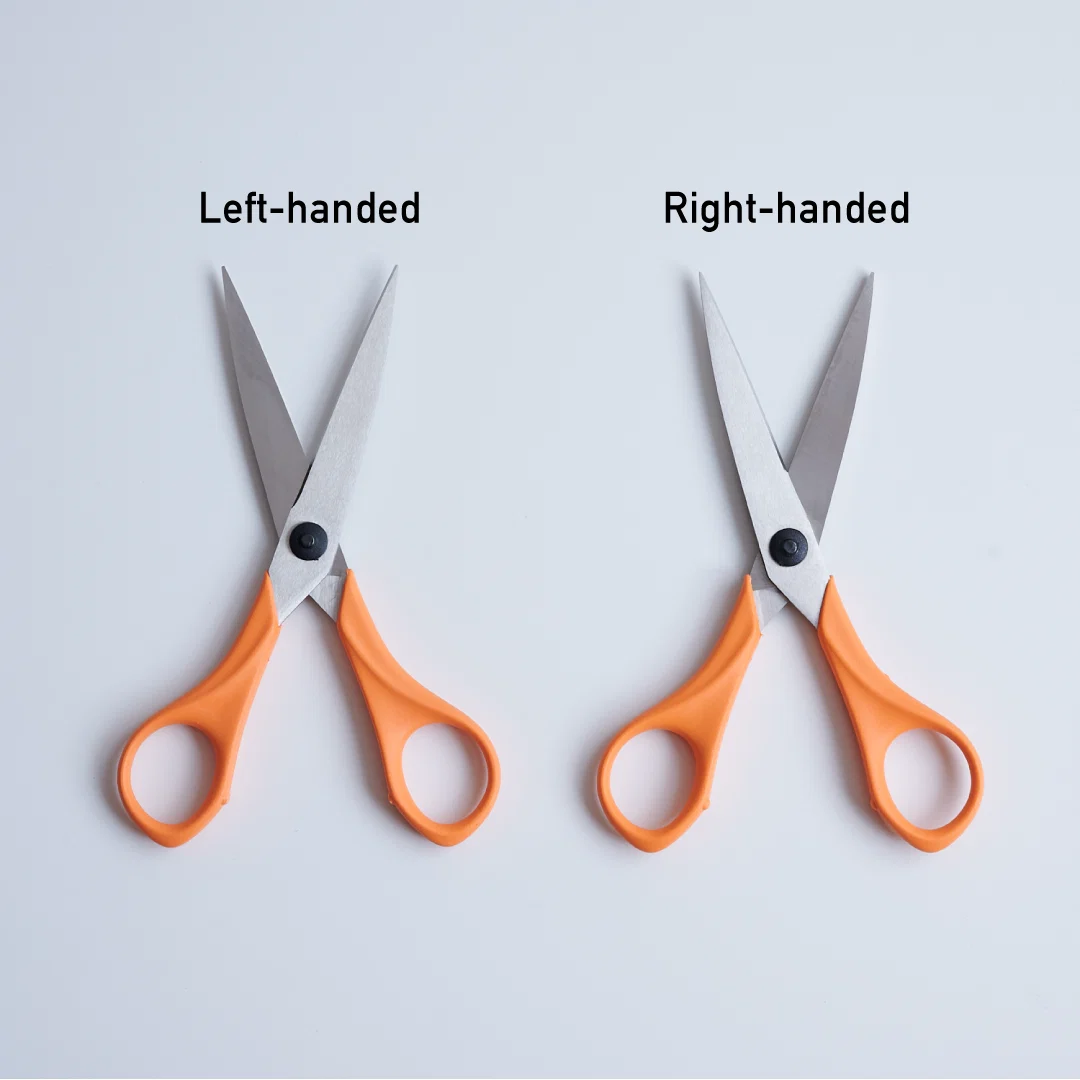
The most famous example of handedness bias is the scissors. Standard scissors are designed for right-handed use. The blades are oriented so that the cutting action is visible to the right-handed user. The handles are shaped to fit the right hand. The thumb controls the upper blade. The fingers control the lower blade.
For a left-handed user, the same scissors are awkward at best and unusable at worst. The cutting line is obscured. The blades separate rather than close. The handles dig into the hand. Left-handed scissors exist, but they are a specialty item, not the default. A left-handed child in a classroom is handed a tool that was not designed for them and told to make it work.
The Everyday Exclusions
Scissors are just the beginning. Consider the mundane objects that shape daily life.
A spiral notebook is designed for the right hand. The spiral binding sits on the left side, allowing the right-handed writer to rest their hand on the page without obstruction. A left-handed writer must either write around the spiral or flip the notebook, which reverses the page order.
A computer mouse is designed for the right hand. The buttons are positioned for right-hand fingers. The shape is contoured for a right-hand grip. Left-handed users must either adapt to the right-handed configuration or remap the buttons, a workaround that is functional but not ergonomic.
A can opener is designed for the right hand. The crank is turned with the right hand while the left hand holds the can. A left-handed user must cross their arms or use their non-dominant hand for the turning motion.
A measuring cup is designed for the right hand. The spout points to the right. A left-handed user pouring from the cup must rotate their wrist awkwardly or pour from the wrong side.
These are small things. Individually, they are minor inconveniences. Collectively, they are a constant reminder that the world was not designed with you in mind.
The Safety Cost
The inconvenience of right-handed design becomes a safety issue in certain contexts.
Power tools are designed for right-handed operation. A circular saw, for example, has the blade on the right side of the motor. A right-handed user holds the saw with their right hand, keeping their body clear of the blade. A left-handed user who uses the saw in their left hand must either reach across the blade or hold the saw awkwardly. The risk of injury is higher.
Kitchen knives are designed with a blade profile that favors the right-handed grip. A left-handed chef using a right-handed knife has less control and more fatigue. Over time, the accumulated strain can lead to injury.
In professional kitchens, workshops, and construction sites, the right-handed bias is not just an annoyance. It is a hazard.
The Digital Default
The digital world is not exempt. Most software interfaces are designed with a right-handed assumption. Menus open to the right. Scroll bars sit on the right. Toolbars are positioned for right-hand access. The mouse is the primary pointing device.
Left-handed users can remap some of these settings, but the default is always right-handed. The assumption is baked into the design.
The Universal Design Failure
The right-handed bias is a failure of universal design. Universal design is the principle that products and environments should be usable by all people, to the greatest extent possible, without the need for adaptation or specialized design.
Right-handed design is not universal. It is majoritarian. It serves the majority and ignores the rest. It treats the needs of the majority as the default and the needs of the minority as exceptions.
The alternative is not to design everything for left-handed users. It is to design for the range of human hands. A can opener that works for both hands. A mouse that is ambidextrous. A notebook that is not hostile to a left-handed writer. A power tool that does not put a left-handed user at risk.
The Bottom Line
Designing for right-handed people is not a conscious choice. It is a default. It is the result of designers not thinking about the people who fall outside the majority.
The lesson is not that right-handed design is malicious. It is that the default is always the majority. The minority is always the exception. And the exception is always an afterthought.
The designer who wants to serve all users must think about the range. Not just the average. Not just the majority. The range. The left-handed. The ambidextrous. The injured. The elderly. The child. The person whose right hand is busy holding a baby, a cane, or a phone.
Design for the range. The majority will still be served. The minority will finally be included. And the world will be a little less frustrating for everyone who was not born right-handed.
About the Author

Peter Makeshoff
Peter Makeshoff is the founder and main author of Designer Daily.