
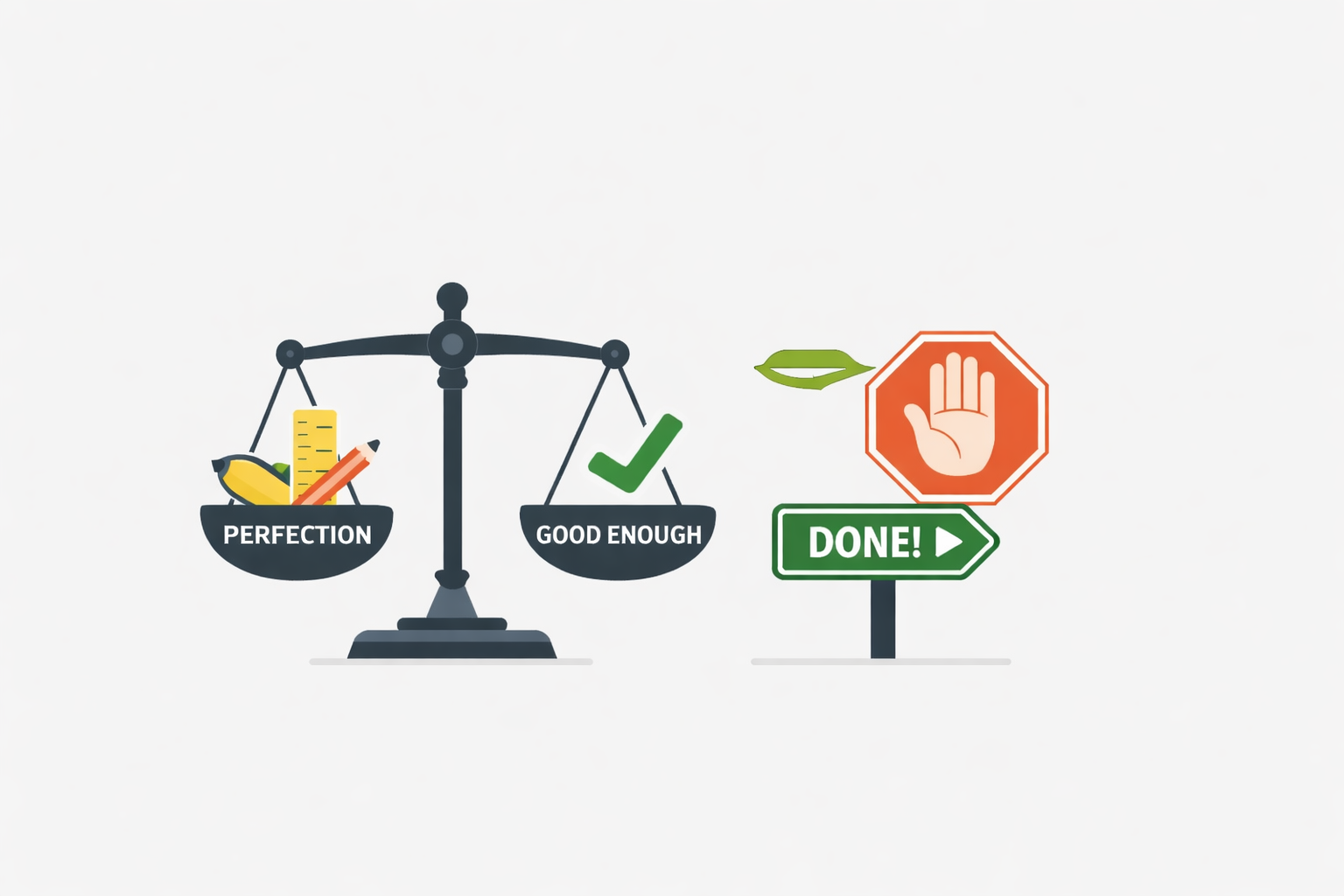
Designing is our craft, and iteration is its engine. We sketch, critique, refine, and tweak. It’s a comfortable, productive cycle. But knowing precisely when to step away from the canvas? That is one of the least taught and most elusive skills in our field. The act of continuing to design can be both a sanctuary and a trap: we refine, we adjust, we “polish.” Sometimes, without realizing it, we are simply deferring a final decision.
The real question isn’t whether to iterate, that’s a given. The question is: at what point does iteration cease to be productive and begin to become a liability?
The Illusion of “Better”
A design project never reaches a state of absolute perfection. It reaches a state of equilibrium. Before this tipping point, every modification yields a tangible gain: improved legibility, a stronger visual hierarchy, a more appropriate response to the user’s context. After this point, changes become a game of diminishing returns; subtle, subjective, and often contradictory.
This is where doubt creeps in. You are no longer solving a defined problem; you are searching for a subjective feeling of “completeness”, a feeling that rarely arrives on cue. The risk is entering a vortex of micro-variations, comparing versions that are functionally identical, and exhausting both the project and the team with no real-world benefit.
Recognizing the Quiet Signals
How do you know when you’ve reached that point of equilibrium? The signs are rarely loud; they are whispers in the workflow:
- Feedback becomes circular. The same points are raised in the third review as were in the first, just phrased differently.
- Changes are matters of taste, not function. You’re adjusting a margin by two pixels or debating a shade of grey that users will never consciously perceive.
- You struggle to articulate the difference. When asked to explain the rationale between Version 24 and Version 25, the justification becomes vague and subjective.
The clearest signal of all is this: when the design already solves the core problem. It functions effectively in its intended context, meets the original brief, and accommodates user needs. Continuing to draw at this stage is no longer a functional necessity; it’s a difficulty in letting go.
Stopping Is Not a Failure
In a culture that often worships the “relentless optimizer,” setting the pencil down can feel like surrender. But it is not. It is an act of profound responsibility.
Design does not exist in a vacuum. It exists in relation to a client, an end-user, and the immutable constraints of production, be it development resources, budget, or time. Saying “this is sufficient” is an act of maturity. It means accepting that the project must now live its own life, independent of its creator. It means trusting the strength of the framework you have built, rather than pinning your hopes on one final, elusive adjustment.
When Iteration Masks the Real Problem
Sometimes, the compulsion to keep designing is a symptom of a deeper issue. Iteration becomes a comfortable escape from a more uncomfortable truth. Are you redrawing because:
- There’s an unspoken disagreement within the team?
- A critical strategic decision hasn’t been made?
- You’re afraid of public exposure and the finality of shipping?
In these cases, producing more versions is not just unproductive; it’s counterproductive. It delays the necessary confrontation. The designer’s most valuable tool in this moment isn’t the stylus, but a clear, direct question: What is really blocking us here? Is this a problem of form, or a problem of decision?
The Silent Skill
Knowing when to stop isn’t a feature in any software. You can’t learn it from a tutorial. It’s a silent skill, honed through experience, through shipped projects, and (most importantly) through the mistakes made on the ones that weren’t.
It is rarely celebrated in portfolio reviews, yet it is arguably one of the most essential traits of a seasoned designer. A project that is “good enough” is not a static, frozen thing. It is a project that is finally ready: ready to be handed off, to be used, to be interpreted, and to exist out in the wild.
Sometimes, the most powerful, decisive, and skillful gesture a designer can make is to simply put the pencil down.
About the Author

Peter Makeshoff
Peter Makeshoff is the founder and main author of Designer Daily.