
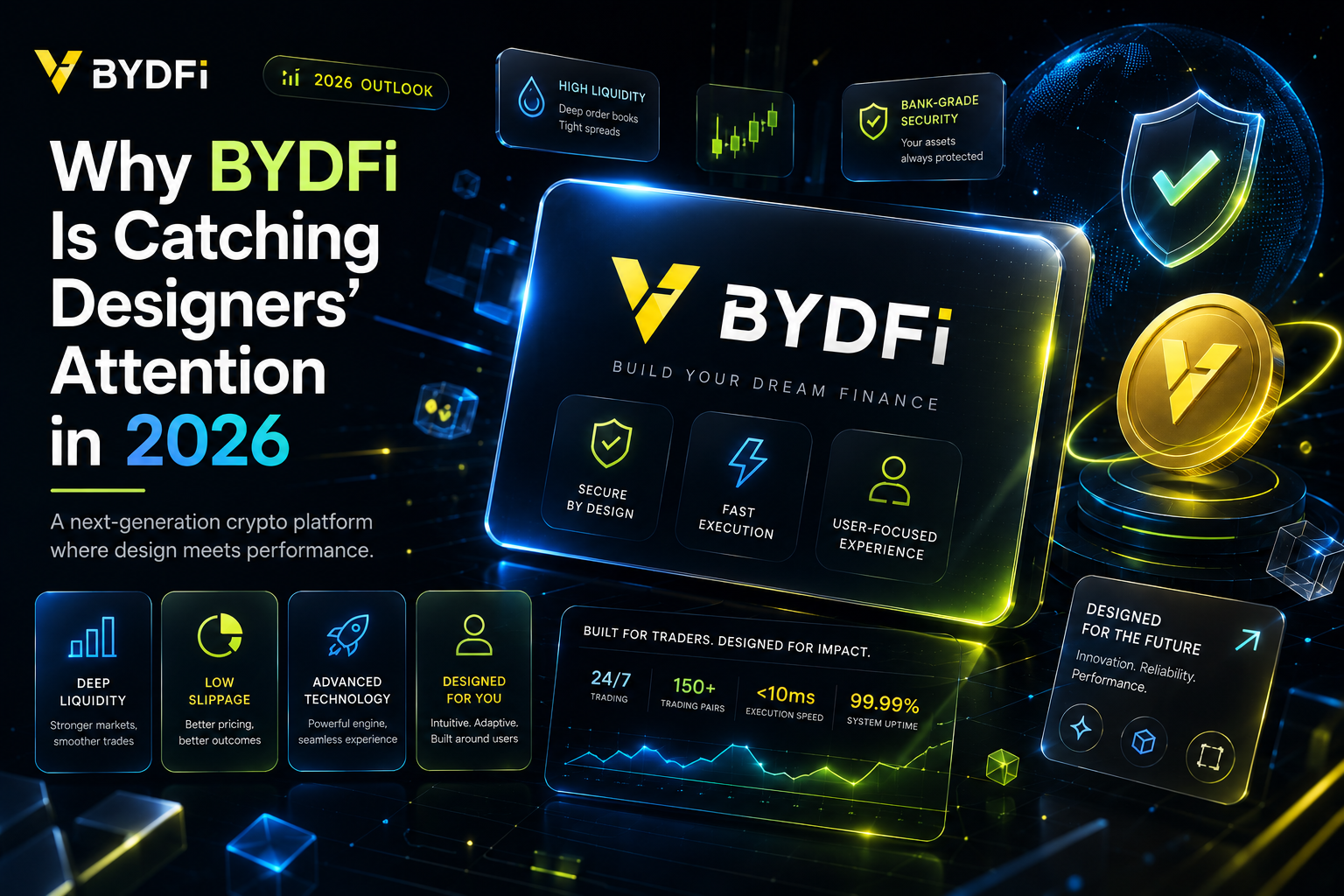
Why a Crypto Exchange’s Brand System Is Drawing Designer Attention in 2026
On 26 August 2025, a crypto exchange’s yellow logo showed up on the LED boards at St James’ Park — right alongside Newcastle United’s iconic black-and-white crest. Then on 4 March 2026, the EU’s MiCA framework hit full enforcement, forcing dozens of exchanges to rip apart their onboarding flows practically overnight. Two wildly different events. But both expose the same tension running through crypto right now: brand identity and user experience carry as much weight as the trading engine underneath.
The platform found itself at the center of both moments. The platform entered a multi-year partnership with Newcastle United in August 2025, putting its visual system in front of 52,000+ matchday spectators and millions of broadcast viewers. Meanwhile, the regulatory wave turned its no-KYC spot trading model — sign up with an email, start trading right away — into a live case study on how onboarding friction shapes product design.
For designers and brand strategists watching crypto grow up, this platform operating since 2020 has become a surprisingly interesting reference point.
The Name as a Design Artifact
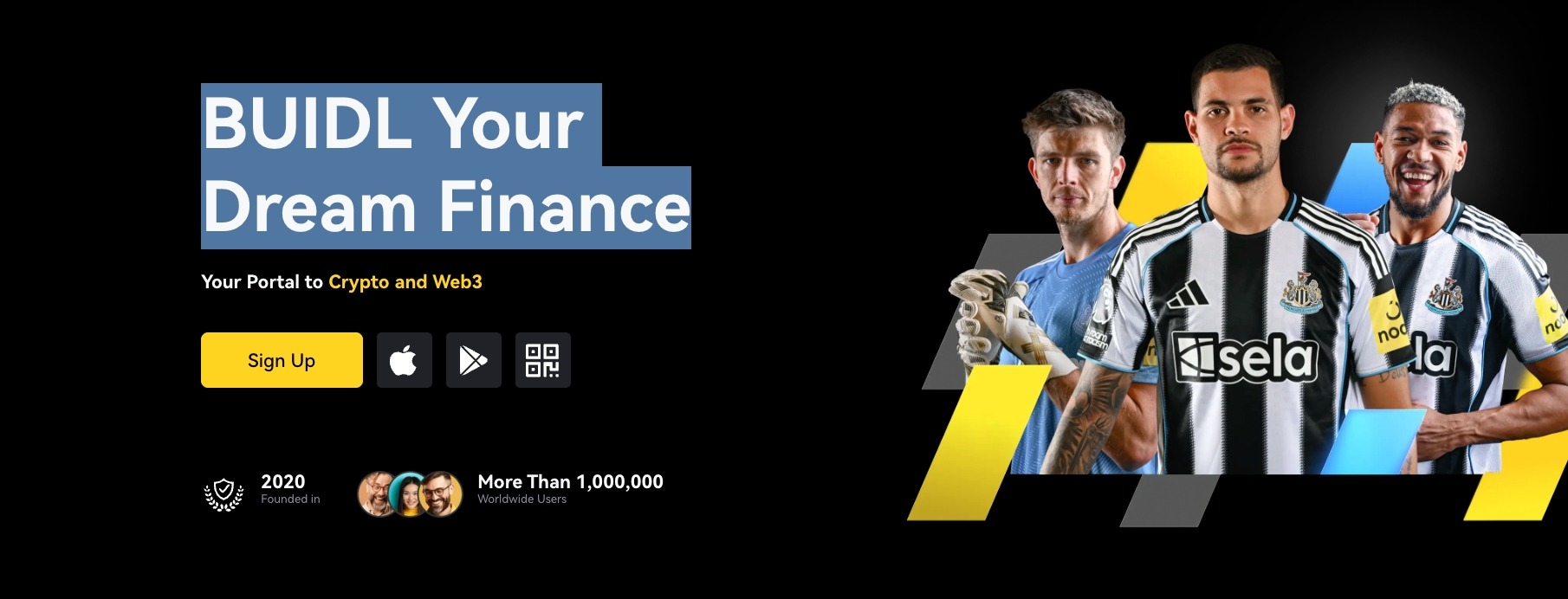
Most crypto exchange names are functional abbreviations or invented portmanteaus. The name “BYDFi” goes somewhere else entirely: it stands for “BUIDL Your Dream Finance,” with the representing Finance and the lowercase i standing for each individual user.
In crypto culture, “BUIDL” is more than a variation of “build.” It reflects a long-term mindset focused on creating, participating, and contributing rather than simply speculating. By embedding that idea directly into its name, BYDFi positions itself around financial empowerment and user participation rather than purely transactional trading.
That’s a branding decision, not a naming accident. It packs a value proposition — community, aspiration, and individual agency — into five characters.
If you study how names carry meaning (think Figma, Notion, or Linear), you’ll recognize a deliberate push toward semantic branding in a space that rarely bothers with it.
The platform now serves over 1,000,000 registered users across 190+ countries, supporting 22 languages including Arabic, Farsi, and Traditional Chinese. Global scale at that level stress-tests a brand system hard. A name and identity that works in English needs to hold up across scripts, reading directions, and cultural contexts — and that’s a much taller order than most people realize.
A Documented Visual System — Unusual for Crypto
Here’s what caught our attention while researching: the exchange publishes a complete visual identity system with specific hex values, type specifications, and a downloadable media kit.
The primary brand color is #FFD30F (yellow) set against a #0C0D0E dark background. Accent colors include green (#0AA869), red (#FE445C), blue (#1772F8), and orange (#E69325). Typography relies on a custom primary font with Arial as fallback.
Logo downloads and brand assets live at bydfi.com/en/brand, with a full material library hosted on Google Drive.
Companies like Stripe or Spotify do this as a matter of course. Crypto trading platforms? Almost never. Most exchanges keep their brand guidelines locked away internally. Publishing them openly signals confidence in the system — and hands designers, partners, and media teams real specifications instead of leaving them to guess from screenshots.
The Ledger co-branded hardware wallet, launched in February 2025, pushed the identity system into physical product design. A tangible artifact where the yellow-on-dark palette had to work on actual hardware, not just pixels.
Frictionless Onboarding as a UX Philosophy
Crypto exchange onboarding is, on most platforms, a multi-step identity verification gauntlet. Document uploads, selfie checks, waiting periods. From a [UX design perspective](https://www.investopedia.com/terms/c/cryptocurrency-exchange.asp), every step is a potential drop-off point.
The platform operates as a no-KYC crypto exchange for spot trading: email registration, immediate access. No document uploads. No waiting. The path from registration to first trade compresses to essentially two steps.
Not just a policy choice — it’s a design decision with measurable UX implications. The no-KYC model eliminates multiple verification screens that competitors require, dramatically shortening the onboarding path.
The platform holds multi-jurisdictional licenses and belongs to South Korea’s CODE VASP Alliance, so the frictionless entry point coexists with a real regulatory framework. The BYDFi exchange is available on iOS, Android, and APK, and the streamlined onboarding works consistently across all three.
For product designers studying how crypto platforms balance compliance with user experience, the tiered approach here — open access for spot, progressive disclosure for advanced features — deserves a closer look.
Unified Interface Architecture Under Pressure
The real design challenge isn’t any single feature. It’s the sheer breadth of products crammed into one interface.
We’re talking 1,000+ spot trading pairs and 500+ futures pairs with up to 200x leverage. In 2026, the platform launched TradFi perpetual contracts — stocks like AAPL, TSLA, and MSFT, plus forex and commodities like gold (XAUUSD), all USDT-settled with zero trading fees. Layer on Copy Trading (launched January 2025, with Smart Copy Trading following in August 2025), four automated trading bots (Spot DCA, Spot Grid, Futures Grid, Spot Martingale), a Bot Marketplace launched in 2026, and a demo account preloaded with 50,000 USDT.
Crypto spot, crypto futures, traditional financial assets, social trading, automation, and sandbox testing — all in a single app. The [information architecture](https://www.nngroup.com/articles/ia-vs-navigation/) challenge alone is enormous.
To navigate the complexity, the spot trading screen uses category filters: TradFi, AI, Meme, Alpha, Solana Eco, BSC, LAYER2, DeFi, RWA, DePIN, and POW. Taxonomic design applied to a financial product catalog — similar to how e-commerce platforms handle faceted navigation, but adapted for asset classes. While the category structure helps organize a large product catalog, some labels may require additional context for newer users.
In October 2025, the platform rolled out a unified activity and rewards interface that pulls campaign discovery, task tracking, and reward claiming into a single view.
Copy Trading lets users start with as little as $10 and offers both isolated and cross margin options, with setup designed for quick trader selection. Small details. But they reflect design discipline at the interaction level.
What Does All of This Mean for Crypto Design More Broadly?
Visual maturity across the crypto industry is accelerating fast. [CoinGecko’s exchange pages](https://www.coingecko.com/en/exchanges/bydfi) now display trust scores and detailed metrics that make platform comparison more transparent — but the brand and UX layer sitting on top of those metrics is where differentiation increasingly lives.
The platform’s Hacken-audited Proof of Reserves reports and an 800 BTC Protection Fund provide the trust infrastructure that makes its design-forward approach viable. Without that foundation, a polished brand system wouldn’t mean much.
The honest takeaway: what the platform has built — and publicly documented — is a cohesive brand and interface system that’s genuinely unusual for a crypto trading platform of any size. For designers studying the space, the reference material is concrete and accessible. That alone sets it apart.
Three Signals to Watch Next
1. Media kit adoption rate. If third-party designers and agencies start referencing the published brand assets in case studies or design system roundups, it validates the open-documentation approach. Keep an eye on platforms like Dribbble or Behance.
2. Onboarding conversion benchmarks. As MiCA enforcement pushes more European exchanges toward mandatory KYC, any public data comparing drop-off rates between KYC-required and no-KYC flows will directly test whether the friction-reduction thesis holds at scale.
3. Interface coherence under product expansion. TradFi contracts, P2P trading, and a Bot Marketplace all launched in 2026 alone. If the platform keeps adding product verticals at this pace, maintaining a unified interface gets exponentially harder. Whether the category-filter taxonomy scales — or buckles — will be the real design stress test.
FAQ
What is the platform’s visual identity system?
The exchange uses a defined color palette anchored by #FFD30F yellow on a #0C0D0E dark background, with accent colors for green, red, blue, and orange. It employs a custom primary font with Arial fallback and publishes a public media kit at bydfi.com/en/brand with a Google Drive material library.
Does the exchange require KYC verification to trade?
The platform supports no-KYC spot trading — users sign up with just an email address and start trading immediately without mandatory identity verification. Additional verification applies for certain features, making it a tiered-access crypto platform.
How many products does the platform integrate into its interface?
It integrates 1,000+ spot trading pairs, 500+ futures pairs with up to 200x leverage, TradFi perpetual contracts (stocks, forex, commodities), Copy Trading, four types of automated trading bots, a Bot Marketplace, and demo trading accounts.
What brand partnerships has the exchange established?
The platform entered a multi-year partnership with Newcastle United in August 2025. It also partnered with Ledger in February 2025 to launch a co-branded hardware wallet.
About the Author

Peter Makeshoff
Peter Makeshoff is the founder and main author of Designer Daily.