
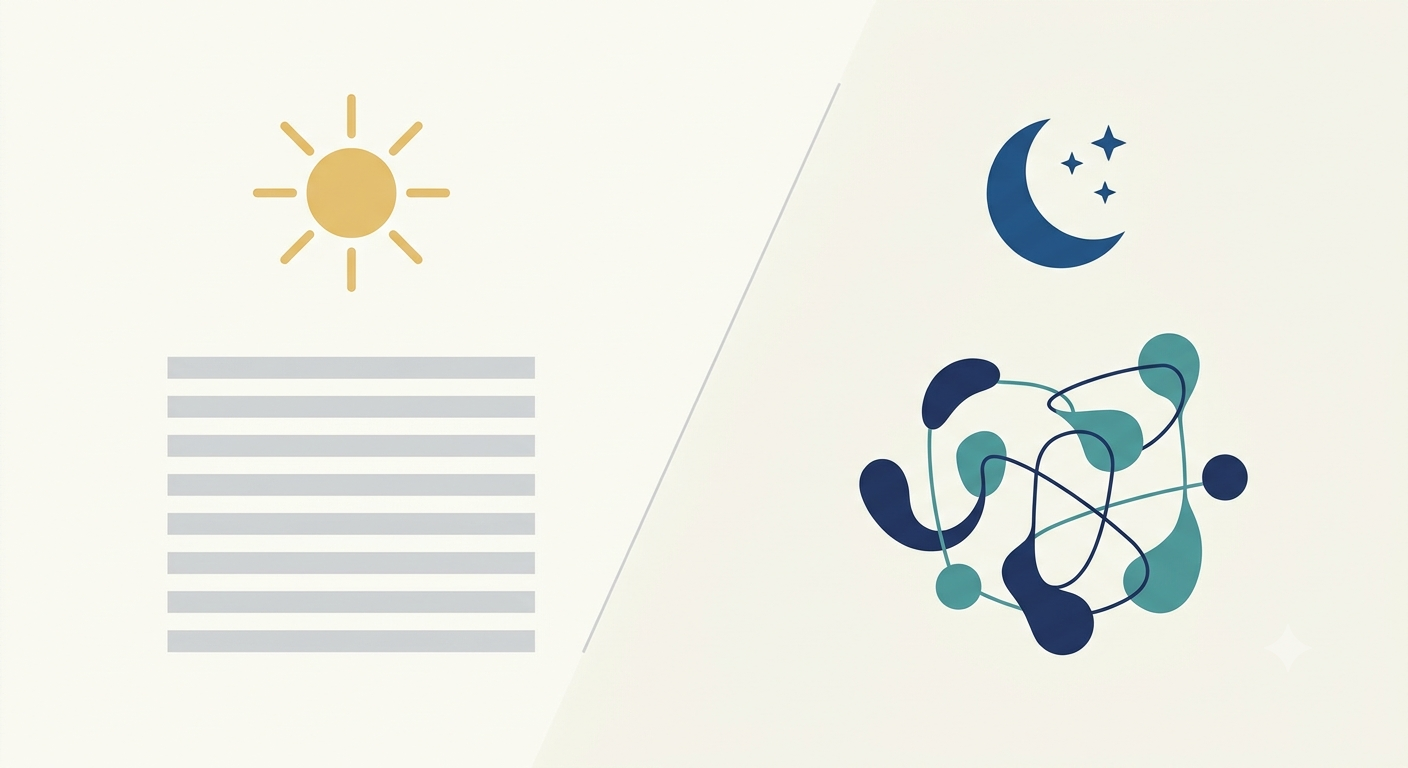
Design is not a neutral activity. The time of day you work shapes the quality of your ideas, the energy of your execution, and the nature of your decisions. Morning people and night owls operate with fundamentally different cognitive states, and these states produce fundamentally different design outcomes.
The Morning Mind
Morning people design with a fresh mind. They have not yet been worn down by decisions, distractions, or fatigue. Their cognitive load is low. Their attention is high. They are capable of deep, focused work.
This is the time for structure. Morning designers excel at layout, hierarchy, and organization. They make precise decisions about typography, spacing, and alignment. They build systems that are coherent and logical.
Morning people design with clarity. They see the big picture before they see the details. They prioritize what matters and set aside what does not.
The Night Mind
Night people design with a tired mind. They have been processing information all day. Their cognitive load is high. Their attention is fragmented. They are less capable of focused work.
This is the time for intuition. Night designers excel at exploration, experimentation, and discovery. They make intuitive decisions about color, texture, and mood. They create work that is emotional and surprising.
Night people design with feeling. They see the details before they see the big picture. They follow associations and make connections that are not obvious. The work is looser, but it is also more alive.
The Trade-Off
Morning work is precise. It is coherent. It is also predictable. The fresh mind follows established patterns. It is less likely to take risks. The work is good, but it may not be great.
Night work is emotional. It is surprising. It is also messy. The tired mind follows unexpected paths. It is more likely to make mistakes. The work is uneven, but it may contain moments of brilliance.
The trade-off is not between good and bad. It is between control and discovery.
The Hybrid Approach
The most effective designers use both states. They structure their day to align with their natural rhythm, but they also create conditions for the opposite mode.
A morning person who wants to tap into night energy can create constraints that force them to explore. Try a new tool. Set a timer. Use a random prompt. The structure disrupts the pattern.
A night person who wants to tap into morning clarity can create conditions that support focus. Start with a sketch. Work without music. Set a single goal. The constraint supports the effort.
The Bottom Line
The time of day you work shapes the work you produce. Morning people design with clarity. Night people design with feeling. Neither is better. Both are necessary.
If you are stuck, change the time. Work when you normally rest. Rest when you normally work. The shift in state will shift the output. The work you produce will be different. It may be what you needed.
About the Author
Peter Makeshoff
Peter Makeshoff is the founder and main author of Designer Daily.