
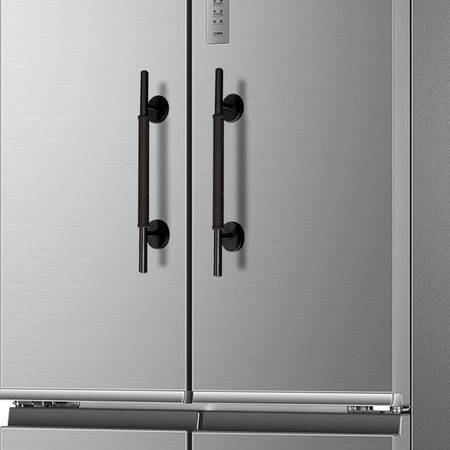
Open your refrigerator. Which side is the handle on? Now think about your kitchen. Where is the fridge positioned relative to the counter, the stove, and the sink? If the handle is on the side that faces away from your workspace, you have experienced a design failure that is remarkably common and remarkably easy to fix.
The refrigerator handle is not a trivial detail. It is the primary point of interaction with one of the most-used appliances in the home. It determines how you open the door, how you access the contents, and how efficiently you move through your kitchen. When it is on the wrong side, every interaction is slightly awkward, and the cumulative effect is a daily irritation that most people cannot articulate but everyone feels.
The Standard Configuration
Most refrigerators are manufactured with the handle on the right side. The door hinges on the left and opens to the right. This configuration is the default because it suits the majority of kitchen layouts. In a typical kitchen, the fridge is positioned to the left of the main workspace, and the door opens toward the counter, allowing the user to transfer items directly from the fridge to the prep area.
But this configuration assumes a specific layout. If your fridge is positioned to the right of the workspace, the default configuration is backwards. The door opens away from the counter, forcing you to walk around the door to access the contents. The handle is on the wrong side.
The Reversible Door
The good news is that most refrigerator doors are reversible. The hinges can be moved from one side to the other, and the handle can be relocated. The process takes about thirty minutes and requires only a screwdriver and a willingness to follow the instructions in the manual.
The bad news is that most people never do it. They live with the wrong configuration for years, unaware that the problem is solvable. The fridge works. The door opens. The food stays cold. The awkwardness is tolerated because it is not recognized as a design flaw.
The Deeper Lesson
The fridge handle is a small example of a larger principle: the default is not always the right choice. The manufacturer’s default configuration is designed for the average kitchen. But there is no average kitchen. There is your kitchen, with its specific layout, its specific workflow, and its specific needs.
The same principle applies to digital design. The default settings in software are designed for the average user. But there is no average user. There is your user, with their specific context, their specific goals, and their specific constraints. The designer who understands this designs for the range, not the average.
The User’s Blind Spot
The fridge handle also illustrates a blind spot in user behavior. People adapt to poor design. They develop workarounds. They open the door with the other hand. They step around the door. They accept the inconvenience as normal.
This adaptation is a survival mechanism. It allows people to function in a world that is not designed for them. But it also hides the design failure. The user does not complain because they do not know they could. They do not ask for a better design because they have forgotten that design could be better.
The designer’s job is to see what the user has stopped seeing. To notice the awkwardness that has become invisible. To ask why the handle is on the wrong side, even when no one else is asking.
The Bottom Line
The fridge handle is a small thing. But it is also a reminder that design is everywhere. It is in the appliances we use every day. It is in the interfaces we navigate without thinking. It is in the systems we take for granted.
The designer who notices the small things is the designer who can fix the big things. The fridge handle is a starting point. Look at your kitchen. Look at your phone. Look at your desk. What is on the wrong side? What has been adapted to? What could be better?
The answer is usually there. You just have to see it.
About the Author

Peter Makeshoff
Peter Makeshoff is the founder and main author of Designer Daily.