
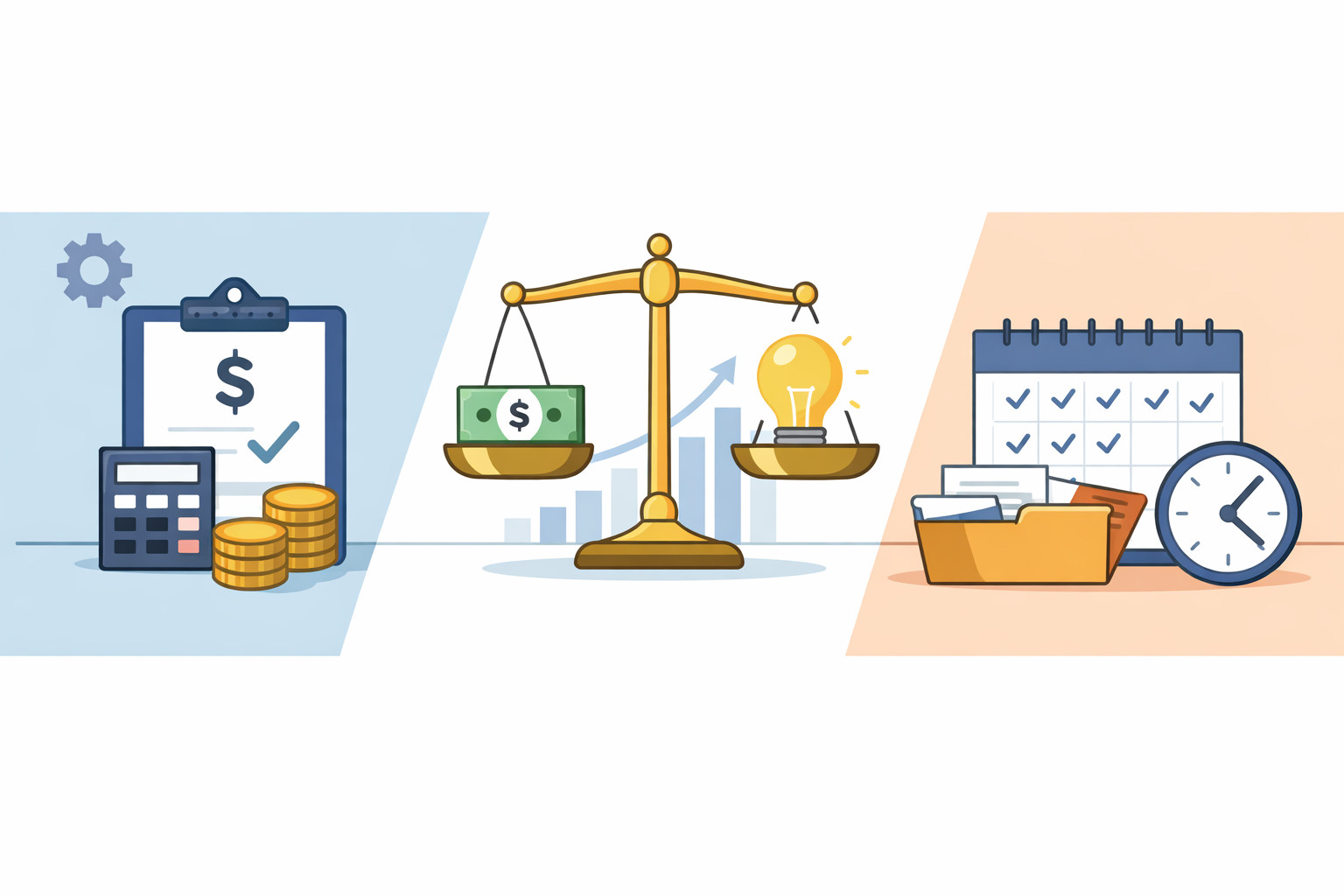
The way agencies price their work is undergoing its most significant shift in decades. The traditional model, charging by the hour, is under pressure from AI-driven efficiency gains, procurement scrutiny, and a fundamental question from clients: “What am I actually getting for this?”
This guide breaks down the four main pricing models available to design agencies in 2026, with current data on what clients prefer, what maximizes profitability, and how to transition from hourly billing to the holy grail of agency economics: value-based pricing.
The Four Pricing Models at a Glance
| Model | How It Works | Best For | Profit Potential |
|---|---|---|---|
| Hourly | Fixed rate per hour of work | Freelancers, ad-hoc tasks, unpredictable scope | Low (punishes efficiency) |
| Fixed Fee | Single price for defined scope | Branding, websites, campaigns | Medium |
| Retainer | Monthly fee for ongoing services | Ongoing support, growth partnerships | High (recurring revenue) |
| Value-Based | Price tied to client outcomes | Strategic work with measurable impact | Very high |
Model 1: Hourly Billing – The Starting Point
How it works: You charge a fixed rate per hour of work. Track your time, multiply by your rate, invoice the total.
Best for: Freelancers in their first year, ongoing support work where scope is genuinely unpredictable, and ad-hoc tasks that don’t fit a project scope.
- Junior designer: £40–£60 per hour
- Mid-level designer: £60–£90 per hour
- Senior designer/strategist: £90–£150 per hour
- Creative director: £120–£200 per hour
- Freelance/small studio: $50–$100 per hour
- Mid-size agency: $100–$200 per hour
- Premium agency: $200–$350+ per hour
Why Agencies Outgrow Hourly Pricing
Hourly pricing punishes efficiency. The better you get at your craft, the less time it takes, and the less you earn. A logo that took 20 hours in year one takes 5 hours in year five. Your skill increased. Your revenue per project dropped by 75%.
Hourly pricing also creates an absolute ceiling. There are only so many billable hours in a week. If your rate is £80 per hour and you bill 30 hours a week, your maximum annual revenue is about £125,000. No amount of skill improvement changes that math.
Perhaps most damningly, Sir Martin Sorrell, Executive Chairman of S4 Capital, recently stated that generative AI is sharply cutting the time needed for creative production, directly challenging the time-based billing approach. He argues agencies “have to shift to output-based pricing, charging clients on the number of assets produced, not the number of hours it took to produce it”.
Use hourly pricing to learn your workflow and understand your costs. Then move on.
Model 2: Fixed Fee (Project-Based Pricing)
How it works: You quote a fixed price for a defined scope of work. The client pays the same regardless of how long it takes you.
Best for: Defined deliverables with clear scope, branding projects, website builds, campaign creation. Any work where you can predict the effort within a reasonable range.
Typical UK project ranges (2026) :
- Logo design: £500–£2,000 (solo), £2,000–£8,000 (agency)
- Brand identity package: £3,000–£15,000
- Website design and build: £3,000–£25,000
- Campaign creative: £2,000–£10,000
US project ranges (2026):
- Squarespace Circle members’ lowest-priced website projects averaged $2,160, with highest averaging $8,179
- UI/UX projects: $10,000–$200,000+ depending on complexity
- Clutch data shows average UX agency project at $84,973 over 10 months
How to Price Projects Correctly
Do not calculate your hours and multiply by your rate. That is just hourly pricing with a fixed number on top.
Instead, price based on three factors :
- Your cost of delivery: What will this actually cost you in time, tools, and team?
- The market rate: What are comparable agencies charging for similar work?
- The value to the client: What is this work worth to their business?
Start with your cost of delivery to set the floor. The market rate tells you where the middle is. The client’s value tells you where the ceiling is.
The Win Rate Test
Track every proposal. If you are winning more than 70% of your quotes, your prices are too low. You should be testing the ceiling constantly.
With every major project one agency won, they increased the quote on the next comparable project by £500 or £1,000. They kept doing this until someone said no. Not scientific, but effective.
Scope Creep Prevention
Project pricing only works if you define the scope clearly. Include in every proposal :
- Exactly what is included (deliverables, revision rounds, formats)
- Exactly what is excluded
- What happens when the client requests additional work
- A clear change request process
Without these boundaries, fixed-price projects become unlimited-scope disasters.
Model 3: Monthly Retainers – The Revenue Foundation
How it works: The client pays a fixed monthly fee for ongoing services. The scope is defined per month rather than per project.
Best for: Ongoing design support, marketing management, website maintenance. Any service where the client needs regular access to your skills.
Typical UK retainer ranges (2026) :
- Basic support retainer: £400–£800 per month
- Growth and strategy retainer: £800–£2,000 per month
- Full-service retainer: £2,000–£5,000+ per month
US retainer ranges (2026):
- Graphic design: $1,500–$5,000 per month
- Small business basic needs: $500–$1,000 per month
- Active marketing needs: $3,000–$8,000 per month
The Retainer Tier Model
Not all retainers should offer the same thing. Separate your offering into two tiers :
Support tier: Reactive work. Bug fixes, small updates, keeping things running. Lower price point. No strategy, no accountability.
Scale tier: Proactive work. Monthly reviews, strategic recommendations, improvement roadmap. Higher price point. You are accountable for results.
The distinction prevents the most common retainer problem: clients expecting strategy at support prices.
Building a Retainer Base
The single most important thing retainers do for your agency is create a revenue floor. If your monthly fixed costs are £15,000 and your retainer base covers £12,000, you only need to sell £3,000 in project work to break even. That changes every decision you make.
Start by offering retainers to your best project clients after delivery. “We’ve built this for you. To maintain it and keep improving it, we recommend our monthly support plan.” The transition from project to retainer should feel natural, not like a new sales conversation.
The Workstream-First Approach
For new clients, do not lead with a retainer proposal. Lead with a defined project (workstream) at £2,000–£3,000 that fixes their most pressing problem. Complete it in 2–4 weeks. Then transition to a retainer.
This prevents the month-one overdelivery problem. If you sell a retainer first, you spend the first month doing foundational work that should have been a separate project.
Model 4: Value-Based Pricing – The Holy Grail
How it works: You price based on the commercial outcome the work creates for the client, not the time it takes or the deliverables involved.
Best for: Brand strategy, repositioning, strategic consulting. Work that directly affects the client’s revenue, margins, or valuation. Established agencies with strong case studies and proven results.
How it differs: A website redesign priced at £8,000 is project pricing. The same website redesign priced at £25,000 because the client’s current site is losing them £200,000 per year in missed conversions is value pricing. The deliverables are the same. The price reflects the impact.
Why Value-Based Pricing Is the Future
Squarespace’s 2026 industry report found that US-based designers who use AI to help design sites earn roughly 21% more annually than those who don’t. This efficiency gain should flow to the agency’s bottom line, but only if you’re not charging by the hour.
The Value Alchemists, a consultancy specializing in value-based transformation, reports that their clients typically achieve :
- 13% average price increase with little to no loss of customers
- 46% profit margin growth through combined pricing and operational changes
- 97% customer retention
How to Have the Value Conversation
You need to understand three things before quoting :
- What is the problem costing them? “How much revenue do you estimate you’re losing because of [the problem]?”
- What is the value of solving it? “If this was fixed, what would the impact be on your business over 12 months?”
- What have they budgeted? “What range have you set aside for this project?”
One agency’s brand work helped a client grow from £50M to £60M in the year after rebranding. While their delivery was just one element of the client’s overall business change, the commercial framing justified a premium price.
When Value Pricing Goes Wrong
Value pricing does not work when :
- You cannot quantify the impact
- The client is buying a commodity (they will compare you on price)
- You do not have case studies proving the outcomes
- The client does not think in commercial terms
Do not force value pricing on every project. It works for strategic work with measurable outcomes. For routine production work, project pricing is still the right model.
What Clients Actually Prefer
Squarespace’s survey of 1,034 creative professionals reveals that 90% of designers price on a per-project basis for at least some of their work.
But client expectations are shifting. The Savage Sentiment Survey 2026 indicates :
- Budgets are tighter
- Approvals take longer
- There is greater scrutiny on value and outcomes
- Clients are actively choosing smaller agencies for senior input, transparency, and true partnership
Chris Savage notes that agencies who confidently articulate the outcomes they deliver are better placed to protect their fees and have more balanced client relationships.
The ProCreator blog emphasizes that many businesses still treat design agencies as a cost center rather than a revenue lever, a “mindset that is expensive.” Great design impacts conversions, retention, and long-term scalability.
ROI Metrics That Justify Premium Pricing
When clients question your fees, these statistics help :
- Well-designed UI alone can increase conversions by 200%
- Companies investing just 10% of development in UX report an 83% rise in conversions
- 72% of customers share positive brand experiences with at least 6 other people
- Early UX research can save 33–50% in development time
- 94% of users cite poor design as their main reason to distrust a website
The Transition Framework: Moving Up the Pricing Ladder
Most agencies use a mix of models simultaneously. Here is the typical progression :
| Stage | Primary Model | Focus |
|---|---|---|
| Year 1–2 | Hourly | Learning workflow, understanding costs |
| Year 2–4 | Project-based | Capturing efficiency gains |
| Year 3–5 | Retainers | Building recurring revenue |
| Year 5+ | Value-based | Premium strategic work |
You do not abandon earlier models as you add new ones. A mature agency might price strategy engagements on value, production work on project rates, and ongoing support on retainers. The skill is knowing which model fits which situation.
Insights from Architecture: Transparency as a Tool
The architecture profession offers valuable lessons on fee transparency. The Royal Architectural Institute of Canada advocates for :
- Quality-based selection: Choosing teams on qualifications, competence, and relevant experience
- Scope-aligned fees: Matching fees to defined scope, deliverables, risk, and schedule
- Clarity and accountability: Using clear contracts and measurable deliverables
Work Program Architects, a Virginia-based firm, has taken transparency further with an “open-books policy” including full pay transparency. Salaries are openly shared among employees, from junior designers to principals.
This approach allows employees to see how revenue, expenses, and salaries interconnect, providing a clearly defined pathway for growth and linking responsibilities to compensation. The result? Stronger employee satisfaction, better retention, and a culture of trust. For agencies, the lesson is that transparency, with both clients and your team, can be a competitive advantage, not a vulnerability.
The Pricing Conversation: A Simple Framework
The biggest barrier to better pricing is not the market. It is the conversation. Most agency owners avoid talking about money because it feels uncomfortable.
- Understand before quoting. Never price before a discovery conversation. You need to understand the scope, the timeline, the value, and the budget.
- Present options. Give two or three options at different price points. This shifts the conversation from “yes or no” to “which one.”
- State the price confidently. If you flinch when you say the number, the client will flinch too. Practice saying your price out loud until it feels natural.
- Let them respond. After stating the price, stop talking. The silence feels uncomfortable but it gives the client space to process.
What to Do This Week
- Calculate your effective hourly rate. Take your revenue from last month. Divide by the total hours worked (not just billable hours). If the number is lower than your target hourly rate, your pricing model needs work.
- Identify one project to reprice. Look at your most recent quote. Could you have charged 20% more? 50%? What would need to change in the proposal to justify the higher price?
- Start tracking win rates. Log every proposal you send and whether it was won or lost. In 3 months, you will have the data to know whether you are pricing too low.
- Review current pricing adequacy. Ask yourself: “When did I last increase prices?” The Value Alchemists note that UK inflation has ranged from 1% to almost 8% in recent years, if you haven’t increased prices accordingly, profitability is eroding.
The Bottom Line
There has not been one agency owner so far who is overcharging for their work. The question isn’t “how long will this take?” It’s “what is this worth to the client?”
Proper pricing reflects actual value delivery. You are not exploiting clients. You are being honest about what you are worth.
The shift from hourly to value-based pricing is not just about making more money. It’s about aligning your incentives with your client’s success. When you price based on outcomes, you become a partner in their growth, and that is a relationship worth paying for.
About the data: Pricing ranges in this article are compiled from UK and US sources active in 2026. Actual rates vary by location, expertise, and project scope. Use these figures as benchmarks, not absolute standards.
About the Author

Peter Makeshoff
Peter Makeshoff is the founder and main author of Designer Daily.