
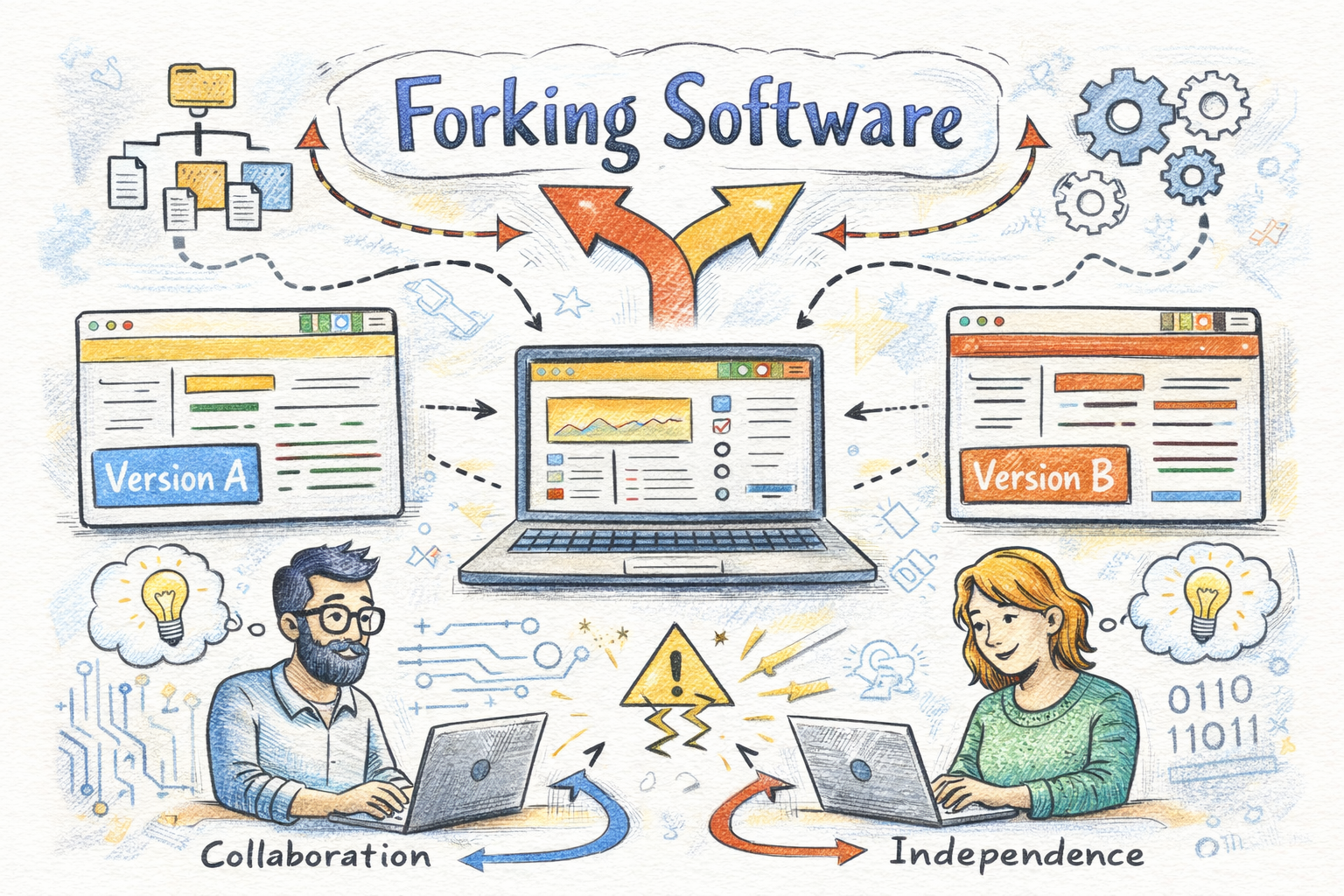
In software, a fork is not a failure. It is a feature. When developers encounter an open-source project that solves 80% of their problem, they don’t plead with maintainers to change it. They fork it. They copy the codebase, adapt the remaining 20% to their exact needs, and move forward. This creates a vibrant ecosystem of shared foundations and specialized solutions.
Now imagine applying this philosophy to design systems. What if instead of treating deviations as heresy, we built systems that were engineered to be intelligently forked and adapted? This is designing for forkability. It acknowledges a fundamental truth: one size never fits all, and centralized control often becomes a bottleneck to innovation.
The Problem with the “Single Source of Truth” Monolith
Most design systems are built as centralized platforms. They promise consistency but often deliver rigidity. When a product team needs a component that behaves slightly differently—a date picker for a complex scheduling tool versus a simple form—they face a dilemma:
- Request and Wait: Submit a ticket to the central design system team and halt their project.
- Hack and Hide: Override styles with !important flags or build a shadow component, creating technical debt and inconsistency.
- Rebel and Rebuild: Build their own component from scratch, fragmenting the system.
Forkability offers a fourth path: Adapt and Contribute.
The Pillars of a Forkable Design System
1. The Clear Core/Plugin Architecture
Like a strong open-source kernel, the system must distinguish between:
- The Immutable Core: Foundational rules that ensure basic interoperability. This includes the token architecture (color, spacing, typography primitives), accessibility standards, and core interaction patterns. These are the “physics” of the system. You don’t fork gravity.
- The Plugins (or Adaptable Modules): Product-specific components and patterns. These are built with core tokens but can be forked and modified. A
DataTablefor an admin dashboard and aDataTablefor a marketing report might be different forks of the same base component.
2. Documentation as a Contribution Guide, Not a Rulebook
Traditional documentation says, “Here is how you use this component.” Forkable documentation says:
- “Here is the philosophy behind this component.”
- “Here are the core tokens and APIs you must maintain if you fork it.”
- “Here is how other teams have forked it for their use cases (with links to their repositories).”
It becomes a living map of the ecosystem, not a set of commandments.
3. Tooling for Synchronization, Not Enforcement
Instead of linters that block builds for deviations, forkable systems offer tooling that enables managed divergence:
- Automated Forking Scripts: A CLI command that creates a new, namespaced version of a component (e.g.,
create-fork @core/button --name @billing/button). - Update Streams: The ability to subscribe to updates from the “upstream” core component. Teams can choose to merge security or token updates from the core while keeping their functional adaptations.
- Registry Browsers: Internal tools that visualize the network of forks, showing what is available and how components relate.
The UX of a Forkable System: A New Workflow for Product Teams
- Discover: A team needs a complex, multi-step form wizard. They browse the registry and find the core
@system/formcomponent. - Evaluate: They see it handles basic validation and layout. The documentation explains its token structure and state machine logic.
- Fork: They run
design-system fork @system/form --target @checkout/wizard. This creates a copy in their team’s namespace. - Adapt: They modify the fork to add progress tracking, save-and-resume logic, and specific validation for their billing flow. They use the same core tokens, so it still feels coherent.
- Optional Contribute: If their innovation is broadly useful (e.g., the save-and-resume logic), they can submit a pull request back to the core as a proposed enhancement.
The Benefits: From Bottleneck to Ecosystem
- Speed: Teams are unblocked. They can adapt immediately to user needs.
- Innovation: Experiments happen at the edges. The best adaptations can be pulled back into the core, improving it for everyone.
- Scale: The central team shifts from being gatekeepers to being platform engineers and stewards. They maintain the core, curate contributions, and facilitate sharing.
- Ownership: Product teams gain true ownership of their UI, leading to better care and maintenance.
The Challenges and Guardrails
Forkability is not anarchy. It requires strong guardrails.
- The Core Must Be Rock Solid: If the foundational tokens and patterns are poorly designed, forks will magnify those flaws.
- Namespacing is Non-Negotiable: Every fork must be clearly labeled (e.g.,
@team/component) so its origin and maintainer are always known. - The “Cost of Fork” Must Be Understood: Teams need to know they are taking on long-term maintenance of their fork. The tooling should make this explicit.
- Accessibility Must Be Inherited, Not Optional: The core must bake accessibility into its contracts, so forks cannot easily break it.
A Cultural Shift: From Consistency to Coherent Diversity
The ultimate goal shifts. We are no longer chasing pixel perfect consistency across every screen. We are building coherent diversity. Interfaces across different products and teams should feel like they speak the same language, even if they use different dialects. They share a common foundation, a similar rhythm, and a mutual understanding, while being optimized for their unique contexts.
Designing for forkability embraces the reality of product development. It trusts teams as experts in their own domains. It builds systems that are resilient, not fragile. It treats the design system not as a finished product, but as a collaborative, evolving codex—a shared starting point for a hundred different, brilliant journeys.
In doing so, it moves the design system from being a department that says “no,” to being a platform that empowers teams to say “yes, and here is how.”
About the Author

Peter Makeshoff
Peter Makeshoff is the founder and main author of Designer Daily.