
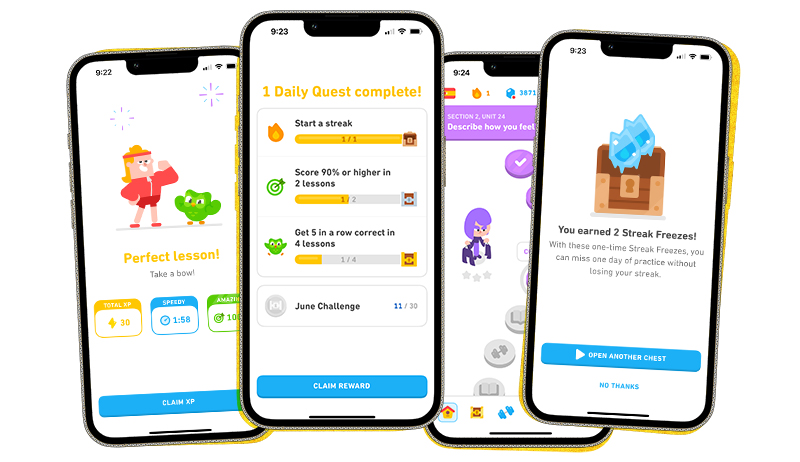
Slapping badges on a fitness app does not make it engaging. Adding leaderboards to a learning platform does not make it addictive. Real gamification is not decoration. It is structural. It changes the user’s relationship with the task by aligning product mechanics with human motivation.
Here is what actually works, what does not, and how to design gamification that drives lasting engagement.
The Difference Between Game and Gamification
A game is an escape. Gamification makes the task itself more motivating. The goal is not to turn work into play. The goal is to make progress visible, effort rewarding, and mastery achievable.
Bad gamification adds points for every click. It feels manipulative because it is disconnected from the user’s goal. Good gamification reinforces behaviors the user already wants to perform. It does not invent motivation. It reveals it.
Progress Mechanics: The Goal-Gradient Effect
People work harder when they perceive themselves as closer to a goal. This is not a theory. It is a replicated finding in behavioral science. The closer users get to a milestone, the more effort they invest.
LinkedIn’s profile strength meter works because it shows progress, not because users care about a “score.” The bar fills as users add information. The visual feedback triggers the goal-gradient effect. Users complete profiles not for the badge but because the finish line feels close.
Implementation: Break user goals into visible steps. Show progress toward completion. Make the next milestone clear. Use partial completion to trigger accelerated effort, not frustration.
Feedback Loops: Immediate, Clear, Actionable
Delayed feedback kills engagement. Users need to know that their action had an effect. This is why fitness apps celebrate a completed workout immediately. The celebration is not the reward. The confirmation of completion is the reward.
The best feedback loops are three-part. Action, result, and next step. “You logged a meal. You have 450 calories remaining for dinner. Add dinner?” The loop closes. The user knows what they did, what it meant, and what to do next.
Implementation: Never leave the user wondering if their action registered. Provide immediate visual or haptic confirmation. Connect the action to a measurable outcome. Suggest the logical next action.
Mastery Mechanics: Skill Expression Over Point Accumulation
Points degrade. Leaderboards depress. Mastery endures. The most engaging gamification allows users to express skill, not just accumulate currency.
Duolingo’s leagues work because they reflect consistent practice, not because the points are valuable. The user who practices daily climbs. The user who practices weekly falls. The mechanic reinforces the desired behavior through visible skill expression, not arbitrary rewards.
Implementation: Design mechanics that require sustained effort, not one-time spikes. Reward consistency over intensity. Make skill visible through levels, titles, or performance tiers that cannot be gamed.
Social Mechanics: Cooperation Over Competition
Leaderboards motivate the top 10% and demotivate everyone else. The user in 847th place does not try harder. They quit. Cooperative mechanics, team goals, shared rewards, collective progress, engage a much wider audience.
The fitness app Strava succeeds because of segments, not because of global leaderboards. Users compete against their own past performance and against a small, achievable target. The social layer is optional. The personal best is mandatory.
Implementation: Default to self-competition. Add social comparison as an opt-in, not a default. Use cooperative goals (team challenges, community milestones) to build engagement across the entire user base.
The Badging Trap: Recognition Without Meaning
Badges are the most overused gamification mechanic because they are the easiest to implement. A badge for completing a profile is not rewarding. It is expected. A badge for a genuinely difficult achievement, maintaining a 100-day streak, helping ten other users, mastering an advanced feature, carries meaning.
Implementation: Only issue badges for achievements that required sacrifice, skill, or sustained effort. Never issue badges for completing basic onboarding. The badge’s value is its scarcity.
Variable Rewards: The Dopamine Loop
The most addictive games use variable ratio reinforcement. The reward is unpredictable. The user does not know when the next reward will come, so they keep engaging.
This is ethically dangerous. Applied to social media, variable rewards create compulsive checking. Applied to a productivity tool, variable rewards can create healthy engagement without manipulation. The difference is the underlying task. Gambling is destructive. Learning is constructive.
Implementation: Use variable rewards sparingly and only when the core task is already beneficial. A flashcard app can surprise the user with a “streak bonus” after consistent study. A social media app should not surprise the user with unpredictable notifications.
Onboarding as First Engagement
The user’s first session determines their long-term retention. Gamification must start immediately. Not after a tutorial. Not after account verification. Within the first sixty seconds.
Headspace, the meditation app, finishes onboarding by giving the user a “basics pack” of meditation sessions. The user has not earned anything. But they have received a gift. The reciprocity principle triggers. The user feels obliged to try the sessions. The first session builds the habit.
Implementation: Give the user something of value within the first minute. A completed checklist. A personalized recommendation. A free asset. The gift does not need to be expensive. It needs to feel intentional.
Testing Gamification
Gamification often fails because designers assume what will motivate users. The assumption is usually wrong. Test every mechanic.
Run an A/B test with the gamification feature on for half of users and off for the other half. Measure retention, not engagement. Users will click on badges. That does not mean badges keep them returning. Retention is the only metric that matters for long-term engagement.
If gamification does not improve 30-day retention, remove it. Gamification is not a permanent addition. It is a hypothesis. Test it. Keep what works. Discard what does not.
The Bottom Line
Gamification is not about making the product fun. It is about making progress visible, effort recognizable, and mastery achievable. Users do not need to be tricked into engagement. They need to see that their effort is working.
Design mechanics that show progress, reward skill, and build community. Avoid empty badges, punishing leaderboards, and manipulative variable rewards. Test everything. And remember: the best gamification is the kind users forget is there. They are not playing a game. They are just getting things done.
About the Author

Peter Makeshoff
Peter Makeshoff is the founder and main author of Designer Daily.