
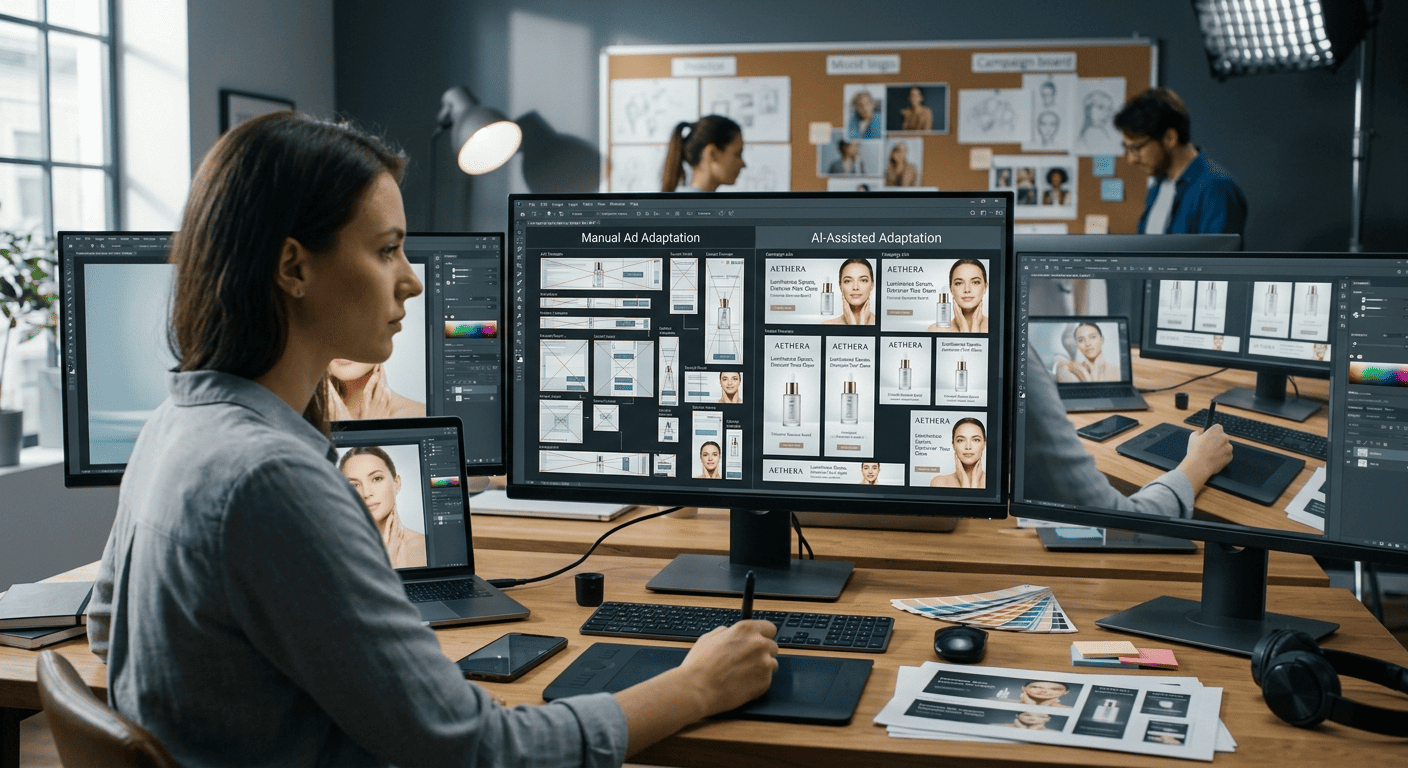
Ask a designer what they spend most of their week doing and very few will say designing. The concept arrives in a morning, sometimes in twenty minutes on the walk to the studio. The type gets settled over a day. The idea is right, everybody agrees it is right, and then the job actually begins: the square version, the vertical version, the leaderboard, the skyscraper, the email header, the stories cut, the print adaptation, the version where legal needs an extra line, the version for the market that reads right to left.
That second phase consumes the majority of the hours on most commercial projects, and almost none of the satisfaction. It is also the only phase an AI Ad Generator has anything useful to say about. It is also the part that clients understand least, because from the outside it looks like resizing.
An AI Ad Generator supporting targeted creative workflows through Higgsfield is relevant to that second phase and to almost nothing in the first, which is a narrower claim than these tools usually make and a more useful one.
Why does adaptation take longer than the concept?
Because a concept is one decision and an adaptation is a series of small decisions that cannot be made in advance.
When a layout moves from a square to a tall narrow banner, almost nothing survives intact. The focal point sits somewhere else. The headline that ran across two lines now needs three, or needs cutting. The logo no longer fits where it was. The negative space that made the original work has been squeezed out, and the thing that made the design feel considered is the first casualty.
Each of those is a judgement, and there are dozens of them per placement. Multiply by the number of formats a modern campaign requires and the arithmetic becomes obvious. A campaign running across paid social, display, email and out of home can easily need thirty distinct outputs from one idea, and each one wants somebody to look at it properly.
The reason this rarely gets discussed honestly is that it sounds like complaining about the job. It is not. It is describing where the hours go, which is worth knowing before deciding what to do about it.
What actually changes between placements?
Four things, and only one of them is dimensions.
Crop is the obvious one, and the least interesting. A wide image becomes a tall one and something has to go.
Hierarchy is the real work. In a large format the eye can travel, so a headline, a subhead, an image and a call to action can each have their moment. In a small banner there is room for one idea and everything else is noise. Deciding which idea survives is a design decision made per placement, and it is why mechanical resizing produces work that technically fits and communicates nothing.
Copy length follows from that. Text written for a poster does not fit a mobile banner, and shortening it well is closer to editing than to design.
And legibility changes with viewing distance and context. Type that reads comfortably on a billboard behaves very differently at thumbnail size in a feed, which is where most of it will actually be seen.
An AI Ad Generator can execute all four once the decisions are made. What it cannot do is make them for you on a campaign that matters, which is the distinction this article keeps returning to.
Why do templates fall over?
Because a template assumes the relationship between elements stays constant, and across formats it does not.
Every designer has built the master file with linked artboards, and every designer has watched it break. The image that anchored the square version is irrelevant in the skyscraper. The type scale that worked across three sizes collapses at the fourth. Something needs a different crop and now the linked asset is fighting you.
Templates work beautifully for genuinely repetitive output, which is why they are the right answer for a weekly social post or a product card. They work poorly for a campaign, because a campaign is one idea expressed differently rather than one layout repeated.
That gap is where an AI Ad Generator sits more comfortably than a template does. It produces each output from the intent rather than from the geometry of the previous one, which is closer to how a designer would approach it than a linked artboard is.
Where does the craft genuinely sit?
In the concept, the type and the hierarchy decisions, and that has not moved.
The idea is still the idea. What a campaign is actually saying, the image that carries it, the tension between the words and the picture, the reason somebody looks twice. No tool produces that, and anybody claiming otherwise is selling something.
Typography remains a decision about tone as much as about legibility, and a designer choosing a typeface is making an argument about what the brand is. That is not a task, it is a position.
And the hierarchy call, the one about which element survives in the small format, is genuinely design work rather than production work.
What sits outside that list is the execution of those decisions across thirty outputs. That is production, it always was, and it has historically been done by designers only because nobody else could. An AI Ad Generator changes the second half of that sentence without touching the first.
What can an AI Ad Generator take on?
The mechanical expression of settled decisions, at volume.
Once a direction is approved, producing the format variants is the obvious case. The same treatment across every placement the media plan calls for, generated rather than rebuilt individually.
Seasonal and market variants follow. The same campaign refreshed for a different season, or adjusted for a different market, where the structure holds and the content shifts. An AI Ad Generator handles that considerably faster than reopening the master file.
Alternate imagery is the third case, and possibly the most useful. A campaign frequently needs the same layout with a different subject, and sourcing or shooting that alternative was previously the constraint on how many versions existed.
And late changes, which every designer recognises. Legal adds a line, a date moves, a price changes, and a set of thirty outputs needs updating on a Friday afternoon. That is the moment an AI Ad Generator earns whatever it costs.
What does Higgsfield handle across a campaign?
Higgsfield is an AI creative suite, which in this context means the generation, the adjustment and the export sit in one place rather than requiring a separate tool at each stage.
The part that matters most for adaptation work is that an AI Ad Generator treatment can be established once and applied afterwards. A designer settles the look on one output, properly, with all the judgement that requires, and Higgsfield stores what produced it. Every subsequent format inherits that rather than being approached fresh, which is precisely the behaviour a linked template promises and rarely delivers across genuinely different shapes.
Project organisation is the second piece. A campaign generates approved versions, rejected versions, market variants and late amendments, and keeping those grouped by client and campaign is what makes the material findable when somebody asks for the German version in November.
Version history does similar work through approval rounds. Design work passes through a creative director, an account team and a client, and a round of notes being an adjustment rather than a rebuild is where the margin on a project survives.
Higgsfield also carries several models rather than one, so the AI Ad Generator behind a photographic treatment and the one behind an illustrated brief are both available without a second subscription. And it runs in a browser, which removes the software request that studio IT tends to treat as a formality with a two week lead time.
How does this hold up against designer scepticism?
Reasonably, provided the claim stays honest.
Designers have better grounds for scepticism about generative tools than almost any other profession, because the marketing around them has consistently overstated what they do and understated whose work they were trained on. That scepticism is earned and it is not going to be argued away by an article.
What can be said is narrower. Nothing above suggests an AI Ad Generator produces a concept, and the concept is the job. The proposition is that the production phase, which designers have always done because it fell to them rather than because it required them, can be executed faster.
A designer who spends three days a week on adaptation and one on concept has a ratio problem, and that ratio is why so much commercial design looks competent and unremarkable. Shifting it is not a threat to the craft. It is the only realistic route to more of the work being the part that requires a designer.
That argument either lands or it does not, and it is more honest than the alternative.
What stays with the designer regardless?
The decisions, the judgement and the responsibility for the output.
Approval stays human because somebody has to look at every asset before it runs. AI Ad Generator output at volume means more things to check, not fewer, and a campaign going live with a mangled crop in the fourth market is a designer’s problem regardless of what produced it.
Typography stays a design decision, and anything with a contractual or legal requirement about wording should be set deliberately rather than generated.
Brand consistency stays a judgement call, because a brand is a set of decisions somebody made and a tool applying them is not the same as a tool understanding why they were made.
And the concept stays where it always was, which is the point of the whole argument.
What happens to junior roles in this?
Worth addressing rather than avoiding, because it is the first question any studio asks internally and the marketing around these tools consistently dodges it.
The honest answer is that adaptation work has historically been where juniors learned, and that matters. A designer resizing forty assets is absorbing something about hierarchy, legibility and how a layout behaves under pressure, and they are absorbing it by making the decisions badly a few times first.
Removing that work entirely would remove the apprenticeship with it, which is a real cost rather than a theoretical one.
What seems to happen in practice is a shift rather than a deletion. The junior stops producing all thirty outputs and starts reviewing them, which means making the same judgement calls on which one is wrong and why, at higher volume, across more varied problems. That is arguably better teaching than executing the same crop repeatedly, provided somebody senior is looking at the review.
The studios getting this wrong are the ones treating an AI Ad Generator as a headcount argument. The ones getting it right are using the recovered hours to put juniors on concept work earlier than the traditional path allowed, which is the outcome most designers would have wanted from the start.
None of that is automatic. It is a decision about how a studio uses the time it gets back, and the tool is indifferent to which choice gets made.
How would this fit a real project?
Concretely, on a campaign with a media plan attached.
The concept happens as it always does, with whatever process the studio uses. Sketches, references, a route presented and chosen.
The hero execution gets built properly, by a designer, at full attention. This is the asset everything else derives from and it deserves the time.
The treatment then gets captured rather than described, so that what made the hero work can be applied to everything downstream. This is the step most studios skip and the one that determines whether the rest of the process is fast or merely automated.
From there the AI Ad Generator produces the format set, with a designer reviewing each output and fixing the ones that need a human decision. In practice that tends to be a handful rather than all of them, and the handful is where the hierarchy call was genuinely different.
Market and seasonal variants follow the same path. Late changes reopen the project rather than the master file, which is the difference between an hour and an afternoon.
What does it cost against the time it returns?
A subscription against several days per campaign, which is a comparison most studios can make quickly.
Higgsfield operates a free tier, which is enough to run one real format set through the AI Ad Generator and judge the output against what the studio currently produces. Paid plans cover the volume a working campaign calendar needs, and everything runs in a browser, so the evaluation does not require procurement approval.
The commercial terms per plan are published, which matters for anybody producing client work rather than personal projects, and is worth reading before anything goes into a deliverable.
The useful comparison is not against hiring a junior, which is how this tends to get framed and which misses the point. It is against a senior designer spending Thursday and Friday on resizes, which is what currently happens, and which nobody involved in the project would choose if the alternative were available.
Conclusion
The part of commercial design that takes the longest is the part that requires a designer least, and that has been true for as long as campaigns have run across more than one placement.
An AI Ad Generator does not change what design is. It changes who executes the thirtieth version of a decision that was made properly the first time, and Higgsfield holds the treatment so that decision actually carries downstream rather than being reconstructed.
The concept was always the job. It would be good if more of the week went on it.
About the Author
Peter Makeshoff
Peter Makeshoff is the founder and main author of Designer Daily.