
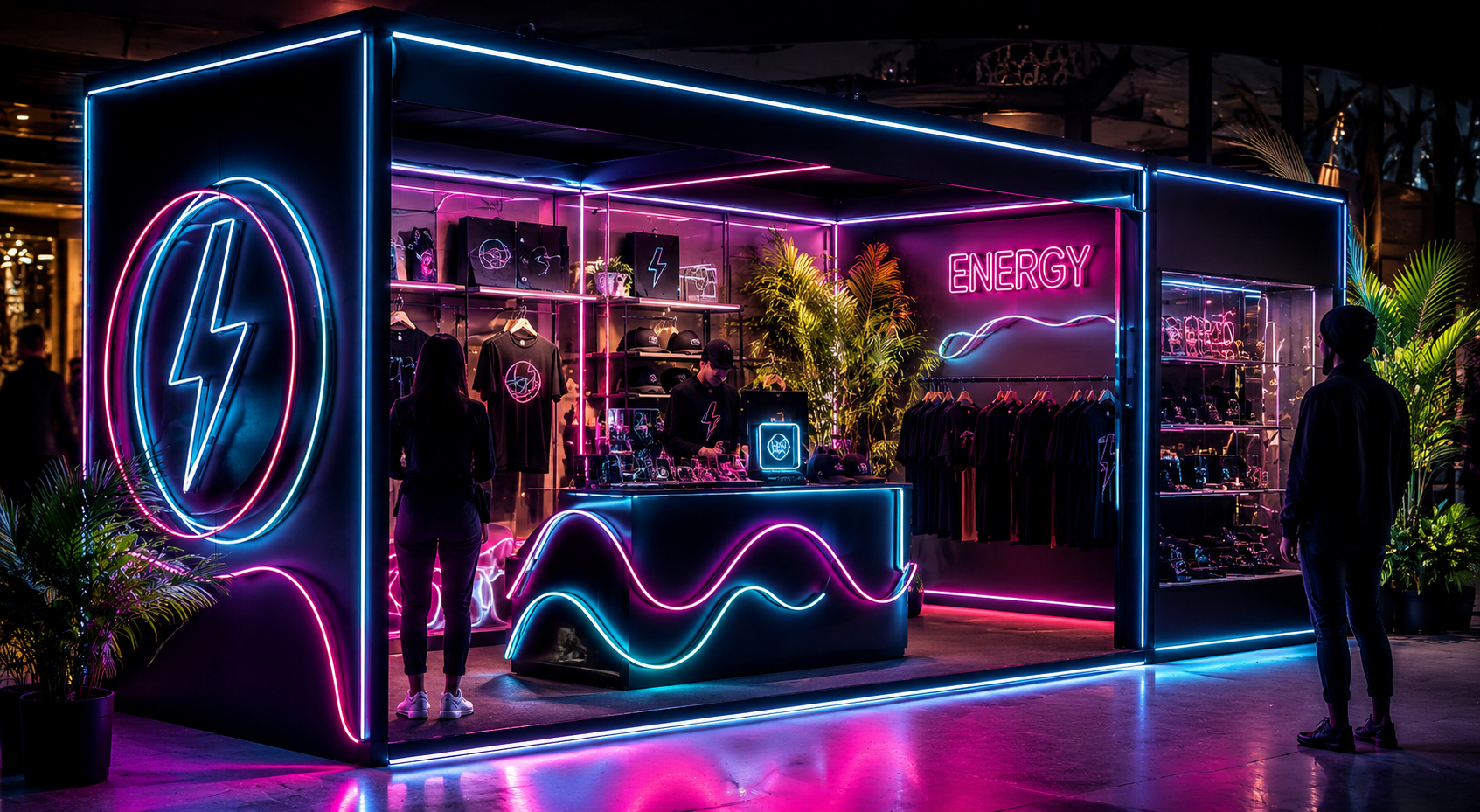
Source: ChatGPT
There’s something almost otherworldly about a glowing line of light that bends, twists, and traces any shape you can imagine without needing a power plant to run it. That’s the quiet magic of el wire, and once you understand what it can do, it’s hard to look at a design brief, an event space, or a brand activation the same way again.
Electroluminescent wire has been around for decades, quietly humming in the background of tech-forward design circles. But in recent years, it’s broken into the mainstream in a big way, showing up in everything from gallery installations and music festivals to retail storefronts and editorial photo shoots. If you work in graphic design, visual branding, or experiential creative, el wire might be the medium you didn’t know you were missing.
What Exactly Is EL Wire?
Before diving into applications, a quick primer. El wire is a thin, flexible copper wire coated with a phosphor layer that emits a soft, continuous glow when electric current passes through it. Unlike LEDs, which emit light from individual points, it produces a smooth, even line of illumination. Think of it like drawing with light itself.
It’s lightweight, bendable into virtually any shape, available in a wide spectrum of colors, and runs cool to the touch. That last point matters more than people realize: no heat means no fire risk, which opens up a whole world of materials and settings you simply can’t use with traditional lighting.
For designers ready to experiment, a great starting point is this el wire from GloFX, available in multiple gauges and colors to suit everything from delicate typography to bold sculptural forms.
EL Wire in Graphic Design: Drawing With Light
Here’s where things get genuinely exciting for designers. This wire essentially turns physical space into a canvas. Logo outlines, typographic installations, and geometric brand patterns—all of these become three-dimensional, luminous, and alive when rendered in electroluminescent wire.
Think about a brand wordmark traced in glowing wire and mounted on a wall at a product launch. Or a custom typeface rendered in electroluminescent wire as the centerpiece of a window display. The effect is immediately arresting: clean, futuristic, and unmistakably intentional. It reads as high-end, even when the materials themselves are surprisingly accessible (For designers exploring how light-based media is reshaping visual communication, check this out).
The key design principle when working with el wire is simplicity. Because the wire itself is the entire visual statement, cluttered compositions fall apart fast. Think single-weight lines, intentional negative space, and forms that read clearly even from a distance. Less, as always, is more. But here, less also glows.
Installations That Stop People in Their Tracks
Art and design installations are where el wire really hits its stride. The medium is tailor-made for immersive environments: large-scale ceiling grids, luminous sculptural trees, glowing tunnel walkways, constellation maps suspended mid-air. Because it’s so lightweight and flexible, installation is far less complicated than neon or LED strip setups, and the effect is arguably more intimate.
Major festivals and experiential design studios have leaned into this hard. The result is a generation of audiences who have come to associate that characteristic soft glow with premium, curated experiences, which is exactly the kind of brand association you want to build.
According to Research on Lighting Installation Art Design in Public Space, light installations have become one of the fastest-growing categories in contemporary design and architecture, with artists and studios increasingly blurring the line between environmental design and fine art. This glowing medium sits right at that intersection.
For a broader look at how installations are influencing mainstream branding aesthetics, read this article on Designer Daily. It’s a solid pulse-check on spatial Communication in contemporary design.
Creative Branding: Making Your Brand Literally Glow
Let’s talk strategy for a second, because this glowing medium isn’t just a cool visual trick. It’s a genuine branding tool when used thoughtfully.
At trade shows and pop-up events, the average exhibitor is fighting for attention in a sea of identical booth setups. An el wire brand element, whether it’s your logo outline, a signature shape, or even just a glowing border, cuts through that visual noise immediately. It signals creativity and investment without requiring an enormous production budget.
Retail environments are another strong play. GloFX offers a range of EL wire accessories and kits that make it straightforward to prototype brand applications before committing to a large-scale installation. That’s a smart move for designers pitching concepts to clients who want to see before they sign off.
The psychology here is simple: light draws the human eye. We’re wired to notice it, literally. Brands that incorporate luminous elements into their physical presence benefit from that primal response every single time.
According to research, the cultural resurgence of glowing, neon-adjacent aesthetics reflects a broader consumer appetite for warmth, handcrafted quality, and sensory richness. All things that el wire delivers in spades.
Practical Tips Before You Start
A few things worth knowing before you dive in:
Wire gauge matters. Thinner wire (around 2.3mm) is best for detailed work and lettering. Thicker gauges (3.2mm or higher) work better for bold shapes and large-format installations where visibility at distance is the priority.
Power inverters are not optional. EL wire requires an AC inverter to drive the phosphor glow. The good news is that modern inverters are compact, quiet, and efficient. Match your inverter to the total length of wire you’re using.
Color behaves differently in different light conditions. What looks vivid in a dim studio can appear washed out under bright ambient lighting. Always prototype in the actual environment before finalizing your design.
Plan your connections. The wire terminations are the fussiest part of any electroluminescent wire project. Give yourself extra lead time for soldering, heat-shrinking, and testing before the installation day.
The Bottom Line
Electroluminescent wire occupies a rare and genuinely exciting space in the designer’s toolkit: it’s tactile, luminous, endlessly flexible, and still uncommon enough to feel fresh. In a design landscape where digital saturation has made physical, crafted experiences feel genuinely scarce, a well-executed el wire installation or branding element doesn’t just look good. It creates a moment people actually remember.
That’s ultimately what the best design does. And if it happens to glow softly in the dark while doing it? Even better.
About the Author

Peter Makeshoff
Peter Makeshoff is the founder and main author of Designer Daily.