
The creative job application used to be a transaction: a PDF portfolio sent into a void, judged solely on the final work inside. Today, the hiring process is a courtship. Before a client ever asks for your portfolio, they’ve likely watched your process on TikTok, resonated with your thoughts on LinkedIn, and absorbed the world view you project online. Your personal brand has become the cover letter, the interview, and the portfolio, all happening before the first official contact.
This is the shift from a static, closed archive to a dynamic, open narrative.
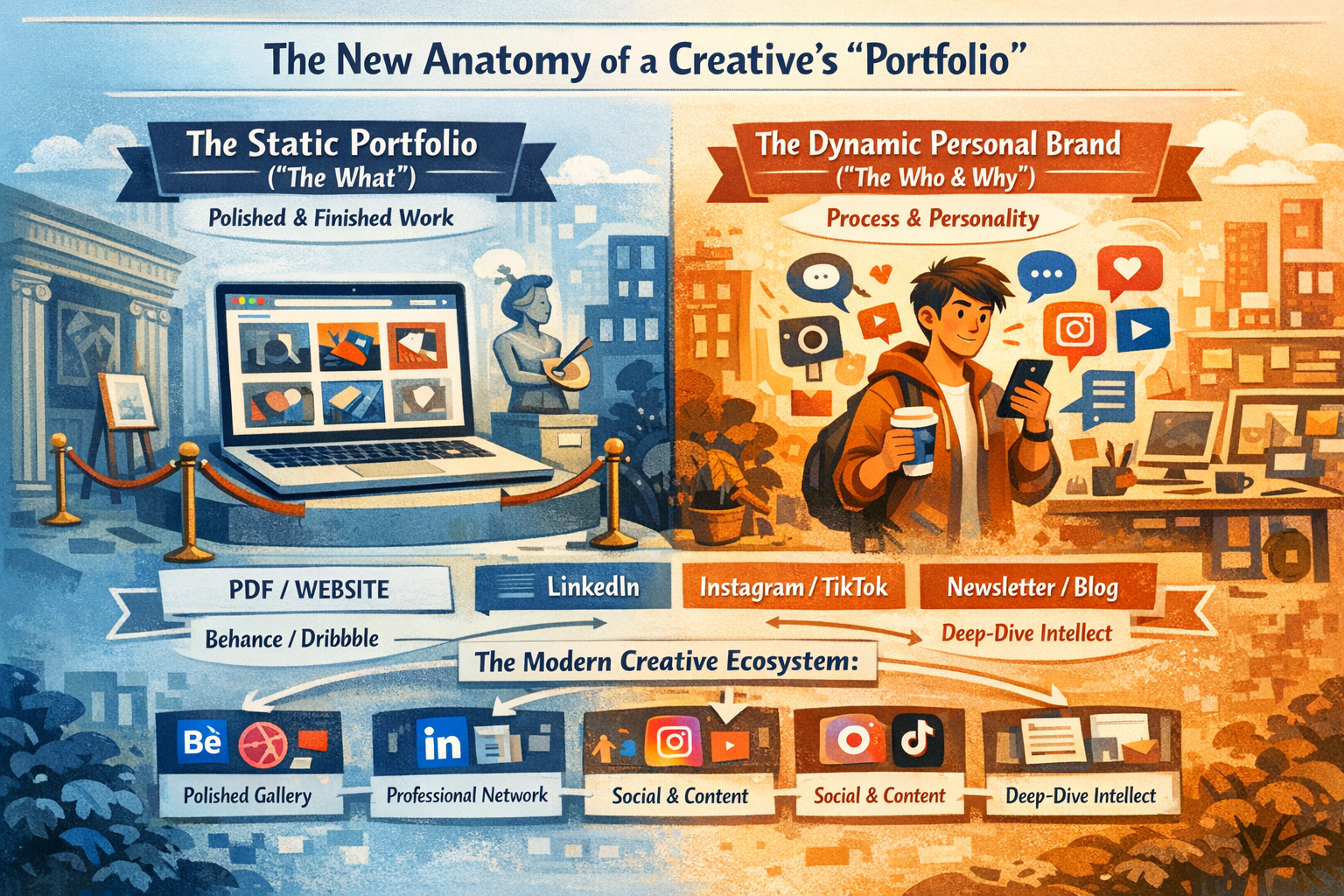
The New Anatomy of a Creative’s “Portfolio”
The Static Portfolio (PDF/Website): The “What.” A curated museum of finished, perfect outcomes. Its job is to prove competence and craft. It answers: Can they do the work?
The Dynamic Personal Brand (Social + Content): The “Who” and “Why.” A living documentary of process, philosophy, and personality. Its job is to build affinity and trust. It answers: Do I want to work with this person? Do they think in a way that solves my problems?
The modern creative’s presence is a layered ecosystem:
- Behance/Dribbble: The polished gallery (the “What”).
- LinkedIn: The professional thesis and network.
- Instagram/TikTok: The personality, process, and cultural commentary.
- Newsletter/Blog: The deep-dive intellect.
The “Pros”: Why This Shift is Powerful
1. It Attracts Aligned Clients (The “Dream Client” Filter)
By publicly sharing your design philosophy, you repel clients who want cheap, fast, generic work and attract those who value your specific approach. A UX designer who consistently posts about ethical design and accessibility will attract mission-driven startups, not get-rich-quick schemes.
2. It Demonstrates Thinking, Not Just Output
A beautiful mockup shows you can execute. A 60-second Loom video explaining why you made three key typography choices shows you can strategize, articulate a rationale, and lead a client through decision-making. This is the skill clients actually pay for.
3. It Creates Opportunities Before You Need Them
A steady stream of thoughtful content acts as a perpetual net. It catches the attention of a creative director who bookmarks your post, a founder who remembers your take on a problem, or a journalist looking for an expert quote. This leads to inbound leads, speaking gigs, and collaborations you never applied for.
4. It Builds Trust at Scale
People hire people they feel they know. By sharing your journey, your failures, and your authentic voice, you build a parasocial relationship with potential clients. When they finally reach out, it feels like contacting a familiar colleague, not a stranger. This dramatically shortens the sales cycle.
The “Cons” and Very Real Pitfalls
1. The “Performance of Self” Burnout
Curating a persona is labor. The pressure to be constantly “on,” to turn every project into content, and to share vulnerably can lead to creative exhaustion and identity confusion. When does the persona end and the person begin?
2. The Authenticity Trap
Audiences are savagely good at detecting inauthenticity. A forced, overly polished, or trend-chasing persona will be seen as just another marketing tactic. The “personal” in personal brand must be genuine, which requires a level of self-exposure not everyone is comfortable with.
3. The Style-Over-Substance Risk
It’s possible to build a large following based on a charismatic persona and mediocre work. This creates a hollow brand that collapses under the weight of a real, complex project. Conversely, brilliant but quiet introverts can feel penalized by a system that rewards extroverted performance.
4. The Algorithmic Prison
Your visibility is governed by opaque platforms. A change in an algorithm can wipe out your reach. Building your “portfolio” on rented land (Instagram, TikTok) is a high-risk strategy. The savvy creator uses these platforms to drive traffic to their owned property (a website, a newsletter list).
The Framework for an Authentic, Effective Personal Brand
This isn’t about becoming an influencer. It’s about strategic visibility.
1. Lead with a Core “Content Pillar,” Not Your Dinner.
Choose one primary professional theme you want to be known for. This is your lens.
- Example Pillars: “Simplifying complexity for early-stage startups,” “Bridging hand-drawn illustration and tech,” “Designing for cognitive accessibility.”
- 80% of your content should tie back to this pillar through case studies, quick tips, commentary on industry news, or reflections on failures within it.
2. Show the “Why” and the “How,” Not Just the “What.”
The magic is in the middle.
- Instead of just posting: The final logo.
- Post: The 3 rejected concepts with a sentence on why they failed. The messy mood board. The one research insight that changed everything. This is your competitive moat; AI can’t replicate your unique process narrative.
3. Build a “Hub and Spoke” Model.
Your website is the Hub (the owned, permanent portfolio and home base). Social platforms are the Spokes (the discovery channels). The sole goal of every spoke is to drive traffic back to the hub, where you control the narrative and can capture leads.
4. Define Your “Non-Negotiables” for Privacy.
What won’t you share? Your family? Your political views? Your hourly rate? Setting clear, internal boundaries protects your mental health and ensures your brand feels professional, not invasive. Authenticity is about being genuine within a defined frame, not confessional.
The Verdict: A Necessary Synthesis
The personal brand is not the replacement for the portfolio. It is its necessary context.
The modern creative’s business engine runs on a fusion:
- Personal Brand = Trust & Affinity
- Portfolio = Proof & Competence
A charismatic persona with a weak portfolio is a hollow salesman. A stunning portfolio with no visible persona is a ghost. The winning combination is exceptional work made visible and legible through a consistent, authentic narrative.
Your PDF portfolio gets you into the room. Your personal brand ensures they’re already excited to meet you before you even arrive. In a world saturated with talent, your differentiated point of view, communicated consistently, is the ultimate competitive advantage. It turns your career from a series of applications into a gravitational force that pulls the right opportunities toward you.
About the Author

Peter Makeshoff
Peter Makeshoff is the founder and main author of Designer Daily.