
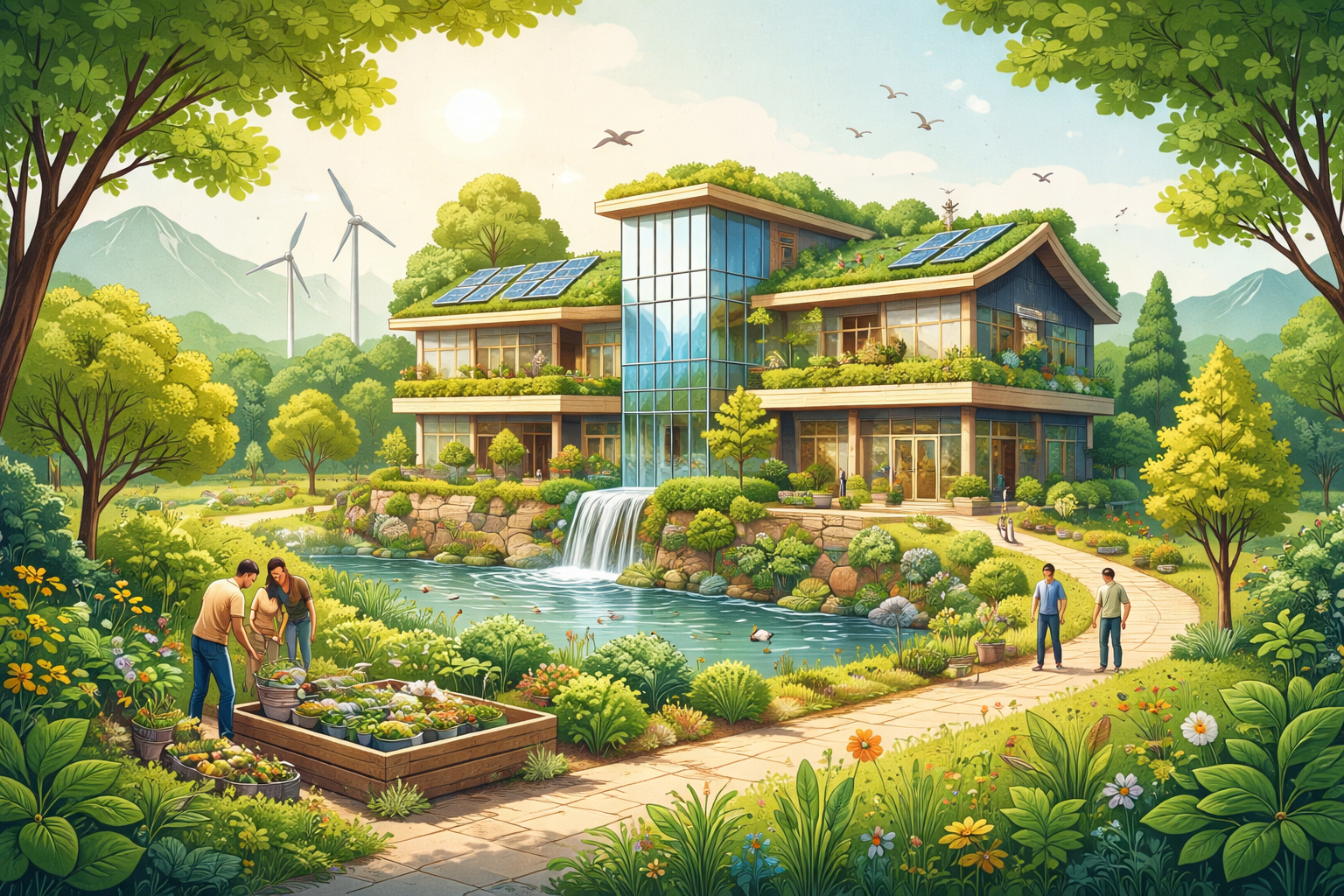
For decades, sustainable design has been an exercise in minimization: less energy, less waste, less damage. The goal has been to be “less bad.” But in an era of climate and biodiversity crisis, doing less harm is no longer enough. The next paradigm is Regenerative Design, architecture conceived not as an extractive endpoint, but as a living, integrated system that actively heals its environment, improves its community, and leaves the site healthier than it found it.
This is architecture that moves beyond neutral footprint to become a net-positive ecological force.
The Core Principles: From Linear to Cyclical
Regenerative design rejects the linear “take-make-waste” model. It operates on three cyclical principles:
- Eco-System Service Producer: The building must perform vital ecological functions (air and water purification, habitat creation, carbon sequestration, nutrient cycling) that would naturally occur on the site.
- Energy Positive: It must generate more clean energy than it consumes annually, feeding the surplus back to the grid or community.
- Water Positive: It must collect, clean, and release more water than it uses, improving the watershed’s health.
- Social & Biophilic Catalyst: It must enhance human well-being and foster a deeper connection to natural systems, strengthening community resilience.
Case Studies in Net-Positive Architecture
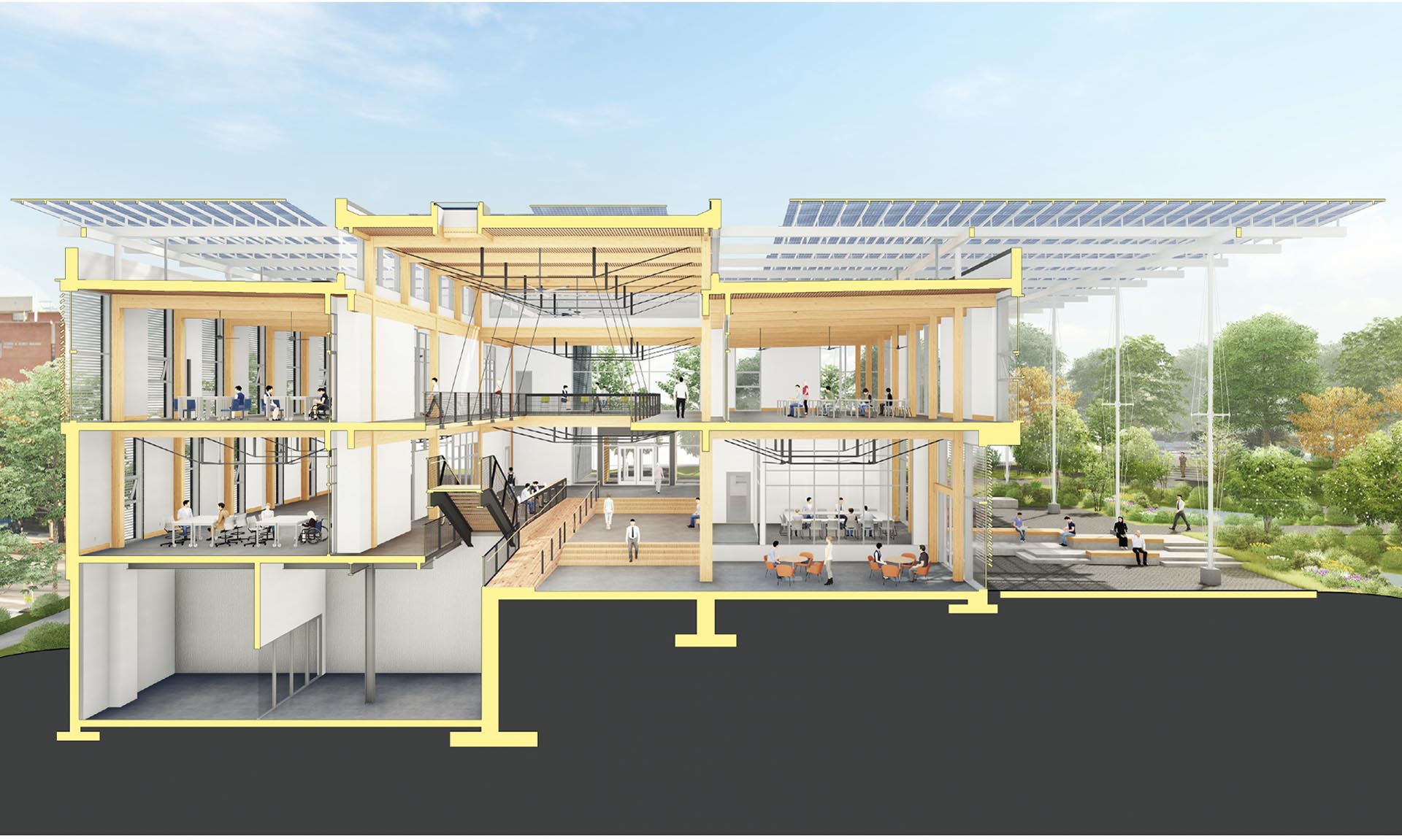
1. The Water-Cleaning Building: The Kendeda Building for Innovative Sustainable Design (Atlanta, USA)
This academic building at Georgia Tech is a “Living Building” that treats 100% of its wastewater on-site, including toilet water, in a constructed wetland in its basement.
- How it Gives Back: The system filters water through plants and microbes, producing clean water used for toilet flushing and irrigation. It captures and treats more rainwater than it uses, recharging the local aquifer with cleaner water than it extracted. The building is a net water-positive machine, turning a liability (waste) into a resource that benefits the local watershed.
2. The Habitat-Creating Façade: Bosco Verticale (Milan, Italy)
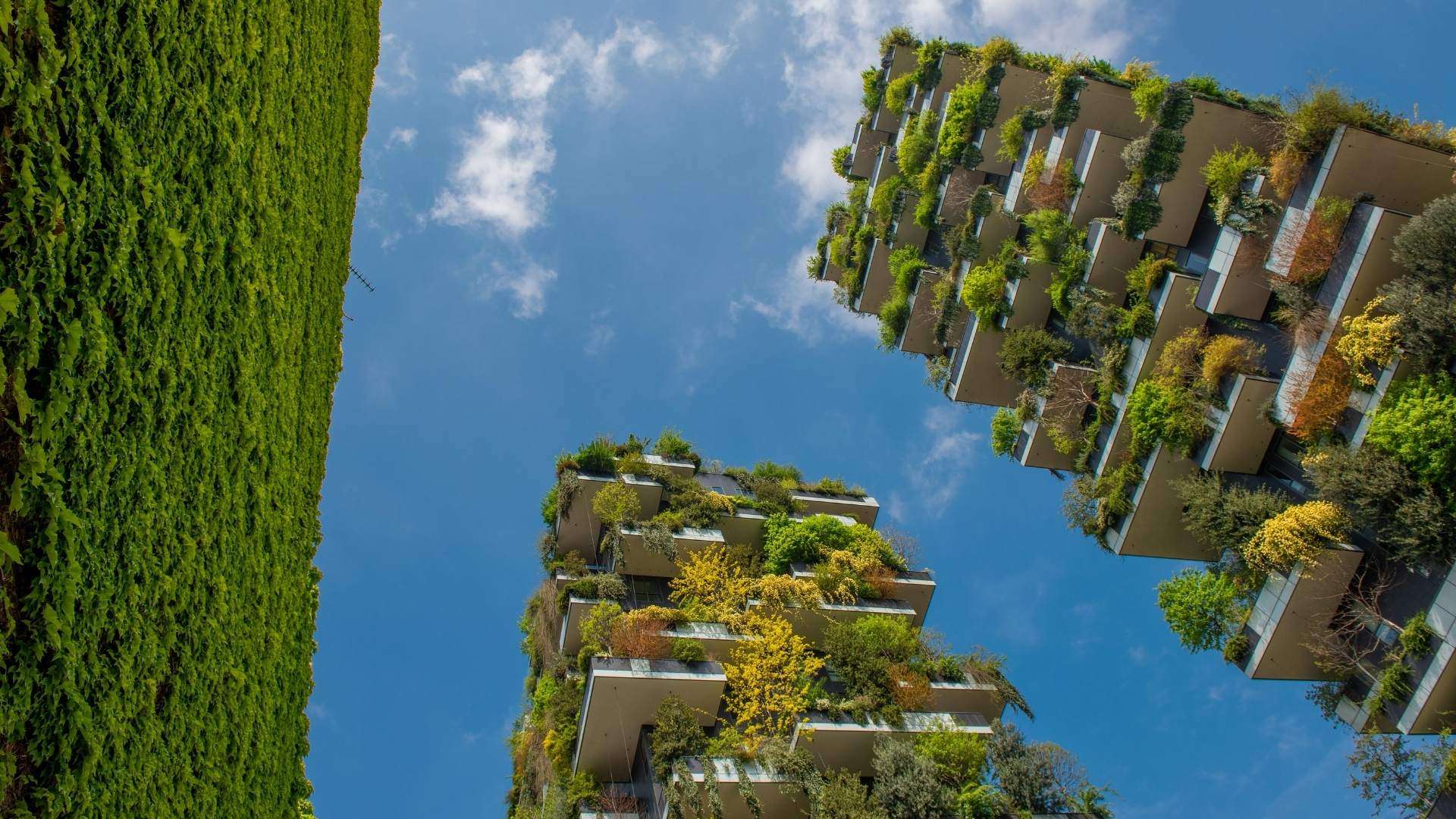
Stefano Boeri’s “Vertical Forest” is more than a green façade. It is a high-rise habitat corridor.
- How it Gives Back: The towers host over 20,000 plants and 800 trees, equivalent to 30,000 square meters of forest. This creates a micro-ecosystem that absorbs CO2 and particulates, produces oxygen, moderates the building’s temperature, and provides a home for birds and insects in the dense city center. It increases urban biodiversity, actively repopulating the site with life rather than displacing it.
3. The Energy-Exporting Community: The Unisphere (Maryland, USA)
This large, mixed-use structure is claimed to be the largest net-positive energy building in the U.S.
- How it Gives Back: A massive 3,200-panel solar array, geothermal wells, and a cutting-edge thermal energy storage system allow it to generate 1.8 times the energy it consumes annually. The surplus is fed back to the local grid, effectively powering neighboring buildings. It transforms from a consumer to a clean energy utility, improving the grid’s resilience.
4. The Architecture as Topography: Moesgaard Museum (Aarhus, Denmark)
Designed by Henning Larsen Architects, this museum dramatically embodies the principle of architecture as landscape.
- How it Gives Back: Its entire roof is a sloping, accessible meadow, seamlessly extending the surrounding forest and parkland. This living roof provides habitat, manages stormwater through natural absorption, and offers public recreational space. The building doesn’t just sit on the land; it becomes the land, increasing usable green space and public access to nature.
5. The Carbon-Sequestering Material Bank: The Sara Kulturhus (Skellefteå, Sweden)
This 20-story cultural center is built almost entirely from mass timber.
- How it Gives Back: The wood acts as a carbon bank, storing over 9,000 tonnes of CO2 removed from the atmosphere by the forests, locking it away for the life of the building. Combined with local renewable energy, the building’s operational carbon is near zero, making its entire life cycle carbon negative. It demonstrates construction as a form of active carbon capture, transforming the building itself into a climate solution.
The Designer’s New Role: Systems Integrator, Not Form-Giver
Regenerative design demands a profound shift in practice. The architect is no longer the sole author of form, but the lead integrator of complex, living systems.
The New Toolkit Includes:
- Ecological & Hydrological Modeling: To understand pre-existing site flows and design for their enhancement.
- Biophilia & Health Metrics: To quantify improvements in human well-being and cognitive function.
- Post-Occupancy Regeneration Audits: To measure actual performance in habitat creation, biodiversity, and community health, not just energy use.
The Argument: From Liability to Asset
The case for regenerative design is both ethical and existential. It re-frames the built environment, currently responsible for ~40% of global carbon emissions, from being our biggest ecological problem to being a primary solution. It is a shift from viewing nature as a resource to be managed, to seeing buildings as nodes within a living system that we must nourish.
This is not utopian. It is a necessary, technical, and deeply creative evolution. It asks the boldest question of all: What if every building made its piece of the world healthier? The result would be cities that function like forests, buildings that act as ecosystems, and a human habitat that actively participates in the planet’s recovery. The goal is no longer to simply sustain life, but to regenerate the conditions for all life to thrive.
About the Author

Peter Makeshoff
Peter Makeshoff is the founder and main author of Designer Daily.