
Walk into a restaurant today, and you’re not just entering a dining room. You’re entering a media studio. Every surface, every light fixture, every plate is a potential frame for a social media post. But in 2026, the rules have shifted. The neon signs and fake greenery that defined “Instagrammable” design for years are giving way to something more enduring: spaces that photograph beautifully because they’re authentic, not because they’re designed for a thumbnail.
Here’s how to build a restaurant that works in person and on screen.
The Numbers: Why Design Matters More Than Ever
OpenTable’s recent polling of diners reveals a clear mandate: 58% of diners deem a restaurant’s “Instagram/TikTok worthiness” as important, with 25% saying it’s extremely important. Nearly half (48%) say cozy, local charm is the most appealing interior style, and 54% are willing to pay a premium for a unique vibe.
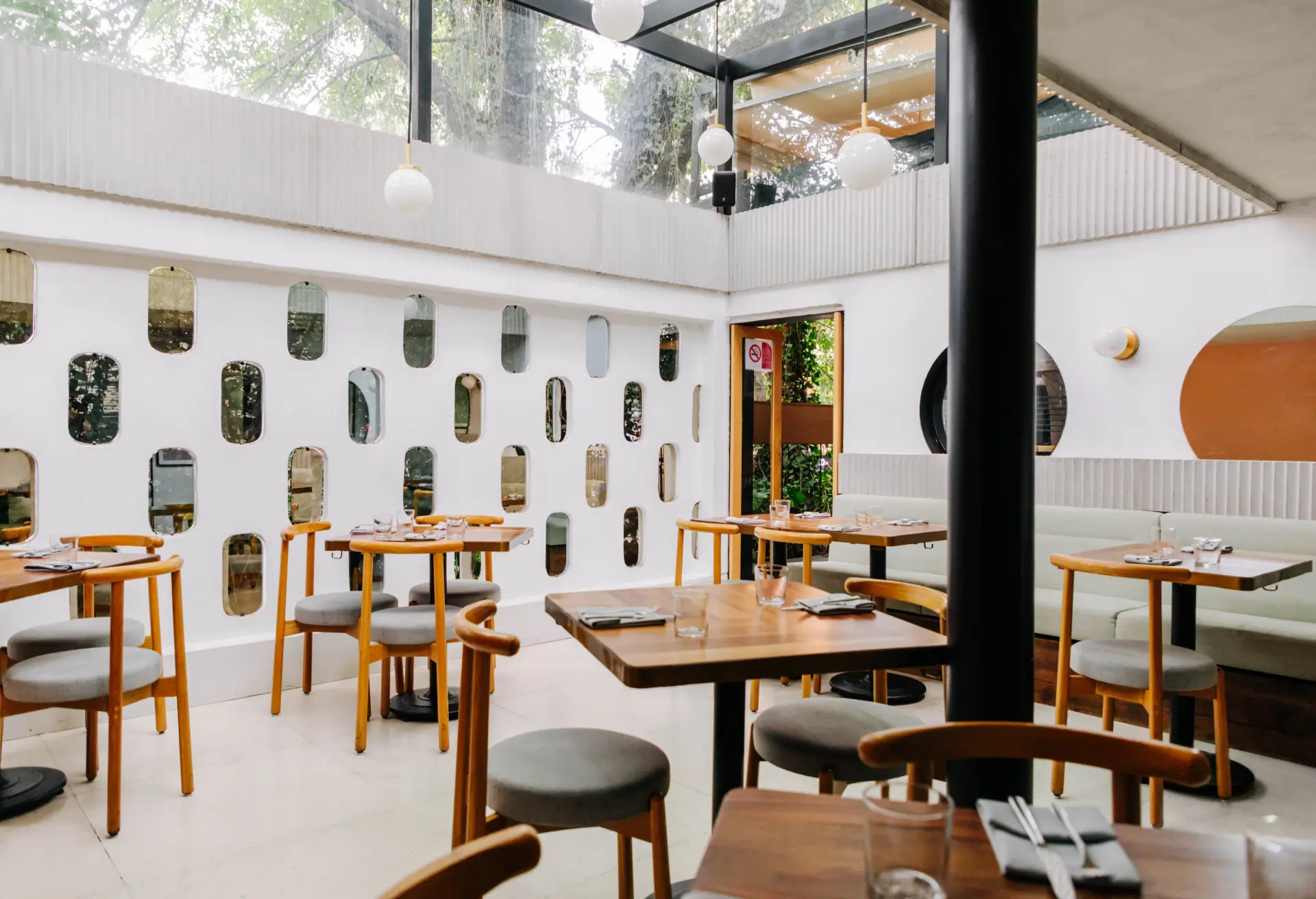
But here’s the nuance. The Boston Globe reports that diners are experiencing “aesthetic fatigue.” When every restaurant looks like a stage set, nothing feels special. Guests are more cost-conscious and intentional, choosing restaurants that feel personal and authentic rather than performative.
The winning formula isn’t “designed for Instagram.” It’s “designed so well that Instagram loves it.”
The Front of House: Creating Shareable Moments
Entry and First Impressions
The entrance is your handshake. It’s also the first photo opportunity. A strong entry, whether through dramatic lighting, a distinctive door, or a striking material change, signals that this space was designed with intention. This is where the “journey” begins, and it’s where many guests will take their first photo.
The “Third Place” Quality
OpenTable found that 40% of diners consider restaurants, cafes, or bars to be their dedicated “third place” after home and work. This means your design must support lingering. Comfortable seating, varied lighting zones (bright for lunch, dim for dinner), and spaces that work for solo diners, couples, and groups all contribute to this feeling.
The Bathroom Paradox
Here’s a surprising design truth: bathrooms matter enormously. OpenTable’s poll found that 21% of restaurateurs are emphasizing “Instagrammable” bathrooms. Libby Slader, a branding and design firm owner, told the Boston Globe: “We’re still making sure that bathrooms either meet the design or even exceed the design in the restaurant. People really associate the bathroom with the cleanliness and the thought and the detail of the kitchen”.
A thoughtful bathroom, good lighting, interesting materials, a distinctive mirror, becomes a natural selfie spot. More importantly, it signals that attention to detail extends everywhere.
The Acoustic Layer: Designing for Conversation
A beautiful restaurant that’s too loud to talk in is a failure. Noise is consistently cited as one of the most irritating aspects of dining out, with 24% of customers ranking it as their top complaint. The financial impact is real: 80% of surveyed diners reported leaving a restaurant or cafe because of noise, and 91% said they would not return to places where noise levels were very high.
The Science of Sound
Research shows that customers begin to be disturbed by noise at 52 dB(A) and begin raising their voices at 57 dB(A). The willingness to spend time and money decreases starting at 52 dB(A). This triggers the Lombard effect: as ambient noise rises, people speak louder, which raises noise further, creating a stressful feedback loop.
Practical Acoustic Solutions
The Väla Centrum food court renovation offers a model. The design team used extensive acoustic wood wool cladding to reduce sound reflections in the human voice range, making the restaurant area “tranquil and homely”. The materials serve double duty: they improve acoustics while creating visual texture and pattern.
Table Spacing as a Design Tool
An analytical model published in Applied Acoustics demonstrates that proper table spacing can directly attenuate the Lombard effect. The model helps architects calculate minimum distances between tables based on room parameters. For intimate, higher-end concepts, greater spacing isn’t just about comfort, it’s about enabling conversation at normal voice levels, which directly supports higher per-person spending.
The Operational Backbone: Kitchen Workflow
Great design isn’t just what guests see. It’s what they don’t see: a kitchen that works.
Layout Fundamentals
An effective restaurant kitchen layout supports speed, safety, and consistency. The most common configurations include assembly line layouts for high-volume concepts, zone layouts for diverse menus, and galley layouts for narrow spaces.
Key Workstations
Every kitchen needs clear zones: prep stations, cooking stations, plating or pass stations, wash areas, and storage zones. Proper placement of these stations limits cross-traffic and supports a smooth production flow. For fast-casual concepts, linear movement from cooking to assembly to pickup, with minimal cross-traffic between stations, is essential.
Staff Safety
Clear walkways, separation of raw and cooked food paths, and strategic placement of handwashing sinks aren’t just code requirements, they’re design features that affect your team’s ability to work efficiently. Reducing manual handling tasks through automation (like integrated oil management systems) helps protect staff while keeping kitchens running smoothly.
The Professional Approach: Operational Design
The most sophisticated restaurant projects now integrate operational planning from the very first design phase. S&S Studio, a firm launched in late 2025, specializes in what they call “Operational Design”, bridging the gap between space design, brand identity, and daily operations.
This approach considers flow management, kitchen and bar technical design, customer journey mapping, and visual identity as a single, integrated system. The goal: minimize the discrepancy between the original creative intent and the day-to-day reality of running the restaurant.
Budgeting Reality
For restaurant owners planning new locations or renovations, design fees typically range from 50-80 yuan per square meter for mid-tier service to 80-300 yuan for comprehensive full-service design. For full-service projects, design fees generally account for 5-10% of total project costs, with higher percentages for more complex, high-end concepts.
The return on this investment is measurable. Industry data suggests that for every 1 yuan invested in design, the brand value return can be 3-5 yuan. More directly, well-designed spaces see improved staff efficiency (reducing unnecessary movement by up to 30%), higher customer satisfaction, and increased willingness to pay premium prices.
The Bottom Line
Restaurant design in 2026 is a balancing act. It must create “Instagrammable” moments without feeling performative. It must be quiet enough for conversation without feeling empty. It must look beautiful on screen while functioning flawlessly off screen.
The restaurants that succeed aren’t chasing trends. They’re building spaces rooted in authenticity, operational intelligence, and genuine hospitality. The photos will follow.
About the Author

Peter Makeshoff
Peter Makeshoff is the founder and main author of Designer Daily.