
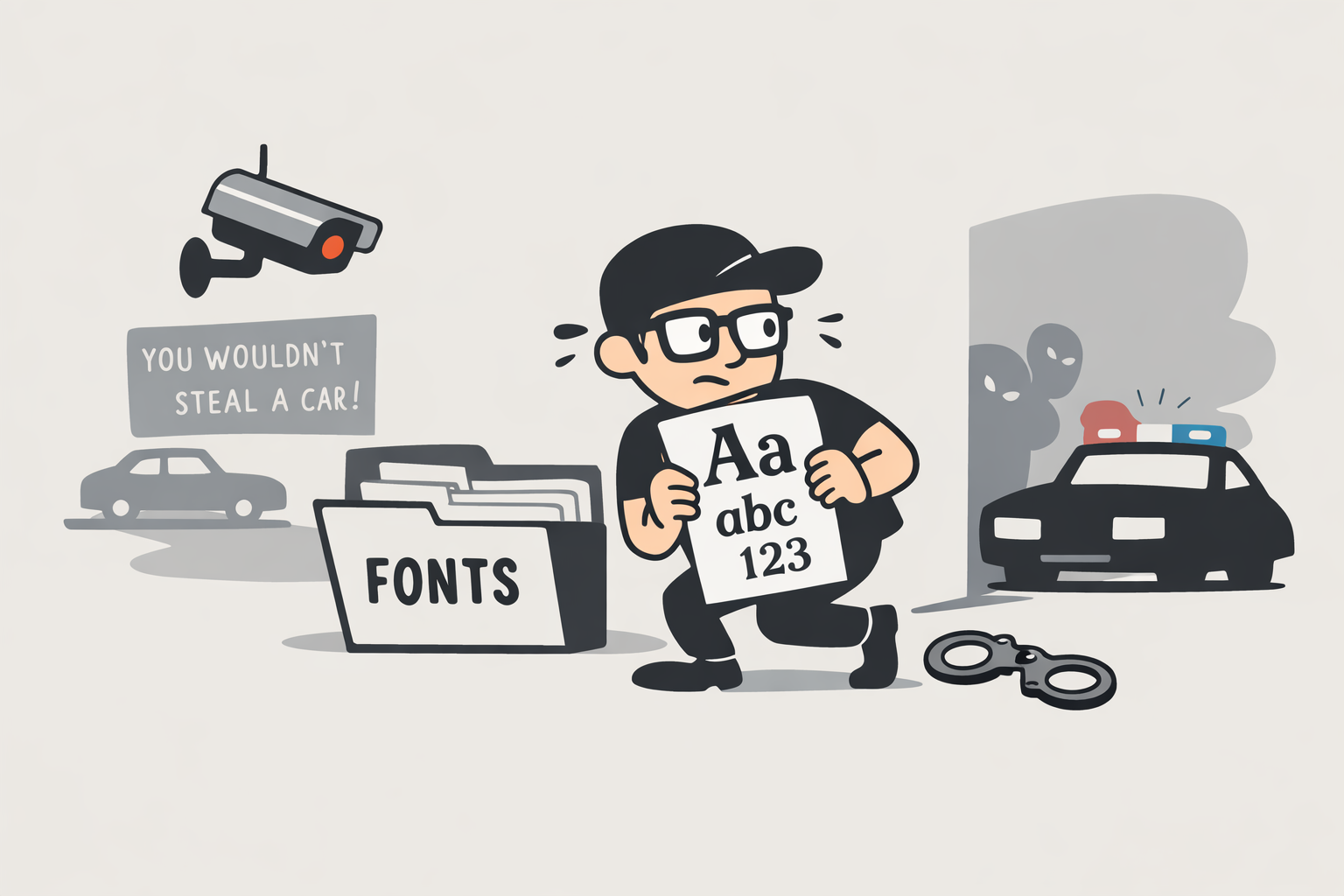
We all know the script. That grim, cinematic warning that played before every DVD in the early 2000s: “You wouldn’t steal a car…” It framed piracy as a moral failing, a deliberate act of theft.
But fonts exist in a gray area of the law, a confusing zone between art and software that turns even well-intentioned professionals into accidental offenders. The question isn’t “Would you steal a font?” For most designers, the real question is: “How would I even know if I already had?”
Open your Fonts folder. It’s likely a digital vault worth more than your first car; a mix of legit purchases, freebies, and files of… uncertain provenance. Passed from colleague to colleague, downloaded from a forgotten “free font” site, inherited with old project files. We treat them with a vague sense of dread, knowing the licensing rules exist but feeling lost in a labyrinth of End User License Agreements (EULAs) and regional legal quirks.
When a client balks at a four-figure license fee for “just the alphabet,” their confusion is understandable. Our industry’s response: “It’s intellectual property!”, feels hollow when dealing with a 50kb file that can be copied in a nanosecond. The moral high ground crumbles without clear legal and practical footing.
The Global Legal Maze: Art vs. Software
The core confusion stems from a single word: font. It conflates two distinct concepts:
- The Typeface: The artistic design, the curves, proportions, and aesthetic soul, this is the art.
- The Font File: The software that instructs your computer to render that design. This is the engine.
Globally, laws grapple with this duality, creating a patchwork of protection.
Territory A: The “Software-First” Approach (e.g., United States)
Here, the artistic design of letterforms is often considered too functional for strong copyright protection. The legal focus shifts to the font software. However, this shield is cracking. As type design tools become more automated, the argument for unique, human-authored software code is weakening. This leaves the industry leaning heavily on contract law, the EULA you click “agree” on. But if an unlicensed user never agreed to the terms, enforcement becomes a shaky game of legal bluff. Recent multi-million dollar acquisitions of historic typeface libraries raise a cynical question: what is actually being bought if the core designs are in the public domain? Often, it’s the trademark, the “official” name, and the existing customer base, a house of cards built on branding, not ironclad copyright.
Territory B: The “Art-With-Loopholes” Approach (e.g., many European jurisdictions)
Some regions acknowledge typefaces as protected artistic works but then create specific, outdated exceptions. A common clause, written for the age of physical printing presses, might allow the ordinary use of a typeface in printing. Designers often misread this as a free pass. It is not.
In the digital world, “use” isn’t just printing. It’s:
- Downloading the file (a copy).
- Installing it on a workstation (another copy).
- Sharing it with a freelancer (distribution).
- Embedding it in a website or app (reproduction and distribution).
- Storing it in a cloud server or Git repository (yet another copy).
Each step is a potentially licensable act that falls outside those old legal loopholes. When foundries enforce their rights, they’re rarely suing over the shape of your ‘R’. They’re auditing the digital trail of copied software files.
The Accidental Criminal: How Good Projects Go Bad
Most font licensing disasters aren’t born of malice, but of workflow pressure and ignorance.
The Collateral Damage: A developer needs to match the comp. The brand uses “Font X.” A quick search yields a “free download” link. The font gets baked into the website code. The launch is a success. Six months later, a stern letter from the foundry’s lawyers arrives at the client’s door, demanding back-licensing fees for web use and threatening an injunction to take the site down. The agency is now in a crisis, scrambling to explain to their furious client why they owe thousands for an asset they thought was handled.
The Inherited Problem: A new designer opens a legacy project file from 2015. The font is missing. They find a .ttf in the project’s Assets/Old_Stuff folder and install it. They’ve just created a fresh, unlicensed copy in 2025, with a clear timestamp. The infringement clock restarts.
The Scope Creep: A desktop license was purchased for creating mockups. The client loves the work and wants to use the font for their new app. The agency, eager to please, hands over the font files or embeds them in a prototype. This jumps from a desktop license to an app/embedding license, a different, often far more expensive product. No one checked.
The Designer’s Defense: A Practical Protocol
Treating fonts like stolen cars is the wrong metaphor. Treat them like regulated software or controlled pharmaceuticals. You need a paper trail and strict controls.
- Centralize & Document: Create a single source of truth for fonts. A spreadsheet or asset management tool that lists every font, its source (exact foundry purchase link), license type (Desktop, Web, App), and proof of purchase (saved receipt and PDF EULA). If you can’t prove it, you don’t own it.
- Educate Your Entire Team: Everyone, designers, developers, project managers, must know the basics: fonts are licensed software, not free candy. A simple internal guideline doc can prevent 90% of issues.
- License for the Final Use, Not the Mockup: At project kickoff, ask: “Where will this final live? Print, web, app, all three?” License accordingly from the start. The cheapest license is the one you buy correctly the first time.
- Manage Handoffs Ruthlessly:
- To Freelancers: Only share fonts if your license explicitly permits it. If not, provide outlined vectors or raster images.
- To Clients: Assume your license does not transfer. Either the client buys their own license, or you deliver final artwork with text outlined (making future edits impossible, a trade-off you must explain).
- Conduct Regular “Font Audits”: Quarterly, audit your active projects and your shared drives. Delete any font files of unknown origin. It’s digital hygiene.
If the Letter Arrives: Don’t Panic, Do This
A compliance letter is not a lawsuit. It’s an opening gambit.
- DO NOT IGNORE IT. Silence is seen as an admission.
- DO NOT immediately buy a license. This can be seen as admitting past infringement.
- DO: Acknowledge receipt professionally. “We are reviewing your inquiry and will investigate internally.”
- DO: Launch your internal fact-find. Which font? Where is it used? What is our license proof? Gather all documentation.
- DO: Seek legal advice if the demand is significant. Often, a reasonable settlement for “back-licensing” can be reached, turning an unlicensed past into a compliant future.
The Bottom Line
The system is flawed, complex, and stacked with traps for the unwary. But the solution isn’t lawlessness. It’s professional diligence.
You wouldn’t build a brand on stolen photography or unlicensed music. The typeface is the voice of that brand, its most repeated visual asset. Protecting yourself isn’t about fearing lawsuits; it’s about respecting the craft, ensuring project stability, and maintaining the trust of your clients. In a world where the lines are blurry, the most ethical and practical choice is to be meticulously, boringly clear.
About the Author

Peter Makeshoff
Peter Makeshoff is the founder and main author of Designer Daily.