
Designers rely on feedback. It is the primary way they improve their work, validate their decisions, and align with client expectations. But there is a fundamental flaw in this reliance: people say one thing and do another. They will praise a design in a meeting and then scroll past it in real life. They will ask for a feature and then never use it.
This is the designer’s trap. It is not a failure of the research. It is a failure to understand the difference between stated preference and actual behavior.
The Gap
A user is asked about a new feature. They say they would use it. They say it is valuable. They say it would improve their workflow. The design team invests time and resources to build the feature. The user tries it once. They never return.
The gap is not a lie. The user genuinely believed they would use the feature. They were not being deceptive. They were being honest about their intention. But intention is not behavior. Behavior is shaped by factors the user cannot anticipate: habit, friction, context, and the environment.
The designer who relies on stated preferences will build the wrong things. The designer who observes behavior will build the right things.
Why People Say What They Say
People say what they say for reasons that have little to do with the design.
- Social desirability. Users want to be helpful. They want to be seen as thoughtful, engaged, and competent. They will say positive things to meet these expectations.
- Memory bias. Users remember highlights, not details. They remember the feeling of a design, not the specifics of its use. Their memory is a reconstruction, not a recording.
- Lack of self-awareness. Users do not always know why they make decisions. They cannot articulate the subconscious factors that drive their behavior. Their explanations are post-hoc rationalizations.
- The abstraction problem. Users are good at evaluating what is in front of them. They are poor at predicting what they will want in the future. They will approve a design because it looks good in a mockup, then reject it because it does not work in reality.
Why People Do What They Do
Users do what they do for reasons that are often invisible.
- Habit. Users follow patterns they have established over time. They will not break a habit for a new feature, no matter how good it is.
- Friction. Users will abandon a task if it requires too much effort. They will choose the path of least resistance, even if it is not the best path.
- Context. Users behave differently in different situations. They will not behave the same way in a usability test as they will in their office.
- Environment. Users are influenced by their surroundings. The physical space, the social dynamics, and the available tools all shape their behavior.
How to Escape the Trap
The solution is not to stop asking users what they want. The solution is to observe what they do.
Watch, do not ask. The most reliable information is not in the user’s words. It is in their behavior. Watch them use the product. Watch them struggle. Watch them succeed. The behavior is the truth.
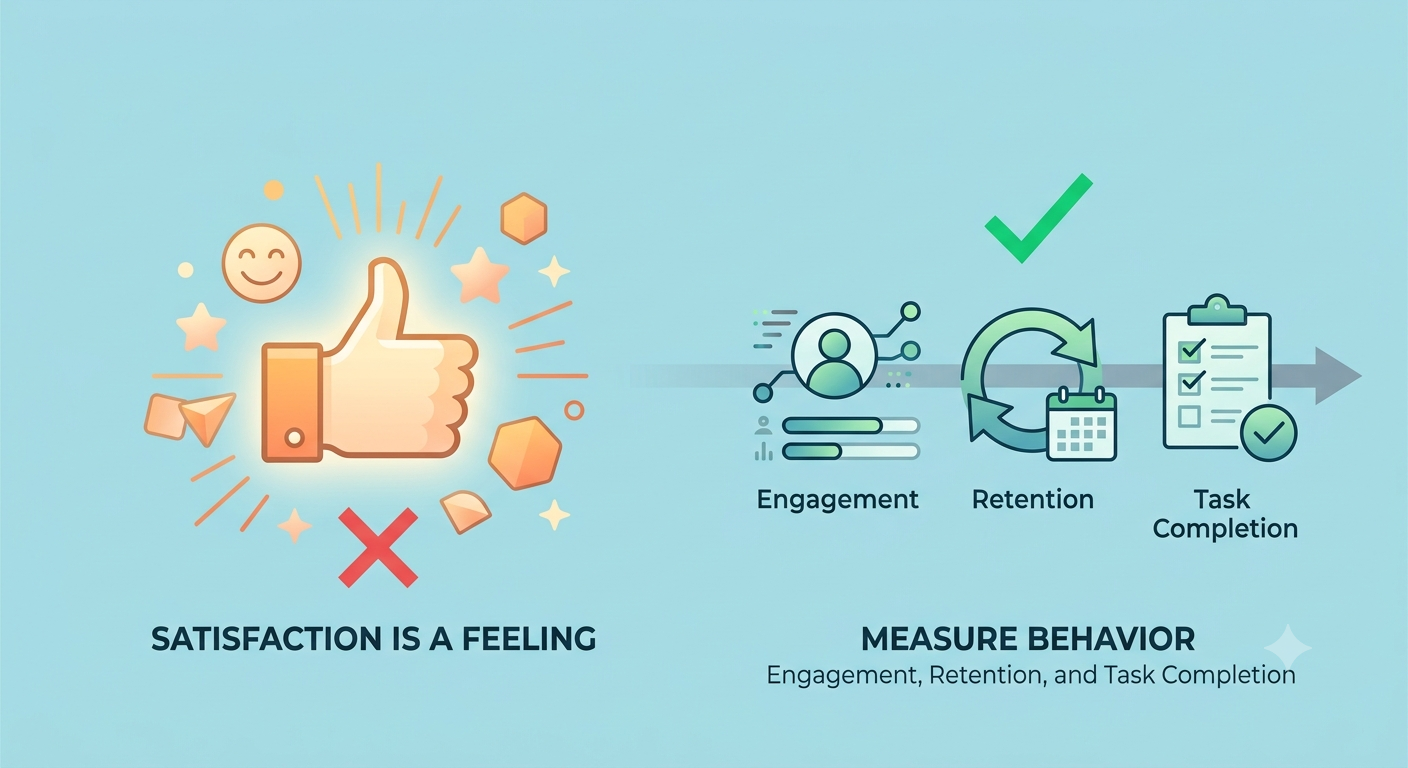
Measure behavior, not satisfaction. Satisfaction is a feeling. It is important, but it is not a reliable indicator of future behavior. Measure engagement, retention, and task completion. These are the metrics that matter.
Test, do not predict. A hypothesis is not a conclusion. Test it. Build a prototype. Watch users interact with it. The results will tell you more than any survey.
Iterate based on behavior. The first version of a design is rarely correct. The second version is better. The fifth version is good. Iteration based on behavior is how good designs become great.
The Bottom Line
Users do not know what they want. They know what they have. They can tell you about the past. They cannot tell you about the future. Your job is not to give them what they ask for. It is to give them what they need.
The designer’s trap is the belief that words are a reliable guide to behavior. They are not. Watch. Measure. Test. Iterate. The behavior is the truth. The words are just the context.
About the Author

Peter Makeshoff
Peter Makeshoff is the founder and main author of Designer Daily.