
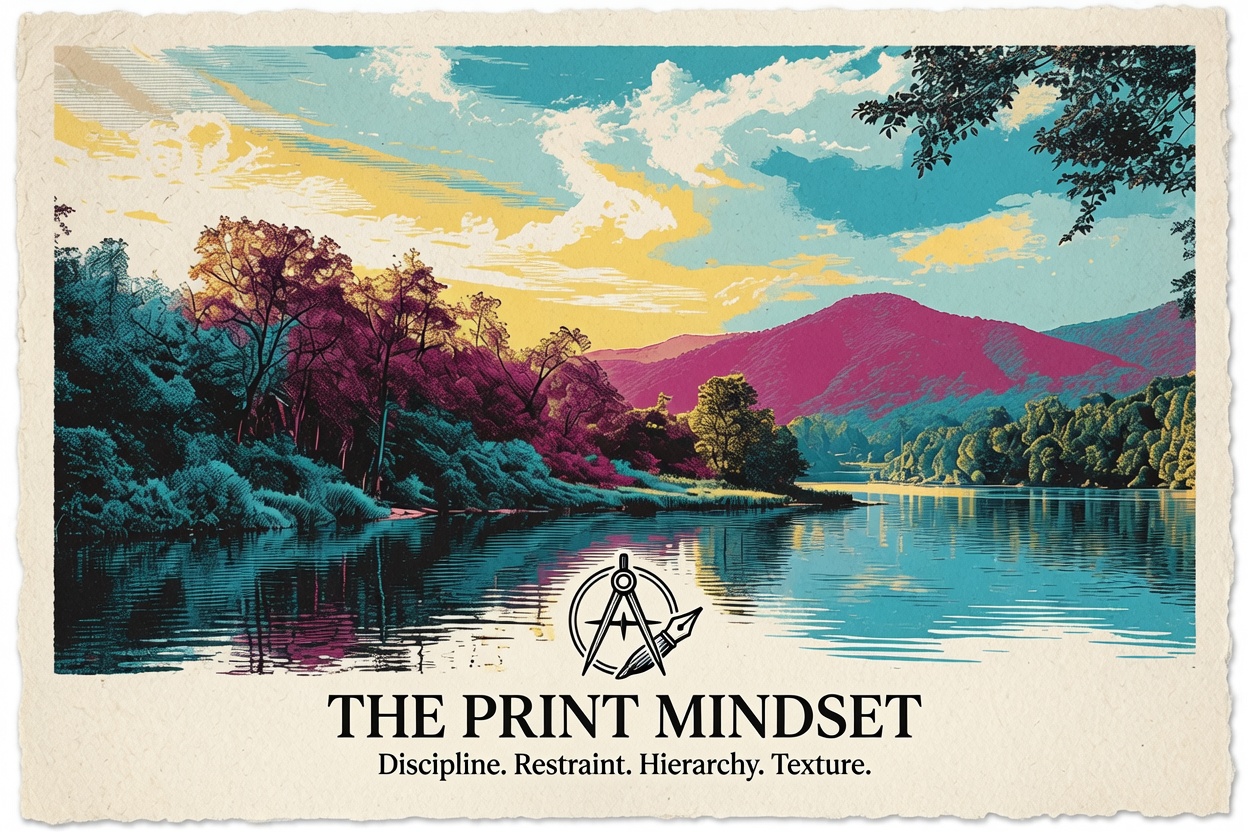
Digital design has inherited many things from print. The grid. Typography. Color theory. But something has been lost in translation. Print designers learned lessons that digital tools have made easy to ignore. Here is what they know that digital designers would benefit from remembering.
The Finality of the Page
A print designer makes a decision, and it is permanent. The ink dries. The paper is cut. The book is bound. There is no undo. There is no version history. There is no hotfix pushed after launch.
This finality changes the design process. Print designers check everything. They proofread obsessively. They test with the actual paper, the actual printer, the actual binding. They cannot assume that a future update will fix their mistakes. There will be no future update.
Digital designers work with a safety net. Mistakes can be corrected. Features can be added. Pages can be redesigned. This is liberating. It is also sloppy. The knowledge that you can always fix it later makes you less careful now.
The print mindset teaches discipline. Assume this is the only version. Get it right.
The Texture of Materials
A digital screen is smooth, backlit, and identical to every other screen of the same resolution. A printed page is textured, reflective, and unique to the paper stock, the ink, and the press.
Print designers know that the same design looks different on coated versus uncoated paper. On newsprint versus cardstock. On a laser printer versus an offset press. They choose materials with intention. They request paper samples. They test with the actual printer.
Digital designers work on screens that look the same everywhere. They forget that the user’s screen may be dim, cracked, or covered in glare. They forget that ambient light changes perception. They forget that not everyone has an OLED display.
The print mindset teaches sensitivity to materials. Assume the medium matters. It does.
The Limits of Color
A digital screen can display millions of colors. A printing press cannot. Process printing uses four colors: cyan, magenta, yellow, and black. Spot printing uses one or two additional custom colors. The gamut is limited. The cost is real.
Print designers work within these limits. They design with a limited palette. They know that a beautiful RGB gradient will become a muddy CMYK mess. They know that a color that looks vibrant on screen will look dull on paper. They proof with swatch books. They specify Pantone numbers.
Digital designers have unlimited color. They use gradients, glows, and transitions that would be impossible or expensive to print. This is not wrong. But it can be lazy. Unlimited color is not a license to ignore color theory. A palette that looks chaotic is still chaotic, even if the screen can render it.
The print mindset teaches discipline with color. Assume you have four colors. Make them work.
The Hierarchy of Information
A print reader holds the entire page at once. The designer controls the order of reading through hierarchy alone. There is no scroll. No hover. No click. The typography, the layout, the contrast must guide the eye.
Print designers master hierarchy because they have no other tools. They use size, weight, spacing, and position to signal importance. They know that a headline must be unmistakably a headline. That a caption must be clearly subordinate. That a pull quote must interrupt the flow without breaking it.
Digital designers have interactive tools that can compensate for weak hierarchy. A hover state can reveal hidden information. A scroll can separate sections. A click can expand a summary. These are powerful. They are also crutches.
The print mindset teaches hierarchy as the primary communication tool. Assume the user will not click. Assume the user will not scroll. Make the hierarchy work anyway.
The Importance of White Space
Paper costs money. Print designers are tempted to fill every inch with content. The best print designers resist this temptation. They understand that white space is not wasted space. It is breathing room. It is visual structure. It is luxury.
A page with generous margins feels more expensive than a page with cramped margins. A layout with adequate spacing is easier to read than a layout where elements compete. The print designer who leaves space is not lazy. They are confident.
Digital screens are free. The designer can scroll forever. This freedom leads to clutter. Too many elements. Too little spacing. The user is overwhelmed. The hierarchy collapses.
The print mindset teaches the value of restraint. Assume you have one page. Make every element earn its place.
The Physical Act of Turning
A book has a spine. A magazine has a binding. A brochure has a fold. The reader interacts with the physical object in ways that digital designers rarely consider.
Print designers design for the gutter, the margin where pages meet. Text too close to the gutter disappears. Images that span the gutter are interrupted. The designer must account for this, or the reader will be frustrated.
Print designers design for the fold. A brochure that opens from the bottom is different from one that opens from the side. A gatefold reveals content gradually. A pop-up surprises. The physical interaction is part of the experience.
Digital designers have no physical constraints. The screen is flat and uniform. This is liberating. It is also limiting. Digital experiences lack the tactile satisfaction of turning a page, the discovery of unfolding a map, the weight of a book in your hands.
The print mindset teaches attention to the physical. Assume the user will touch the object. Design for that touch.
The Inevitability of Proofreading
A print designer cannot push a fix after the press starts rolling. The proof is the last chance. This changes the attitude toward proofreading.
Print designers check everything. Spelling, grammar, punctuation, alignment, color, spacing, cropping. They check again. They ask someone else to check. They check a third time. The cost of a mistake is reprinting, which is expensive and embarrassing.
Digital designers can fix mistakes after launch. This is efficient. It also breeds carelessness. Why proofread when you can update? Why test when you can patch?
The print mindset teaches the value of getting it right the first time. Assume there is no update. Assume the first version is the only version.
The Bottom Line
Print design is not superior to digital design. It is different. The constraints that shaped print are not limitations. They are lessons.
Discipline. Material sensitivity. Color restraint. Hierarchy. White space. Physical interaction. Proofreading. These are not obsolete. They are foundations.
Digital designers would benefit from remembering what print designers never forgot. The page is final. The medium matters. The palette is limited. The hierarchy must work. The space is valuable. The user interacts physically. The proof is the last chance.
Take the lessons. Apply them to screens. The work will be better. And the next time you need to design for print, you will not be starting from zero. You will be returning home.
About the Author

Peter Makeshoff
Peter Makeshoff is the founder and main author of Designer Daily.