
We’ve all admired a slick Figma mock-up, only to watch it fall apart in Outlook or disappear in Gmail’s dark mode. This guide compares 13 email design agencies by what each one publishes on its own site about testing, turnaround, pricing and results, so you can check their claims where it matters: your inbox.
Here is the shortlist.
The best email design agencies at a glance
Before the detail, scan the table below. The last column shows one fact each agency publishes on its own site; prices and figures are as published in October 2026. Find the row that matches your pain point, then read the profile.
| # | Agency | Best for | What its own site publishes |
| 1 | InboxArmy | Template production plus multi-ESP and deliverability work | Templates tested on 40+ email clients; overnight coding offered |
| 2 | Email Uplers | High-volume modular systems | 150 dollars per module to code, 250 dollars to design and code |
| 3 | MH Digital | Complex lifecycle builds, AMP and dynamic content | AMP scripting, dark mode design and dynamic content listed as services |
| 4 | SmartMail | Klaviyo templates tied to revenue | LionParts: email revenue up 6x within one month |
| 5 | Chronos Agency | Ecommerce deliverability with SMS and push | Pet Supplies Empire: bounce rates down 61 percent |
| 6 | The Better Creative | Fast, pay-as-you-go builds | 150 dollars per email, one to two business days |
| 7 | MailBakery | Code-only pilots and template rebuilds | Coding from 98 dollars, three business days |
| 8 | ActionRocket | Interactive email and design systems | Babylon Health AMP email: 56 percent more click-throughs |
| 9 | Flowium | Managed Klaviyo campaigns and flows | Klaviyo Master Elite partner |
| 10 | Hustler Marketing | Multilingual ecommerce programs | BlendJet campaigns translated into five languages |
| 11 | MailStora | Budget direct-developer option | Custom HTML emails from 40 dollars |
| 12 | XHTMLTEAM | Rush Figma-to-HTML and white-label coding | Starter coding plan at 99 dollars |
| 13 | The Email Marketers | Senior-only lifecycle retainers | From 4,400 dollars per month |
InboxArmy: best all-rounder for build-to-inbox accountability
InboxArmy is a full-service email marketing agency that also sells template production on its own, so you can start with one coded template before you hand over a whole program.
Founded in 2016 and based in Grapevine, Texas, InboxArmy supports clients across 40+ email service providers, from Klaviyo and Braze to Salesforce Marketing Cloud. Its template production page says each template is tested to work correctly on 40+ email clients, operating systems and devices. You send a PSD, Sketch, XD, AI, PDF or InVision file and receive a mobile-responsive template ready for the ESP of your choice, and on a tight deadline it offers to code a template overnight. You can learn more about how InboxArmy handles template production.
The same agency also runs deliverability consulting (audits, remediation, warm-up, authentication, list hygiene and monitoring) and marketing automation. Its published results include:
- A cart abandonment automation that increased RC Juice’s monthly revenue by 400 percent
- A rebuilt cart program for Autonomous that delivered a 220 percent increase in conversions and a 240 percent boost in revenue
The minimum for its monthly managed services is 1,500 dollars per month.
Best fit: brands that want design, code, automation, and deliverability handled by one email-only agency.
Email Uplers: best for high-volume modular production
When your calendar fires three promos a week, Email Uplers becomes the on-call production bench you wish you had in-house.
The team builds modular systems: stand-alone blocks like a hero, product grid, testimonial, or footer that marketers can swap and reuse across campaigns.
Its modular template service lists the deliverables: modular HTML templates, ESP integration, a compatibility Litmus report, documentation of each module’s flexibility and limitations, and a tutorial video. HTML modules are built in five business days once the designs are approved, and templates are tested for compatibility in 40+ email clients.
Pricing is posted upfront: 150 dollars per module for development only, 250 dollars per module for design and development. Budget by counting modules, not decoding a mystery rate card.
Best fit: brands or agencies sending dozens of campaigns a month that need reusable building blocks, not one-off masterpieces.
MH Digital: best for technically complex lifecycle builds
When generic flows can’t keep up with AMP carousels, live product feeds, and constantly branching segments, MH Digital steps in.
The Denver team lists AMP scripting, dark mode design and dynamic content among its technical services, alongside strategy, setup and audits, campaign management, automations and segmentation. It works in Klaviyo and Braze, and its published case studies include Ritual (Braze and a mobile app), Neighbor, Kaiyo, Flex, PianoGroove and Manly Man Co.
Pricing is not published on its site, and timing depends on how many data pipes need untangling, so insist on a written SLA. Ask for a recent client-version matrix and an AMP fallback sample before you sign.
Best fit: scale-ups chasing advanced personalisation while demanding bulletproof rendering from Outlook to Apple Mail.
SmartMail: best for Klaviyo templates that move revenue, not pixels
SmartMail ties its work to revenue reported in Klaviyo, not to design awards.
The agency describes itself as an ecommerce email marketing agency and a certified Klaviyo partner, and it handles design, copywriting, subject lines, ESP setup, testing and scheduling.
Its case studies report:
- LionParts: SmartMail redesigned the templates and rebuilt the Klaviyo flows, and within one month revenue from email was up 6x
- Cutting Edge Firewood: over 180,000 dollars generated through email in the first 80 days, after a Klaviyo account audit, revamped automations and a new monthly content calendar
SmartMail says it only charges for what it produces, as an alternative to a traditional retainer. Before signing, request the latest compatibility sheet and agree on attribution windows to be sure every dollar is counted the same way finance will.
Best fit: ecommerce stores that want creative tied directly to Klaviyo revenue, with proof in the revenue line.
Chronos Agency: best for ecommerce deliverability with SMS and push in the mix
A gorgeous template can’t save a sender score, so Chronos fixes the plumbing first.
In its Pet Supplies Empire case study, Chronos set up a dedicated sending domain to pass DMARC, enabled Google Postmaster Tools for diagnostics, and launched welcome, abandoned cart, browse and post-purchase flows. From November 2024 to March 2025, engaged subscribers grew 230 percent and bounce rates fell 61 percent, according to the case study on the agency’s site. Chronos also offers SMS and push alongside email.
The agency has offices in Singapore and Sydney and puts 6+ dedicated specialists on each account. Clutch lists a 10,000-dollar minimum project size, and turnaround hinges on whether you need a warm-up plan or a full flow rebuild. Before signing, request a fresh inbox matrix and confirm how many concurrent campaigns the team can handle without quality slips.
Best fit: stores clawing out of spam-folder purgatory that also want synced email, SMS, and push without doubling message volume.
The Better Creative: best for rapid-fire, pay-as-you-go production
Sometimes you don’t need a retainer; you just need the next promo designed, built, and tested within a day or two. That’s The Better Creative’s lane.
Buy a single email with no subscription, or a monthly plan of 5, 10, or 20 credits. The pricing page promises a one to two business day turnaround on requests, unlimited revisions, and testing across 50+ clients, and the homepage describes QA for responsiveness and accessibility.
At 150 dollars per email (125 dollars on the 20-credit plan), you’re paying for predictability: no scoping calls, and a client portal for briefs, assets, and progress.
Need deliverability rehab or full lifecycle strategy? Look elsewhere. Need a Tuesday send with zero dev capacity? This shop delivers.
Best fit: lean teams that need on-demand, test-verified emails without locking into a monthly retainer.
MailBakery: best for code-only pilots and template rebuilds
Have an approved Figma comp but no time to wrangle email HTML? MailBakery turns pixels into production-ready code.
The online order form works like a menu: pick coding only or design plus coding, choose a delivery window, then add options such as dark mode support, Litmus screenshots, accessibility improvements, or ESP integration (Klaviyo, Braze, Mailchimp and others), each priced on the form. Coding starts at 98 dollars with standard delivery in three business days; design plus coding starts at 196 dollars in five business days, and faster tiers cost more.
MailBakery says it tests across 40+ email clients and includes a defined number of revision rounds per project. As a low-risk pilot to test fresh creative in the wild, it’s hard to beat.
Best fit: designers who need a fast, transparent way to turn approved comps into inbox-ready HTML with no long-term commitment required.
ActionRocket: best for interactive email and scalable design systems
Think email can be interactive? ActionRocket proves it. The London studio names innovation, personalisation, accessibility, and interactivity as its core principles.
For Babylon Health, it used AMP for Email to put an interactive health check inside the inbox; the case study reports 56 percent more click-throughs from interactive emails than from standard ones and a 20 percent rise in people completing health checks. Prefer something steadier? For Supercell’s Brawl Stars team, it built an email design system with templates for every content type, a tone of voice guide, and a practical manual.
The studio covers strategy, copy, design, and code under one roof. Pricing isn’t public, so request a scoped proposal plus a static mock-up and live-code prototype to test fallbacks before you sign.
Best fit: brands ready to impress subscribers with interactivity or needing a documented, multi-market design system that scales beyond single campaigns.
Flowium: best for ongoing Klaviyo campaigns and flows on autopilot
If your email calendar lives on sticky notes, Flowium lays the rails. The Staten Island, New York agency is a Klaviyo Master Elite partner and runs email alongside SMS, push, and other owned channels.
Its case-study page includes one titled “Learn How Five Supplemental Emails Boosted BFCM Revenue by 32%” and another reporting 102 percent email revenue growth in three months for a leading apparel brand.
Most accounts get a dedicated three-person team, according to its FAQ, with kickoff about a week after payment and full onboarding in around 30 days.
Pricing is quoted after scoping, and plans run month to month with 60 days’ cancellation notice. Nail down expected turnaround and the revision count in each monthly plan so no one is guessing halfway through Q4.
Best fit: brands that need a full Klaviyo calendar executed consistently by a dedicated team.
Hustler Marketing: best for multilingual ecommerce programs at scale
Selling blenders in Berlin and yoga mats in Montréal? Hustler Marketing has run multilingual email programs for ecommerce brands.
The agency, registered in Jackson, Wyoming, puts a dedicated four-person team (account manager, copywriter, designer, and technical specialist) on each brand, and each account manager handles just two to three brands. On its BlendJet case study page, the brand’s CEO says Hustler handled the switch from Mailchimp to Klaviyo, built the flows from scratch, and lifted open rates from 7 percent to 30 percent. The page also lists campaigns translated into five languages and 621,970 dollars in email revenue from November 17 through December 17.
Flows are a one-time setup fee and campaigns run on a monthly retainer. Confirm which languages are included in the base fee and how many design variants ship each month.
Ask for a QA sheet that shows renders in every target language, and verify how double-byte characters are handled if Asian expansion is on your roadmap.
Best fit: global DTC brands that need consistent creative and reporting across multiple languages.
MailStora: best budget-friendly direct-developer option
Tight budget, tighter deadline, and no patience for agency layers? MailStora gives you direct access to the developer who will write your HTML.
Founder and lead developer Rashedul Islam oversees every project, turning Figma, PSD, XD, or AI files into hand-coded HTML email. The site promises 24 to 48 hour delivery and testing in 50+ email clients, devices, and dark mode, although the 40-dollar starter package lists testing in 20+ clients. A three-template standard package costs 149 dollars.
Because the shop is small, confirm capacity before a big launch and ask about backup coverage if the developer is out sick. Verify payment terms and revision limits; low prices leave little room for endless tweaks.
For brands that need a handful of solid templates without agency overhead, MailStora offers direct developer access at a low entry price.
Best fit: designers and small businesses that want hand-coded templates without the agency price tag.
XHTMLTEAM: best for rush Figma-to-HTML conversions and white-label coding
Launch date looming and the dev queue still blank? XHTMLTEAM says simple Figma templates can be coded within 24 hours, and standard conversions take 24 to 48 hours.
Upload Figma, XD, PSD, Canva, or Framer files. The team hand-codes table-based layouts with dark mode targeting and tests each template with Litmus or Email on Acid; its Figma-to-email page cites 90+ email clients.
The order page lists a 99-dollar Starter plan (79 dollars per additional template), a 149-dollar Pro plan with rush delivery, and a 299-dollar Advanced plan built for agency white-label coding, with Email on Acid test links and 40+ client previews.
XHTMLTEAM is a coding shop, so bring your own strategy and copy; for last-minute or white-label builds, its speed is the draw.
Best fit: agencies and time-strapped marketers who need rush HTML coding they can drop straight into any ESP without extra polish cycles.
What “tested across 40 plus email clients” should actually mean
Marketers love to say an email was “fully tested in 40 plus clients.” It sounds iron-clad, until you discover Gmail Android dark mode or the new Outlook is not on the list. A number without context is as helpful as a calorie count without a serving size.
When an agency makes that claim, ask for the named matrix. At minimum you should see:
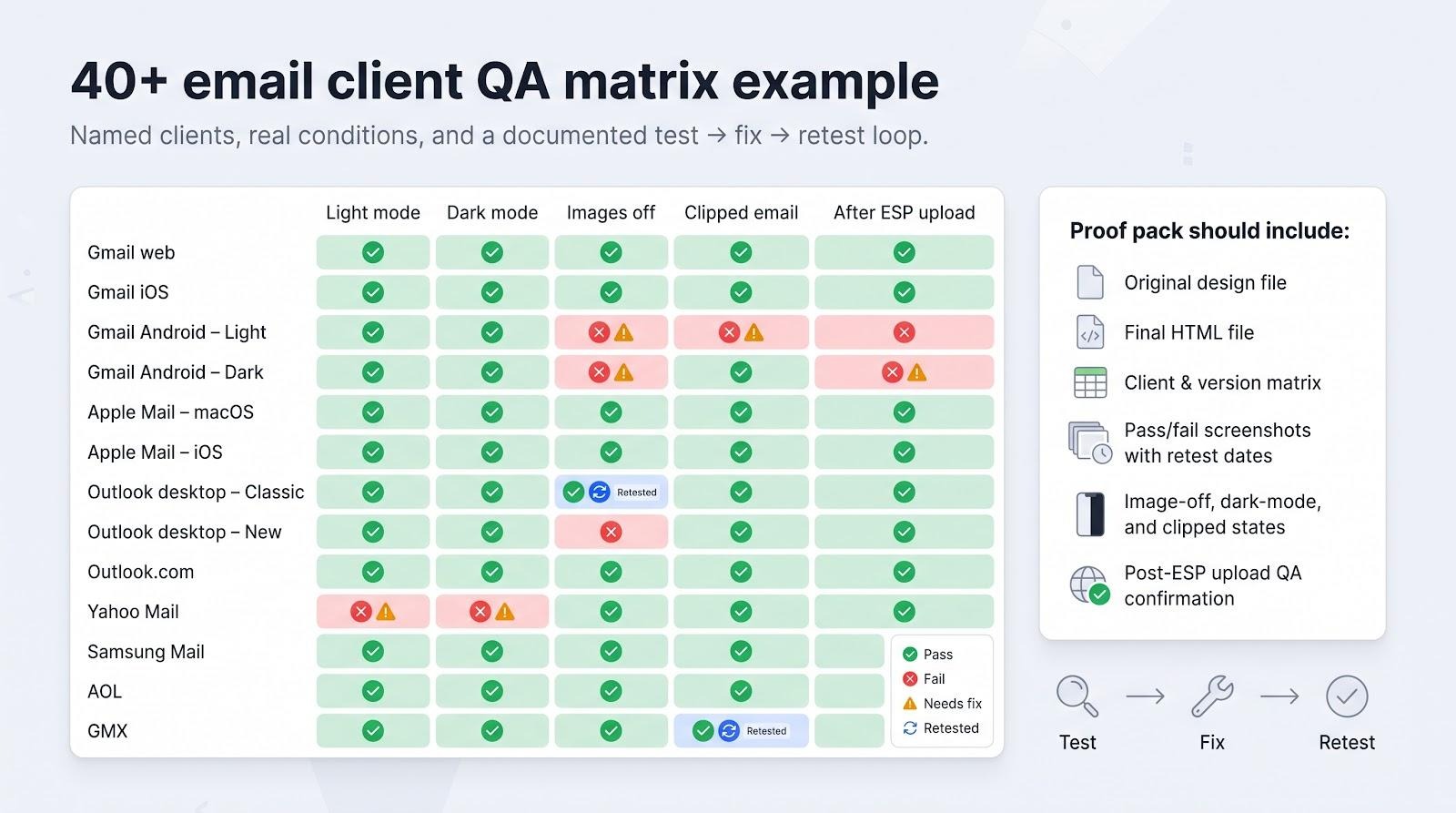
- Gmail web, Gmail iOS, Gmail Android (light and dark)
- Apple Mail on macOS and iOS
- Outlook desktop, classic and new
- Outlook.com
- Yahoo Mail and Samsung Mail
- At least one wildcard client such as AOL or GMX
Screenshots alone do not close the loop. The real test is whether someone fixed the red flags and retested after the HTML lived inside your ESP with real merge tags. Image blocking, link tracking, and dynamic product blocks often break a design that looked fine in a sandbox.
Ask the agency for a proof pack that includes:
- Original design file
- Final HTML file
- Spreadsheet or PDF of every client and version checked
- Side-by-side pass or fail screenshots with retest dates
- Evidence that image-off, dark-mode, and clipped states were reviewed
- Confirmation the test happened after upload to your ESP
If any piece is missing, you are betting on luck, not process. Luck is the most expensive QA tool you can buy.
How to match an agency to the work you actually need
Before you fire off an RFP, narrow the brief to one deliverable you want live within 30 days. Pick the simplest use case first, then choose the partner built for that job.
One approved design that needs coding
Skip full-service retainers. Send the same Figma frame to MailBakery, XHTMLTEAM, and MailStora; pay each for a pilot, then compare:
- 40-client test-matrix pass rate
- Revision turnaround
- Cost per template
The winner handles the next batch; the others were low-cost insurance against a broken launch.
A reusable modular design system
Define every block (hero, product grid, testimonial, footer), then lock padding, font sizes, and button shapes.
- Email Uplers: HTML modules in five business days, a compatibility Litmus report, and documentation of each module.
- InboxArmy: adds deliverability work and support across 40+ ESPs.
- ActionRocket: built an email design system for Supercell’s Brawl Stars team.
Demand three things up front:
- A naming convention that mirrors your ESP
- A living design-tokens file for colours and spacing
- A maintenance plan to retest modules after major client updates
Ongoing high-volume production
When your calendar fires three promos a week, throughput beats artistry. Credit- or module-based shops such as Email Uplers and The Better Creative scale tickets instead of scopes, and InboxArmy’s homepage lists 120+ specialists. Ask:
- How many emails can you ship in a seven-day window before SLAs slip?
- Is QA embedded in that speed?
- What is the revision policy for last-minute legal edits?
Klaviyo and Shopify lifecycle management
Flows earn while you sleep, provided they’re clean. SmartMail, Flowium, and Hustler Marketing all work in Klaviyo. Hand over six months of metrics; insist on a written attribution policy so campaign spikes are not mistaken for organic sales. Small list? Fund the next round with a single, high-converting cart series first.
Deliverability recovery when your domain is on life support
Fix sender reputation before creative. InboxArmy’s deliverability audits cover SPF, DKIM, DMARC, reputation, blacklists, and list hygiene, and Chronos’s Pet Supplies Empire case study describes a dedicated sending domain set up to pass DMARC and Google Postmaster Tools enabled for diagnostics. Scope a written plan with spam-rate targets, DNS ownership, and revenue-attribution rules.
When you need an interactive campaign
ActionRocket used AMP for Babylon Health’s interactive health check; MH Digital lists AMP scripting and dynamic content among its technical services. Confirm:
- Success metric (CTR, conversions)
- List share that can render the feature
- Fallback for non-supporting clients
- Post-deployment QA schedule
Migration to a new ESP
First, audit the current stack; problems blamed on the platform are often fixable with hygiene and template clean-up. Still moving? InboxArmy lists ESP vendor evaluation and migration among its services, and Hustler Marketing’s BlendJet page describes a switch from Mailchimp to Klaviyo with flows rebuilt from scratch. Give the cut-over enough time; a rushed migration can cost more than the licence you save.
Email design red flags you should never ignore
- Only Behance mock-ups, no inbox screenshots
- “Pixel-perfect in every client” promises
- Accessibility listed as a bullet point, not a checklist
- Revenue claims without attribution-window disclosure
Dark-mode checklist for agency buyers
Many people keep dark mode on all day, and one toggle can ghost a high-contrast hero if the HTML is not ready. Before you approve any template, run this checklist:
- Logo treatment: Is there a reversed or outlined logo that still pops on black? Transparent PNGs fade when colours invert.
- CTA contrast: Ask for the exact dark-mode hex values and confirm they meet WCAG 4.5:1. Greens and reds often shift toward neon or brown.
- Live text: Headlines should be real text; images cannot inherit colour-scheme preferences.
- Background fallback: Some Outlook setups block images by default, so specify a background colour to avoid white text on white.
- Image-off proof: Request screenshots with images disabled in both light and dark modes.
- Different inversion behaviour: Verify tests in both Gmail Android and Apple Mail. Clients handle dark mode differently, so a pass in one does not guarantee a pass in the other.
If an agency ignores any box above, keep shopping; your subscribers will not switch back to light mode just to read your email.
Accessibility checklist that keeps legal teams calm and subscribers included
Accessibility is part of quality, and in some markets it is also a legal requirement. Confirm each template meets these marks:
- Semantic hierarchy: Headings follow H1 → H2 → H3 so screen readers keep context.
- Descriptive alt text: Explain purpose, not decoration (for example, “Explore our new espresso range,” not “Woman drinking coffee”).
- Live text: Screen readers get only the alt text of an image, and text inside images cannot adapt to dark mode or zoom; use live text with web-safe or embedded fonts instead.
- Contrast ratios: Meet WCAG 2.1 AA (4.5:1 for body text, 3:1 for large text) in both light and dark modes.
- Keyboard focus and tap targets: Interactive elements need visible focus states; WCAG 2.2 AA asks for targets of at least 24 by 24 CSS pixels, and 44 by 44 is the stricter AAA level.
- Motion control: WCAG asks for a way to pause, stop, or hide moving content that starts automatically and lasts more than five seconds, so give long or looping GIFs a static fallback or a short loop.
Agencies that clear every item lower your legal risk and give every subscriber an equal seat at the table.
What does great email design actually cost?
Published prices on the agencies’ own sites run from 40 dollars for a single coded template to 18,000 dollars a month for a full-scope retainer. The scope, not the headline number, sets the budget.
| Scope | Published price (October 2026) | What’s included |
| Code-only conversion | From 40 dollars (MailStora), 98 dollars (MailBakery), 99 dollars (XHTMLTEAM) | Responsive HTML; testing and extras vary by plan |
| Design and code, one email | 150 dollars (The Better Creative), from 159 dollars (Email Uplers), from 196 dollars (MailBakery) | Custom design plus HTML build |
| Modular blocks | 150 dollars to code, 250 dollars to design and code, per module (Email Uplers) | Reusable modules, Litmus report, module documentation |
| Subscription production | 125 dollars per email (The Better Creative 20-credit plan, 2,500 dollars a month) | One to two business day turnaround, unlimited revisions |
| Full-service lifecycle | 1,500-dollar-per-month minimum for managed services (InboxArmy) or 4,400 to 18,000 dollars per month (The Email Marketers) | Strategy, design, automation, reporting |
Before comparing quotes, pin down nine items:
- Is dark-mode adaptation included?
- Are Litmus or Email on Acid screenshots standard?
- How many revision rounds?
- Does the fee cover ESP integration?
- Are accessibility checks baked in?
- Turnaround time for first draft and final approval?
- Extra cost for AMP or interactivity?
- Do you own the source files?
- Who fixes post-launch bugs in untested clients?
Run a paid pilot before signing a long retainer
Hire two or three finalists to build the same promo email: dynamic product block, dark-mode treatment, accessible live text, and ESP-ready code. Score each on:
- Rendering and code, 25 percent
- Accessibility and dark mode, 15 percent
- Turnaround and communication, 15 percent
- Ease of editing in ESP, 10 percent
- Documentation and QA proof, 10 percent
- Brand fidelity, 15 percent
- Price, 10 percent
A small paid pilot costs a fraction of a retainer, and it uncovers hidden champions and filters out smooth talkers before you commit.
Trends that will shape agency selection in 2027
- AI speeds production but magnifies QA errors. Ask where human review fits and which linting tools run before send.
- Inbox summaries, such as those in Apple Mail and Gmail, work from text, not pixels. Live text, semantic HTML, and alt text that restates key offers give them something to read.
- Accessibility is now a procurement checkbox. The European Accessibility Act has applied since 28 June 2025 to many consumer services sold in the EU, including ecommerce, so brands selling there increasingly ask agencies for an accessibility report.
- Deliverability and creative now share KPIs. Google asks bulk senders to keep spam rates below 0.1 percent and never reach 0.3 percent, which pushes both teams into the same Slack channel.
Frequently asked questions
What does an email design agency deliver beyond a Figma file?
Coded HTML, a named compatibility matrix, dark-mode and accessibility checks, and a post-integration QA report inside your ESP.
How much should one custom email cost?
Published starting prices for code-only conversions on these agencies’ sites run from 40 to 99 dollars; design plus code starts at 150 to 196 dollars. Add dark mode, accessibility work, or rush delivery and the price increases.
How long should one custom email take?
Published turnarounds on these sites range from 24 to 48 hours (MailStora, XHTMLTEAM) to three to five business days (MailBakery standard delivery).
How many email clients should an agency test?
At least 40: Gmail web and mobile, Apple Mail, Outlook variants, Yahoo, Samsung, each in light and dark mode.
Is dark mode a separate design?
No. It is CSS overrides plus image treatments in the same file; good code adapts automatically.
Can design affect deliverability?
Yes. Image-heavy layouts with little live text and bloated code can hurt spam scores, and Gmail clips messages whose HTML is too large.
Should the agency build directly in Klaviyo or another ESP?
Ideally, yes. Final QA must happen in the live editor with real merge tags and tracking scripts, not just a sandbox.
Do I need a long-term retainer?
Only if you need strategy, flows, and optimisation. For one-offs, pay-as-you-go or a pilot project is enough.
How should email revenue be attributed?
Use a consistent look-back window, and make sure the agency’s dashboard matches your ecommerce analytics.
How often should master templates be retested?
After every major ESP update, design refresh, or at least quarterly. Clients update silently; regression tests catch new quirks before subscribers do.
Conclusion
A polished mock-up is only the starting line. The agencies above publish their processes, prices, or results, so you can check them before you sign. Use the matrices, checklists, and pilot guidelines in this guide to match the right partner to your next 30-day milestone, then let the inbox results speak for themselves.
About the Author

Peter Makeshoff
Peter Makeshoff is the founder and main author of Designer Daily.